
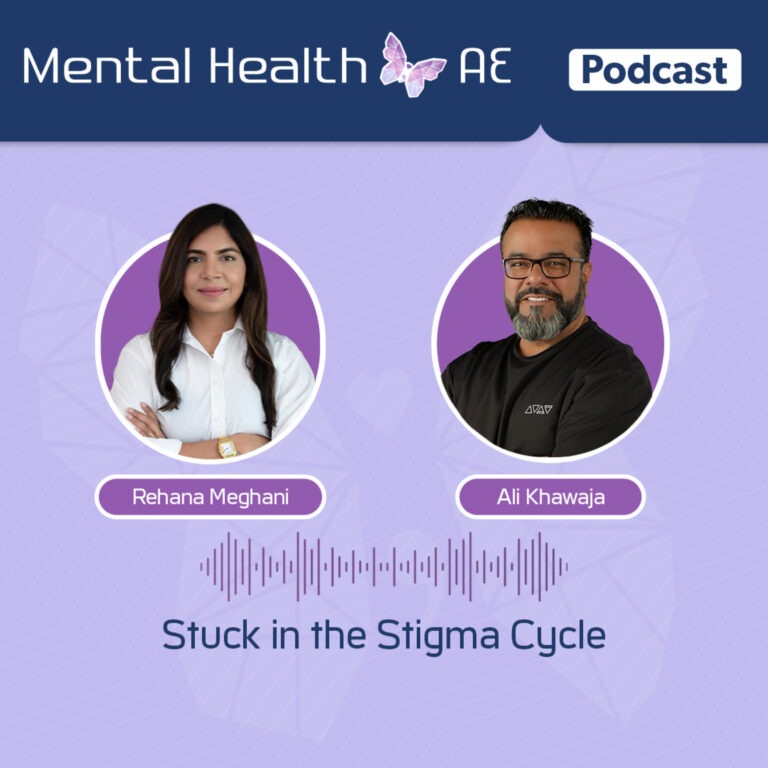
S04E09 – Stuck in the Stigma Cycle – Rehana Meghani

MHAE is a UAE based mental health and wellness initiative, with the aim to create awareness and provide a safe space as well as access to information and resources. Follow us on our Instagram and check out our website.
https://mentalhealth.ae/
https://www.instagram.com/mentalhealthae/
In this episode, Ali sits down with Rehana Meghani, a clinical and organizational psychologist, for a thoughtful conversation about mental health, stigma, generational trauma, parenting, and the importance of creating safe spaces for healing.
Ali and Rehana explore why many people, especially in certain cultural and family systems, delay seeking mental health support until they are in crisis. They discuss how stigma can show up not only in society, but inside families, relationships, workplaces, and even within ourselves. The conversation also looks at parenting, breaking unhealthy generational patterns, the risks of both harsh discipline and overprotective parenting, and how curiosity can help us understand our emotional responses, relationship patterns, and personal history. Rehana shares why therapy is not only for crisis, but can also be a proactive tool for self-discovery, grounding, and long-term emotional wellness.
Ali also reflects on his own experiences with teaching, parenting, yoga, breathing, gardening, and learning how small intentional practices can calm the mind and support mental health. This episode is a grounded, honest, and practical conversation about shifting the way we think about mental health, from something that means “something is wrong with me” to something we actively care for as part of being human.
Outline
0:00 – Ali welcomes listeners back, reflects on staying consistent with the podcast, and thanks Latifah for making the recording setup easier.
0:55 – Rehana Meghani introduces herself as a clinical and organizational psychologist, sharing her work with individuals, couples, and workplaces.
1:23 – Ali and Rehana begin with mental health stigma, discussing how judgment, fear, and family dynamics can stop people from opening up.
2:43 – Rehana explains how cultural background can affect when people seek therapy, especially in Asian communities where support is often delayed.
3:26 – Ali reflects on generational trauma, physical discipline, and how normalized behaviors from childhood can continue into adulthood if left unexamined.
7:31 – Rehana discusses two parenting extremes: repeating harmful patterns or overcorrecting through overly permissive parenting without boundaries.
13:42 – Rehana shares how families can reduce stigma by openly modeling mental health care, just as they would model physical health or fitness.
17:14 – The conversation turns to support outside the family, including therapy, peer support groups, podcasts, books, and other safe spaces for healing.
23:41 – Rehana explains why mental health care should not only happen during crisis, but can also be a proactive path toward curiosity and self-discovery.
30:20 – Rehana shares her areas of work, including trauma, complex trauma, EMDR, couples therapy, and recovery from emotionally abusive dynamics.








Summary
In this episode, Ali sits down with Rehana Meghani, a clinical and organizational psychologist, for a thoughtful conversation about mental health, stigma, generational trauma, parenting, and the importance of creating safe spaces for healing.
Ali and Rehana explore why many people, especially in certain cultural and family systems, delay seeking mental health support until they are in crisis. They discuss how stigma can show up not only in society, but inside families, relationships, workplaces, and even within ourselves.
The conversation also looks at parenting, breaking unhealthy generational patterns, the risks of both harsh discipline and overprotective parenting, and how curiosity can help us understand our emotional responses, relationship patterns, and personal history. Rehana shares why therapy is not only for crisis, but can also be a proactive tool for self-discovery, grounding, and long-term emotional wellness.
Ali also reflects on his own experiences with teaching, parenting, yoga, breathing, gardening, and learning how small intentional practices can calm the mind and support mental health.
This episode is a grounded, honest, and practical conversation about shifting the way we think about mental health, from something that means “something is wrong with me” to something we actively care for as part of being human.
#MentalHealthMatters #BreakTheStigma #SelfDiscovery #EmotionalWellbeing #MentalHealthAwareness #GrowthJourney #Mindfulness #HealingStartsHere
Podcasters:
Ali Khawaja | https://alikhawaja.com
Rehana Meghani | https://www.instagram.com/drrehanameghani/
MHAE Website | https://www.mentalhealth.ae
MHAE Instagram | http://instagram.com/mentalhealthae
Outline
0:00 – Ali welcomes listeners back, reflects on staying consistent with the podcast, and thanks Latifah for making the recording setup easier.
0:55 – Rehana Meghani introduces herself as a clinical and organizational psychologist, sharing her work with individuals, couples, and workplaces.
1:23 – Ali and Rehana begin with mental health stigma, discussing how judgment, fear, and family dynamics can stop people from opening up.
2:43 – Rehana explains how cultural background can affect when people seek therapy, especially in Asian communities where support is often delayed.
3:26 – Ali reflects on generational trauma, physical discipline, and how normalized behaviors from childhood can continue into adulthood if left unexamined.
7:31 – Rehana discusses two parenting extremes: repeating harmful patterns or overcorrecting through overly permissive parenting without boundaries.
13:42 – Rehana shares how families can reduce stigma by openly modeling mental health care, just as they would model physical health or fitness.
17:14 – The conversation turns to support outside the family, including therapy, peer support groups, podcasts, books, and other safe spaces for healing.
23:41 – Rehana explains why mental health care should not only happen during crisis, but can also be a proactive path toward curiosity and self-discovery.
30:20 – Rehana shares her areas of work, including trauma, complex trauma, EMDR, couples therapy, and recovery from emotionally abusive dynamics.
Transcript
0:00 – Ali Khawaja
Foreign. Welcome back. Yes, yes. One more episode. Aren’t you, aren’t you so proud of me? Like really like Ali hasn’t disappeared for a year again now. I’ve really, really pushed myself and I’m not gonna lie, it’s been the, I don’t know, the art and practice of self discipline in. It’s been tough maintaining myself. And I gotta thank my co founder Latifah. She’s given me her office to record. The studio is literally always set up. I have access to it seven days a week. So zero excuses. Zero excuses other than my self laziness. So I’m doing good. I’m doing good. I have an amazing guest with me today. We’re going to have some interesting conversation. I’m going to let her introduce herself.
0:55 – Rehana Meghani
Well, thank you. My name is Rohana. I am a clinical psychologist and organizational psychologist. I’ve been working with individuals, couples, organizations for over 10 years facing a variety of different things. So the regular mental health concerns, but also challenges in the workplace, challenges within relationships and things like that.
1:21 – Ali Khawaja
Well, welcome, welcome to the podcast.
1:23 – Rehana Meghani
Thank you so much.
1:23 – Ali Khawaja
Good having you here. I think, and I keep saying this every time, I really should start recording our pre podcast sessions. Always great conversation. But I think one of the things I want to kind of kickstart our conversation with today is with stigma. You know, a big part of our conversation today kind of got to that conclusion that so much of the problems that we’re dealing with are stigma related. How’s your experience been?
1:55 – Rehana Meghani
I would agree with that. And stigma, I mean it’s not even just in terms of culture. It can even go like, for example, in the family, even in having conversations, you might not even be as open and honest with somebody that you’re close to regarding things concerning mental health because perhaps you might feel like you’re going to be judged or you don’t know this person’s mindset or how they look at mental health and whether that conversation would be welcome.
2:22 – Ali Khawaja
I hear you on that. If you could, obviously without giving any specifics, if you could kind of reflect a little bit in terms of your career and your interaction with patients. Do you notice a difference in the associated stigma and perhaps the cultural background they belong to?
2:43 – Rehana Meghani
Yeah, so I would say culturally, you know, from like, I would say more. Was it appropriate to say Asian cultures?
2:55 – Ali Khawaja
Yeah, that’s fine.
2:57 – Rehana Meghani
Background. It’s. I see them come in a lot less or at a later age in their life. So that has been very common. And I guess more recently I think that some of the younger generations, they are. They’re more aware of mental health and mental health struggles. So. So it’s. It’s. It’s shifting a bit, but that difference is. Is definitely still there on who is booking the appointments and who is seeking out help. So I do see that in terms
3:26 – Ali Khawaja
of clients, you know, the cultural difference in great many things is always there. I’m. I was. This is going to be funny. I was having a discussion last week with a close group of friends. Some family members were also sitting there. And I’m 46, right? So. So. And I’ve got two adult kids now, and I don’t know how the conversation got to, you know, how often did you get beat up by your parents or smacked around? And I was just kind of sitting in shock and awe of all the stories they were telling me. And then I was like. And then one. One of them was like, ali, you’re very quiet. I’m like, I don’t have a story, man. I never got beat up. Then they looked at me in shock, and I was like, what? You never got, like, hit with, like, a belt? I’m like, a belt? Are you mad? No. Or like, a slap? I’m like, no, mom or dad. I’m like, no, me, my sister? No. There was no physical assault. Shit happened in our house. But for all of them, it was normal. And then another interesting part of that discussion was how they believed that it was acceptable with their kids. And I was like, hell, no, this is not acceptable. And if you think it’s acceptable, you need to have a, you know, sidebar with me, because this is not acceptable. No, but we’re okay. I’m like, no, you’re not. You survived trauma. You ain’t okay, well, we need to have a discussion, but very cultural. Very cultural. And I remember when I. When I came home from this. This little meetup that we had, we were having dinner. My daughter is in college now. She’s 20. And I was telling her. I was like, man, I had the weirdest conversation. And she’s like, I’ve had that conversation with my friends. I’m like. And she goes, they’re from a whole bunch of parts of the world. And they’re like, yeah, we’ve gotten smacked around by our parents. I’m like, your generation. We’re not talking my generation. Like, your generation. I’ll tell them. My daughter, she goes, yeah, baba. And when I told them my parents have never hit me, they just looked at me in shock, and I was like, wow. Wow. So, you know, I Don’t know. This, this, this trauma cycle, generational trauma transfer, whatever it’s called, is kind of. It kind of sucks. It kind of sucks big time. But even with. And this is kind of what icked me a little, that even with all of the awareness, all of this Internet and AI and all of this stuff that we have, all. Why are these young people of the mindset that, you know, when we have families and grow up, it’ll be okay to, like, hit our kid? So a lot of that cultural, you know, generational trauma that gets transferred, it needs active approach, I think. You know, and I’ve mentioned this in many of my previous episodes, I think I was lucky with my mom. My mom was the changing. The person who changed the generational thing. She was just a wall. We didn’t get anything from anything in the family or the extended family. We were never told, what will someone think? We were never told any of that stuff. We could have very comfortable conversations about mental health and wellness or sex ed or whatever it was, or whatever was bothering us. Never had any issue. But for me to see it in today’s generation, this is a little worrisome to me because I can still understand my parents or my grandparents where they didn’t know any better, but now this is kind of, like, significant, and it still reflects. I teach at university. I’m constantly surrounded by people between 18 and 22, and I have definitely seen a shift, but that shift is still very small. That shift in stigma is still very small. We had a bit of a boost with awareness during COVID but post Covid, at least from what I’m seeing, it seems to have fizzled out for the most part. What do you think we can talk to families and tell them about how to overcome or tell young people how to overcome this type of stuff and not kind of get stuck in that cycle?
7:31 – Rehana Meghani
Yeah, that’s a great question. And just to speak and add to what you were saying is that even with the, like, while we’re trying to overcome, you know, generational trauma or our past, there’s also, like, the other extreme types of parents that are generational, just so focused on, like. Like, I’m just not repeating that stuff that happened to me. So I’m going to be completely positive parenting. And they don’t, you know, they have trouble with, like, boundaries and, you know, like, disciplining in a positive and appropriate way. So I’ve seen both, obviously, that generational trauma continuing with some people and them just doing whatever their, their parents did to them, regardless of all the information that we have, like, now that we talk about generational trauma, so that. And how it can be, how we can stop that cycle from happening, right? And then there’s like, that other extreme. But what I would. What I would say to people is to really get curious because we can actually heal through our own parenting. We can heal our own wounds through our parenting. And in the same way, we get to. We get to offer our children a different start to life and a different understanding of mental health and things like that by what we do today.
8:51 – Ali Khawaja
That’s wonderful. Well, two things on that. First, you’re 100% right. I constantly see, when I say young people, I’m talking about college kids, because that’s my interaction. I constantly see these young people coming in, and you can tell that these are, like, they’ve been collecting participation certificates for 20th place, and they have no internal sense of achievement. I think they’ve been over and over Umbrella Parenthood and whatnot. There’s definitely that group. There’s definitely that group. Dear parents, you’re doing them a disservice. When they step into the real world, you’re not going to be there. And this is something my mom told me a long time ago. She goes, my job is to protect you when you’re small and then to educate you while you’re grown up so that when you’re an adult, you’re ready to take care of yourself and the responsibility of others. And funnily enough, talking about parenting and healing yourself, I think that’s beautiful. But it requires active attention. When I started teaching way back when, I want to say 2002, first time teaching, I did my first class. I came back, I was sitting in my office scratching my head. I’m like, did I do it right? Am I doing it right? Then two doors down, great, great professor of mine, Dr. Ralph. I walked into his office. I’m a Dr. Ralph. You gotta admit it. He goes, ali, please sit down. Tell me. I’m like, I’ve got a question. You know, I’m teaching, but I don’t know if I’m doing it right. And, you know, I’ve got a classroom full of people and these young minds. I don’t want to mess it up. It’s a big. For me, it’s a big responsibility. It’s not a paycheck. It’s a big responsibility. And he just kind of like, leaned back a little in his chair, you know, took a breath and said, look, you’ve sat in how many classes over how many years as A student, you know, from kindergarten all the way to, you know, your graduate programs, I’m like, man, a gazillion. How many teachers did you have in that time? So many. He goes, think back on every one of them. What did they do that you liked? What did they do that you didn’t like? And that’s how you want to teach? And I was like, thank you. No follow up questions. That literally became my teaching philosophy. Right? That’s where I built it. You know, a handful of years later, I was expecting my first kid, totally freaked out. And this was like third trimester, you know, kids gonna pop out any day now. They’re kind of like, there. I remember very clearly sitting with my mom, and my mom is just super excited because she’s gonna be a grandma. You. You could not tell her anything that would take. Take away that joy of being a grandma from her. And I’m like, mom, I need to have a serious conversation. She goes, why is the baby okay? I’m like, mom, my baby’s okay. I’m talking about me. I’m not okay. What’s wrong with you? Like one of those, like, I don’t have time to deal with you. I’ve got a grandbaby on the way. Look, that’s where mine was at. And I’m like, look, there wasn’t like a parenting course, like, how do I do this? And she goes, well, you’ve had two parents, your mom and your dad. You’ve seen your friends, you’ve seen how their parents have been. And literally, like, Ralph’s voice was echoing in her. Whatever you saw, that was good. Do that. Whatever you saw, that wasn’t good. Don’t do that. And I was like, damn, I heard this before. And honestly, that’s what I’ve been doing. So 20 years in my kids in college, I think they’re doing all right. I’ve honestly done the best I can. But you know what I’m circling back to is what you said. It has been very healing. And I never thought about it from that perspective, but I did get to those realizations in time. Like, something would happen. I’d be like, huh, that’s nice. That’s nice. Oh, I got to do this activity with the kids. And that was some quality time right there. Okay, that was nice. So a lot of those realizations from time to time would roll in. And that definitely has to do with your own healing also. So I think. Thank you very much. I think that’s very rightfully said. Excellent, Excellent. Talk to me a Little bit more. And, you know, not that I want to get stuck on the stigma aspect of our conversation. I want to kind of pivot a little bit more towards what can people actively do now to kind of reduce the stigma, at least in their own families. You know, I can’t put it on one person to fix society or fix the culture that they’re in, because the country they’re from or whatever it is, but just within the family. What, what, what things can somebody do to help facilitate more open conversations and more acceptance?
13:42 – Rehana Meghani
Yeah, that’s a great question. In terms of what we can do in the family, I think, you know, being maybe open about our own journey and take. Being an active participant in that journey could be a start. So a lot of people, you know, seek out mental health when they’re in crisis or when mental health support when they’re in crisis or there’s a problem or they’re feeling a certain way. But I could challenge that in that, you know, if we, for example, right now, everybody’s talking about fitness and hitting your protein and your steps and all of that because, you know, you want to take care of your body. I think we have to look at our mind in the same kind of way. So to give that time to yourself, to be able to sit with somebody and talk, maybe on a regular basis, maybe once a month or something like that, it can be quite grounding. And then being open about that, your journey, what you’ve noticed with your. Within your family or people around you. Similarly, if you have children, they learn by modeling, right? So if we can show them that we’re not scared of these conversations or we’re not, it’s not a thing to be scared about. It’s actually something that I’m doing for myself. We can kind of change that conversation for them so that they can start to look at it in that way as well.
14:59 – Ali Khawaja
I think that’s really good. I think that’s really good. A lot of this gets tricky because, you know, again, different cultures, different countries, Right. But I found, you know, I was telling you a little earlier, the peer support groups that we had done well over a hundred. I’ve had conversations with people from so many parts of the world. And what was very, very funny, honestly, was that everyone thought it was only their culture. Everyone thought it was only their family. And I think the two things that just, like, in my head, these are like the worst data points was that the amount of loneliness every single person was feeling and not knowing that, you know, there’s a gazillion other people dealing with what you’re dealing with, it was sad. It was heartbreaking. I remember we had. And this sticks out of my head. I remember we had a meetup at a cafe. I think 20 some people showed up. That particular one. 15, 20. And we’re just kind of going around just introducing ourselves. And I didn’t tell anybody to introduce themselves beyond a name. I’m like, hey, guys, let’s just introduce ourselves. Just tell us your name. That’s it. But somebody said, you know, my name is this. And I’ve been struggling with this. And I was like, okay. You know, because, you know, part of our peer support group format is you share what you want. You don’t share what you. If you don’t want. If you just want to sit and listen, nobody will point at you, nobody will push you. And for some reason, everybody picked on that. Like, and then they started introducing themselves with what’s going on about halfway around the table, you know, one kid gets up and high fives the other kid. Oh, you’re ADHD too? I’m ADHD too, and high five. And I’m just sitting there like, wow, wow. Like, wow, you found each other. Wow. Right. But because nobody talks and nobody tells what’s going on with them, that isolation, I think, multiplies the problem. Right. What do you think about, you know, how people can, you know, get maybe perhaps support from outside the family also?
17:14 – Rehana Meghani
Yeah. So outside of the family. I mean, working with a therapist, obviously, since that’s what I do, I think people are scared of that too, because they, like, I think that there’s a lot of perception that when you go for therapy, the person that’s sitting with you is going to be analyzing you, they’re going to be judging you, that, you know, you might. You’re not in a safe space or what are they going to think of me if I say that? So that is a big misconception as well. Because therapy, it’s really supposed to be a supportive place. It’s supposed to be a space for you. Not really the therapist, they’re more there as a guide. A good therapist is there guide. So it gives you a space to explore. Explore feelings, thoughts, behaviors, your life experiences. And it can be really quite helpful to sit with somebody you don’t know to talk about those things because you know they’re not going to go and tell another friend or somebody else. And it’s very contained. So I think having. Having a professional to talk to, like you talked about having support groups, if that’s where you feel more comfortable, even as simple as just as somebody starting on their journey, listening to podcasts, picking up some books, there’s lots of people talking about stuff online if you feel safer. But just, I think just engaging, starting to engage and doing so mindfully in a way that, you know, making it a part of your life, not just something’s wrong. So I need this now, but having some curiosity.
18:54 – Ali Khawaja
I like what you said and you know, engaging mindfully I think is very important. And then again, I think this is a lot to do with being a bit more proactive and kind of pushing past that initial resistance. But, you know, like you said, it’s, it’s important to find that safe space. And if that safe space is with someone who you don’t know because you’re not worried about judgment or you’re not worried about them telling somebody, that removes a lot of those barriers. So I think that definitely helps. So, you know, from my previous podcast, you guys know I’m ICF certified. I’ve been coaching for 10ish years, ADHD specific coaching for six, seven years. And this is exactly what we talk about, that, you know, that our conversation is private, it’s confidential. This is a safe space for you, share what you’re comfortable with. And I have always found that it takes one or two coaching sessions and then all of a sudden the floodgates open up. And even in the coaching aspect, we have very clear boundaries defined. And there’s many, many instances where I will tell my client, look what you’re talking about. That’s not me. I need you to go work with a therapist. I’m happy to recommend a therapist. I know lots of them. So we have that recognition in how we want to work. And jumping back to the other thing that you’ve talked about is, you know, working on it just like you would work on your health or, you know, tracking your macros and, you know, it’s like fitness this and fitness that and the now we got, everyone’s got like a Fitbit, you know, whoop something. I’d lost track. There’s a ring, there’s a band, there’s. I don’t know what, all of that type of stuff. So your, your brain’s the same, you know, your brain and I, I don’t remember. Somebody can correct me if I’m wrong. But you know, when we talk about oxygen in your blood, your brain uses the largest percentage of any organ in your body, so it’s the biggest muscle you got. So if that’s how much Oxygen it uses. Imagine how important it is. And your body and your mind are connected. You can’t work on one and not the other. So I think being proactive, exactly like you said, being proactive with taking care of your mental health and wellness, I think is very important. I started yoga. I think it’s been nine, ten months now. A little maybe a year. I started yoga because I realized I was getting, like, stiff age and being lazy. And my friend said, oh, you need to do yoga. And I said, have you seen this body? It’s not compatible with yoga. She goes, yeah, yoga is not like all the pretzel stuff you see. Just. Just trust me. Find a good, good instructor. My yoga instructor is like, the bomb. I love her. She’s amazing. So, yeah, we have two sessions a week. She’s on my little, little iPad. And then, you know, she’s very, very, very kind with me. You know, she says, let’s do this. And I’m looking at her, I’m like, I know, I’ll try it. And I probably bend, like, 10% of what she’s able to bend. But it’s been good, you know, aside from a little bit, I’m gaining a little bit of my flexibility back. But it’s been good because we always start with breathing exercises, and I never thought of that. You know, I’ve done meditation on and off a little bit. Mostly not because I don’t have time to meditate. I’ll meditate, you know, when I’m brushing my teeth. Like, you know, like, me trying to, like, double down on stuff.
22:24 – Rehana Meghani
That.
22:24 – Ali Khawaja
Not how it works, guys. But my yoga instructor, she always starts with, like, breathing. And I didn’t realize this till a few months later. I’m like, oh, my goodness. You know, I skipped last week’s sessions because I had, you know, meetings or whatever. I’m feeling a little. I don’t know. I didn’t know how to explain it. I’m, like, feeling a little.
22:45 – Rehana Meghani
I don’t know.
22:45 – Ali Khawaja
What am I feeling? Am I feeling, like, on edge? What am I feeling? And then I’m like, wait a second. It brings down the levels of whatever because I don’t feel stressed, I don’t feel anxious, but I feel, like, a little on edge. I don’t know how to exactly explain it, but whatever it is, that breathing part of my yoga thingy twice a week brought down those levels of whatever it was. And I realized that that helped calm my mind in a way. And then that, in turn reduced the cloudiness, gave me more clarity, and that’s just maybe 10 minutes twice a week at the beginning of my yoga session. So definitely a lot is to be said for being preventative. Definitely, like what I’m hearing there. In your experience, are you seeing an increase in that when people are coming earlier than they normally would?
23:41 – Rehana Meghani
Not as much as I would hope to see, to be honest. It’s usually, I think I see a lot of people that maybe get curious because now people are talking about trauma, which is really important because we all go through life with different struggles, but two people in the same situation may not have felt or experienced that situation in the same way. So a lot of people come in curious about trauma because that’s what’s being talked about a lot. Or people in active crisis. So I see a lot of that. Um, but I have actually seen a few people just come in and it could be that their employer has like a really good health plan, that they’re like, okay, you know, I. I’m. I’m committing to a session every. Every two weeks. This is my slot. And they come with whatever. Right. It’s. It could be a space to open up about stuff, or I’m feeling stressed, or here’s some issues of things that are happening in the workplace, so they kind of get that support. But it would be good to see people be a little bit more proactive and, and think about it. Because mental health, I think, is so much more than a crisis that has just happened. Because again, like I said, we can get curious about our lives and different situations and how that felt to us and why did it feel that way. Right. Or we can get curious about that generational trauma that we talked about earlier. You know, this is what happened in. In my house. I’m curious about that. About how, for example, maybe that’s like sitting in my body, how that affects how I think or how I am in relationships with other people. How does it affect how I react, how I parent. Right. So that goes. It’s also about self discovery. Not so much about, I feel really anxious or I’m really depressed, I can’t get anything done, or I think I have ptsd. Can you help me? I think there’s that curiosity side of it that’s really important, and that could. That sits more in line with that, that more of that preventative health. It’s. Let me get curious about me, about why I feel the way that I do and why the world is the way that it is for me in my experience around me.
25:55 – Ali Khawaja
I like that. And it makes a lot of sense. I’VE always kind of grown up with a mindset. And again, props to my mom of, you know, explore life. There’s never a why do you want to do this? And why you want to do this? Why not? You know, why not? Even my kids find it surprising, like their bubbles going off to do some other random thing now. So you notice I’ve got a little hydroponic tower in the office right now. We’re experimenting. Embarrassed to admit it. I think I’ve killed off 80% of them. I’m learning. It’s a learning process, guys. You know, be nice. I’m learning. And honestly, it was an experimentation that’s still ongoing. But the reasoning is commercial. I’m looking at commercial viability of setting up a massive hydroponic setup because, you know, I do a lot of consulting and advisory and whatever, and this is one of my clients that I’m working with on this. But because of this and starting to look at plants and starting to look at stuff, I’ve got a tiny, maybe like 2 square meter little gravel spot outside the front of my house and like a gazillion different pots. I don’t know what my gardener does. Like, they’re like 18 different pots. Nothing matches. I don’t know what’s growing in them. Half of them is just dirt anyhow. So two weeks ago, I was like, maybe I need to, like, fix this garden. And then again, why not? How hard could it be? You know, I got YouTube. I got AI. I can learn it. So I’ve started doing that, and the kids makes fun of me. Baba’s becoming a farmer, guys. He’s becoming a farmer. Anyone who visits the house, what the
27:27 – Rehana Meghani
hell is going on?
27:27 – Ali Khawaja
Why do you have like 10 sacks of soil and, I don’t know, this and this stuff every. They’re like, baba’s new thing is becoming a farmer. And I’m like, yeah, well, what I’m getting at is, what I found interesting was I used to help my mom as a kid in her garden and never thought about going back to gardening since I was like, I don’t know, middle school, But I’ve been doing it now for, like, two weeks. Oh, my goodness, it is so calming. Like, I’ll be sitting there and I’m like, guys, I. I gotta go out. They’re like, papa’s hot. I’m like, yeah, it’s, it’s. The sun has a little hit the shade. It’s a little bit in the corner. So the little or tiny patch, you know, has a little bit of shade. They’re like, yeah, but still, like, 40 degrees out. I’m like, yeah, my plants must be feeling hot right now. They’re just looking at me like, what? Like, I’ll be back. Yesterday, I was at ikea. I bought myself a nice little, you know, watering pot, because, you know, that’s how I roll now, guys. Mr. Ali the farmer. But just that process of me going out and, you know, watering the plants that I put in or repotting them or. And by the way, I haven’t successfully done anything miraculous. I just buy them and pot them. I’m still trying not to kill them. So level one, don’t kill them. That’s my objective. Level two, maybe I grow something. I’ll let you know. I’ll be so proud. And it’ll be like one of those Instagram thingies. After spending $5,000, I get to eat my, you know, $2 cucumber for free or something. We’re getting there. But the point I’m trying to make, it was so interesting that that process slowed me down, and that intentional slowing down allowed for my brain to just get more calm, you know?
29:17 – Rehana Meghani
Yeah. Gardening is. And, you know, we call it very grounding, and so is the breathing that you talked about.
29:22 – Ali Khawaja
So I. I mean, this is gonna be embarrassing. I teach for a living, right? I’ve heard this and read this, like, a gazillion times. Gardening is good. Gardening calms you down. Gardening slows you. Grounding, gardening grounds. I heard all of it. I was like, oh, good, good. I even told people I never tried it myself. So now I’m going through this wow experience. So, you know, first thing I do, when I came to the office, I didn’t check the podcast gear. I didn’t check if things was charged. I went, oh, where’s my plants? They have water. Let me top up the water. Oh, you looking okay. Oh, wait. Why is this leaf looking wonky? Took out my phone, took a picture, send it to ChatGPT. I’m like, this plant leaf is looking wonky. What am I doing wrong? It replied, it’s okay. Calm down. It’s okay. I’m like, thank you. So that’s kind of where I am. But, you know, it’s like I said, I’m always the why not? Let’s try stuff. Let’s pivot a little bit to you. Now, are there any particular areas of therapy that you work in if somebody’s got to look you up?
30:20 – Rehana Meghani
Yeah, I work with trauma, complex trauma, developmental trauma. I’m trained in EMDR, so I’ve been, I would say, probably done over 7,000 hours of EMDR sessions. So I’ve done a lot of work with trauma, anxiety, depression. I do couples work. Another type, another kind of client that I do see a lot of is people that have been in emotionally abusive or narcissistic dynamics. So trying to kind of find yourself back after that type of relationship. So. Yeah, and I met connect psychology. I should have said that earlier.
31:00 – Ali Khawaja
Oh, fantastic. Fantastic. No, I’ll have you do a name drop in a second. No, that’s good. I like what I’m hearing. I have noticed this, and this is just in my extended group of friends. I’ve noticed. I don’t know what it’s called. It’s. I don’t think it’s a trauma cycle. I think they just go from bad relationship to bad relationship. And in my head, I’m like, did you not see what was messed up in that first one? And now you’re like, on the same fifth one. It’s like, repeat. Just the face is different. They don’t seem to be able to get out of it. Is this part of how stuff is
31:36 – Rehana Meghani
like, it can be. And that’s why, you know, we talked about having that curiosity, because quite often we. We will repeat patterns. Right. And things. For example, the way that we learn about love or the way that we feel seen really gets shaped in our childhood.
31:54 – Ali Khawaja
Yes.
31:54 – Rehana Meghani
Right. So, for example, if you’re always competing for attention or not feeling seen or heard or loved at home, you know, it can make us susceptible later in life, maybe to not so great situations. Because a little bit of affection there is just something that you. You maybe were craving so much that you look, overlook certain things. You’re like, oh, maybe. Maybe that wasn’t like that. Like, I got that piece. I feel good. I love this person.
32:20 – Ali Khawaja
The lie to yourself.
32:22 – Rehana Meghani
Yeah. But I do think that, again, like, we repeat patterns, um, so you might find yourself in those dynamics repeatedly across different areas of your life. It could even be workplace. It could be, et cetera, et cetera. So that’s why. That’s why it’s. It’s good to. To sort of understand your. Why, especially in relationships and dynamics and patterns that you see. Getting curious about patterns, that’s what I. I think is really important.
32:50 – Ali Khawaja
Talking about patterns. I’m cognizant of time talking about patterns. One thing that I’ve noticed, you know, a lot of. A lot of my friends that I grew up with, I. And I mean, we hang out at each other’s houses. You see Their parents. And it’s not like a one off thing. You’re hanging out there very regularly. So the guard is down. The parents are acting like how they would normally act in their households. And now I’m seeing, you know, with a lot of my friends now as they are like they are now parents, they’re doing the same stuff, the not good stuff. They’re doing the same not good stuff. And that doesn’t make sense to me. But then, you know, I think you’re right. If it’s not actively addressed and you haven’t had, you know, proper conversation with someone to help you navigate, you will get stuck into that. So it’s not just a dynamic about, you know, a romantic relationship and a chain of those being disastrous, but from, from what you see in your parents as the normal. Because that’s how, that’s your, that’s your example of what affection is. That’s your example of know, reference point of what a, a couple is and how they’re supposed to behave and how they’re supposed to act. That’s always been very interesting to me. Okay, cool. So where can everybody find you? Drop. Drop me some Instagram, some websites.
34:07 – Rehana Meghani
Sure. I’m at Connect Psychology. Like I said, my Instagram is @doctor rahanamigani. I’m also going to be posting stuff for Connect as well. So you might find some reels and blogs and, and things like that. I’m on LinkedIn.
34:26 – Ali Khawaja
Okay, fantastic.
34:27 – Rehana Meghani
Find me and have a conversation and open to answering anything.
34:31 – Ali Khawaja
All right, awesome, awesome. So, you know, my podcast has like, you know, my mom’s a good listener and you know, my kids probably not because I’ve talked so much crap about them and they haven’t told me that’s how I that title. They’re not listening to my podcast, but my mom is definitely a listener. She’s the first one who gives me a heart every time I post something on my Instagram. Thank you, mom. But imagine if I had like a million followers. What message would you like to share?
35:00 – Rehana Meghani
Yeah, I would say, you know, whatever we’ve been taught about mental health as it being something wrong. Like if you’re struggling, something is wrong, something is wrong with you. I think we just need to shift that in that this is my mental health and I’m going to do this for me. Yeah.
35:22 – Ali Khawaja
Thank you very much for taking the time. You’re welcome to talk to us today. I will definitely have you back. There’s, there’s that the. I get the guys. I’m really bad with that emdr. Yeah, we need to have a talk about that. There’s like a gazillion people who’ve asked me about it. I’ve looked into it a little bit, and I’ve promised. I’m like, I’ll get somebody who understands it better and. Ta da. So you will see her again in a handful of episodes. Later, everybody. Thank you very much for listening. I’ll have all the links and whatever posted everywhere they’re supposed to be posted. And what’s that? Like, follow that stuff. All right, take care.
36:03 – Rehana Meghani
Thank you for having me.
36:05 – Ali Khawaja
Bye. Bye. Thank you. Thank you.