
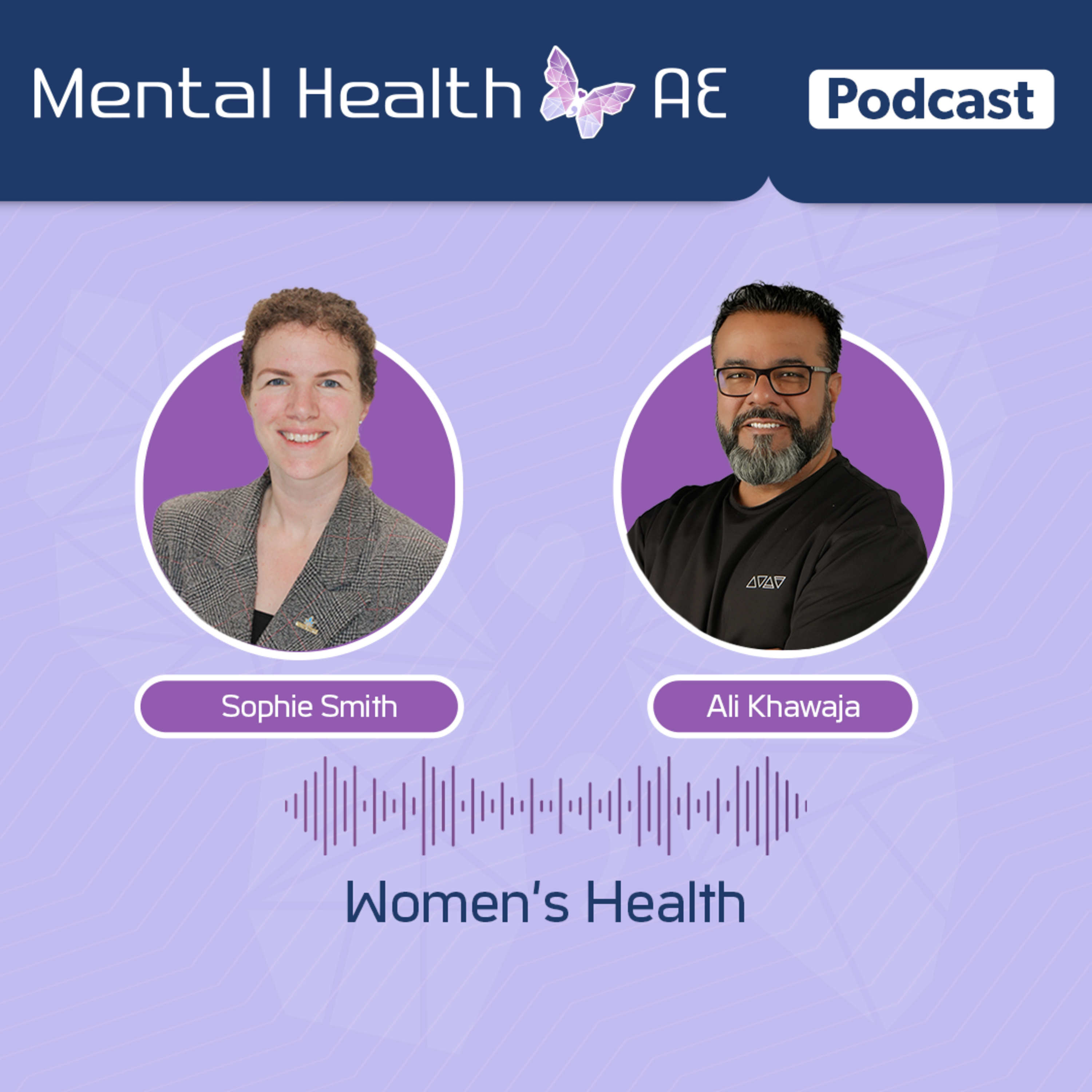
S04E08 – Women’s Health – Sophie Smith

MHAE is a UAE based mental health and wellness initiative, with the aim to create awareness and provide a safe space as well as access to information and resources. Follow us on our Instagram and check out our website.
https://mentalhealth.ae/
https://www.instagram.com/mentalhealthae/
In this episode, Ali sits down with Sophie Smith, founder and CEO of NABTA Health, to explore one of the most overlooked areas in healthcare: women’s preventative health.
Sophie shares the story behind NABTA Health, the first women’s health tech company in the West Asia and Africa region, and explains why so many women are diagnosed late, dismissed by healthcare systems, or left without access to the care they need. The conversation moves through mental health, stigma, late-stage diagnosis, hormonal health, workplace wellbeing, preventative care, funding challenges, and the urgent need to normalize conversations around women’s bodies and health.
This episode is a powerful reminder that prevention, access, and open dialogue can save lives. It is also a call for families, employers, founders, investors, and communities to take women’s health seriously before symptoms become crises.
Podcasters:
Ali Khawaja | https://alikhawaja.com
Sophie Smith | https://business.nabtahealth.com
MHAE Website | https://www.mentalhealth.ae
MHAE Instagram | http://instagram.com/mentalhealthae








Summary
In this episode, Ali sits down with Sophie Smith, founder and CEO of NABTA Health, to explore one of the most overlooked areas in healthcare: women’s preventative health.
Sophie shares the story behind NABTA Health, the first women’s health tech company in the West Asia and Africa region, and explains why so many women are diagnosed late, dismissed by healthcare systems, or left without access to the care they need. The conversation moves through mental health, stigma, late-stage diagnosis, hormonal health, workplace wellbeing, preventative care, funding challenges, and the urgent need to normalize conversations around women’s bodies and health.
This episode is a powerful reminder that prevention, access, and open dialogue can save lives. It is also a call for families, employers, founders, investors, and communities to take women’s health seriously before symptoms become crises.
#WomensHealth #PreventativeCare #HealthcareInnovation #HealthTech #MentalHealthAwareness #FemTech #AIHealthcare #PodcastInsights
Podcasters:
Ali Khawaja | https://alikhawaja.com
Sophie Smith | https://business.nabtahealth.com
MHAE Website | https://www.mentalhealth.ae
MHAE Instagram | http://instagram.com/mentalhealthae
Outline
0:00 – Meet Sophie Smith
Ali introduces Sophie Smith, founder and CEO of NABTA Health, and sets up the conversation around women’s health and prevention.
0:53 – What NABTA Health Does
Sophie explains NABTA Health’s AI-powered preventative care platform and its focus on closing women’s health gaps across West Asia and Africa.
1:45 – The Overlooked Health Gap
Ali reflects on the parallels between mental health and women’s health, especially around preventable complications and ignored data.
3:30 – Invisible in the Data
Sophie explains how mental health and women’s health often disappear from insurance and claims data when they are not formally covered.
5:59 – Sophie’s Personal Why
Sophie shares the story of her grandmother’s late-stage breast cancer diagnosis and how it shaped her commitment to women’s healthcare.
9:53 – Tech Can Do Better
Ali compares advanced everyday technology with the persistent failure to detect and prevent serious women’s health issues early.
10:49 – The Femtech Opportunity
Sophie describes the massive gap in women’s health services and why the region needed dedicated women’s health innovation.
12:58 – Why Symptoms Get Missed
Sophie breaks down the three barriers women face: recognizing symptoms, acting on them, and being taken seriously by doctors.
16:44 – Building Hybrid Healthcare
Sophie explains NABTA’s decentralized, person-centered model that combines patient, clinician, and artificial intelligence.
20:17 – Scaling Across the Region
Sophie shares NABTA Health’s expansion plans across the UAE, Saudi Arabia, and Africa, along with its long-term IPO ambition.
Transcript
0:00 – Ali Khawaja
Hey guys. Welcome back. Yes, yes, I know. I’m doing good this season, right? I’m doing real good. So, as usual, I have an amazing guest. So, you know, I’ve, I’ve seen her on and off. She doesn’t even know this at different events and she’s been on talks or panels or presentations and I always kind of had a, oh, we need to, we need to have a chat. You know, she’s one of those people. I’d be like, we need to have a chat. I think, I think we have things we should be discussing. So it just so happened that I was like, it’s time. So I had my team reach out to her and she’s been kind enough to give us some time. She’s in my tiny, super tiny podcast. Well, makeshift podcast studio. We try. So I’m going to let her introduce herself.
0:53 – Sophie Smith
So please, thank you for having me on in your tiny makeshift podcast studio. My name is Sophie Smith. I am the founder and CEO of NABTA Health. We operate an AI powered preventative care platform for West Asian Africa with a focus on women’s health. So first women’s health tech company in the region. Founded 2017. Objective of doing for women’s health what M Pesa did for banking. So bringing the 87% of women who are today health unbanked in into the system through affordable mobile, first access, six years in R&D. Started commercializing April 2023. Realized that what we built for women actually worked very well as a kind of universal model of preventative care. But closing gender equity gaps is our primary focus.
1:45 – Ali Khawaja
Oh, you can tell she’s done this before, guys. Very smooth. 100%. I love it. Not gonna lie, I love it. So a lot of my listeners know that I’m, I’m a coach and I work in a whole bunch of different areas. The podcast you’re listening to is one of those little side quest ventures that has kind of expanded into honestly, a lot of passion that has gone into it. The more I looked into mental health, the more I looked into this sector and you guys know my background is business strategy, innovation, entrepreneurship, that type of stuff. The more I found massive gaps. Massive gaps. So my, my research predominantly was surrounding mental health, but obviously it trickles down and the layers go down and then you branch out. Also the other massive statistic that I found superbly shocking was women’s health. I could not believe the data. Global data, by the way around post delivery, complications, death after delivery. The thing that really kind of like got me, you know, Crawling up the wall was the word preventative. It could have been prevented. It could have been prevented. I’m like, then why not? Then why not? Why isn’t anybody looking at this? And then I got angry and then I realized this is just like mental health. It’s an entire massive segment that’s overlooked. And quite honestly, as humanity, I think we need to be a little bit embarrassed. But thanks to people like Sophie here, you know, a little bit of impact goes a long way. And you, as my mom says, start anywhere.
3:30 – Sophie Smith
Exactly. I think the point you make about mental health and preventative care being similar, prurient one. So effectively there are many similarities between them, but fundamentally they’re things that haven’t been counted before. They don’t appear anywhere in the data. So if you look at insurance claims data, insurance, we operate in an insurance led market. Health insurance is mandatory. Prevention is not. The things that guide the decisions of payors in the country are things that are surfaced in claims data. And if something isn’t covered as mental health wasn’t until 1st of January 2025, then things relating to mental health will not appear there. Women’s health is the same. So today within the central benefits plan, which is the minimum mandated benefits that everybody in the country has to have access to, the only gender lens benefit you get is maternity. But there is no coverage of or support for menstrual health, fertility and family planning, postpartum care, pelvic health, menopause. And so these things don’t appear with claims against them, which means people think the population doesn’t need them. And actually again in the context of workforce health. So we sell our preventative care infrastructure into companies. Often the single greatest hidden burden that is potentially impacting workplace performance near term claims risk is mental health.
5:03 – Ali Khawaja
You’re 100% right on that. And you know the sa. The sad thing when it comes to all of this is, and this is something, we were just talking about this before we started recording is that in my head as a business person it says supply demand question. And if there’s no supply for a service, that means there must not be any demand. That’s completely wrong. So you know, if you skip over an entire segment, that doesn’t mean there isn’t a problem. It means you skipped over an entire segment and it’s a serious issue. Talk to me a little bit about early days when you were kind of getting started into this. What were, what were areas that, you know, you, you felt were of significant concern? You felt like, oh my goodness, I definitely have to do something about this or this. I think another way to look at, look at it is why, why did you pick this particular area?
5:59 – Sophie Smith
Okay, so I think the, the, one of the things that got to me when I looked through my first load of statistics on women’s health in the region was the prevalence of late stage diagnosis. And there’s a very specific story that goes with this, right, I told you a little bit about it when we were chatting before as well. So. And it took me years to understand my why in that context, which is my grandmother. So in 1998, my grandmother passed away, age 59 with metastatic breast cancer and she had had cancer five years previously, was given the all clear, was feeling unwell. So went to see a gp, a general practitioner in the uk, who took one look at her, saw an overweight woman in her late 50s, said, you’re feeling unwell because you’re overweight. And he put her on a diet and sent her away and she lost a bunch of weight, still feeling unwell, came back to see him a few months later, only then did he think to run the proper checks. But by then the cancer had spread to her liver. They started her own chemo, but she died a couple of months later. And she was an amazing woman. She used her big, big voice to stand up for everybody, including herself most of the time. She tutored neurodivergent kids through primary school, got herself into all sorts of trouble, was very much like a. At the heart of her family, at the heart of her community. And actually when we engaged with almost, in fact, just over 25 million women across West Asia and Africa during the early days of R and D, the thing that was true for her proved to be true for the vast majority of these women who said, I feel like I don’t have a voice. I feel like the doctor doesn’t hear me. They dismiss me, they tell me it’s all in my head. They tell me to take a painkiller, you know, they send me away. I don’t have a voice. I don’t have a voice. I don’t have a voice. And yeah, I had just moved to Dubai. I had four companies in three years, including a doctor finding appointment booking platform in Pakistan, a plastic recycling company in Sierra Leone, all kind of impact focused but totally random, and went to speak at a conference in Kuwait on diabetes. Got chatting to the organizer, not about diabetes, but about the fact that I was pregnant, which he found fascinating. And about a month later he sent me all of these statistics in women’s health that proved this high, high prevalence of late diagnosis. Very first statistic I read was that 80% of breast cancers are diagnosed in the region at stage four, which has a 27% five year survival rate versus 99% at stage one. And that was my grandmother. And I thought, like, again, what will happen will happen. But if that doctor had listened to her and seen the woman standing in front of her, circumstances might have been very different. And the fact that still almost 30 years later, things haven’t changed. We’re still diagnosing women super late. We’re still taking seven years on average to diagnose endometriosis, which is as common in women as type 2 diabetes. The fact that what used to be called PCOS but is now PMOS, Polyendocrine Metabolic Ovarian Syndrome, affects one in six, is implicated in one in six cases of infertility in women. Again super common. Three years on average to diagnose longer than that and at least three doctor visits. The fact that these things are still happening, that somehow think of the advancements that we have made in the past 30 years. We can send a targeted ad to somebody in 0.003 seconds, and it still takes us seven years to diagnose a woman with endometriosis. It’s crazy.
9:53 – Ali Khawaja
Oh, it. Wow. It’s sad. You know, this is the same realization I came to when I looked at the data and I was like, this is sad. Why, why can’t we not the amount of tech that we have, you know, and we were just talking about. Actually, we should have started recording earlier. I’ve got a little hydra hydroponic plant experiment going on. I’m trying to. Well, experiment is simple. I’m trying to keep it alive. But the tech side of that conversation was that I’m getting my team to put together these little cameras that’ll be connected to some AI thingy that will keep an eye on the plant. Oh, it seems to be wilting now versus, you know, three pictures ago or whatever. Let’s run a diagnostics on the temperature and the this and the this and that. And that’s to keep lettuce alive. Like, I mean, really. So there’s definitely a massive gap. So talk to me more about how your ventures is addressing that.
10:49 – Sophie Smith
Okay. And by the way, to that point, around the gap, like, everybody knows in the entrepreneurship space, a gap’s an opportunity. I remember, like, again, sat with this deck of statistics in front of me in the old impact hub in Sukabaha. I remember thinking as I Was reading through it, I was like, people must be building in this space. Like, the gap is so vast. The amount of stigma and shame that is attached to women’s bodies going wrong at every age and stage from puberty to postmenopause. I mean, just gap after gap after gap after gap. I was like, the opportunity associated with this is huge. You assume that an entire industry has largely ignored and not served over 50% of the global population. The amount of money that there is to be made and doing this right.
11:35 – Ali Khawaja
Yeah.
11:35 – Sophie Smith
Is huge. And I went and I looked and there was nobody building in West Asia and Africa. Nobody.
11:42 – Ali Khawaja
Nope.
11:43 – Sophie Smith
We were the first women’s health tech company in the region. I couldn’t believe it. And then I was like, we have to build this thing as fast as we can because, you know, once people cotton onto the opportunity here, there’s going to be thousands of companies again this year. First time we have seen. So there was a little bit of a shift in momentum around the time the government announced the National Policy for Improving Women’s Health. Then we saw a little bit of movement starting. But this year we’re starting to finally see momentum going. The Organon Flatsix Labs femtech accelerator is now doing its third cohort. Qatar Science and Technology park with Merck and C. Three companies creating change is running a femtech accelerator. There’s a new fund, Rasmul Ventures, that now has a mandate. It’s the first fund to have a mandate to invest in women’s health in the region. Just started to do some outreach and look for potential investment opportunities. Like just now, nine and a half years later, are people waking up to the fact that this is an opportunity and we’re still waiting for the investment to catch up? I have now completely forgotten your question.
12:51 – Ali Khawaja
I think you answered, what did you ask me? I’m not too sure anymore. I was just going to ask, how are you addressing that gap?
12:58 – Sophie Smith
Oh, yeah, yeah, yeah. That’s an important question. I should answer that one. Okay, so. So when we are in R and D and we engage with over 25 million women, we learn three really critical things. One, women are not good at identifying symptoms as symptoms for very legitimate reasons. If you have two children under the age of three, you’re never going to question the fact that you’re tired all the time because you have two children under the age of three. But as a result, fatigue often gets dismissed as a symptom. But it could be a symptom of any one of a number of different deficiencies. B12, iron Iron deficient anemia is super common here. It could be the result of a thyroid imbalance. But often women will have been tired for two decades and not done anything about it. The second thing that we learned is that even when women do identify symptoms as symptoms, because of the stigma and shame attached to women’s bodies going wrong from puberty to post menopause, they’re very slow to act on them. And that means that things get diagnosed very late because they’ll wait until the symptom becomes so overwhelming that they can’t ignore it anymore until they had a little bit of bleeding between their periods. But then suddenly they’ve been bleeding continuously for 30 days, they’ve lost so much blood they can’t get out of bed in the morning. Then their son or their daughter says to them, mama, you have to go and see a doctor. And the third thing that we learned is that when women finally do identify symptoms and act on them. Because historically women have been excluded from clinical trials, still today, female test subjects make up only 20% of animal studies because they’re deemed to be too hormonally complex and less likely to give a clean result when they do present. When women do present in front of a doctor, the doctor is often diagnosing them based on male factor diagnostic criteria. We talked about this in the context of adhd, right? Like boys on average get diagnosed in their, like in the, somewhere between 0 and 18 because a boy with ADHD stands up and runs out of the room, can’t sit still, fidgets all the time. A girl with ADHD stares out of the window like she’s off running, but in her mind.
15:10 – Ali Khawaja
Exactly. It’s completely different.
15:14 – Sophie Smith
Totally different. So women conversely tend to get diagnosed in their late 30s and 40s when they hit perimenopause. And the reason they get diagnosed when they hit perimenopause is because their estrogen levels start to drop and, and, or wildly fluctuate. Estrogen in the female body is the hormone that, that is the primary regulator of all other hormones, your cortisol, your neurotransmitters, so your G, your dopamine, all of these sorts of things during estrogen deplete periods. So second half of your menstrual cycle, or after you’ve given birth, or when you’re going through perimenopause, you don’t have so much estrogen and so everything else is less regulated. It’s why also, for example, women with ADHD are three to four times more likely to suffer with pmdd. So Premenstrual dysphoric disorder, which is like the severe potential suicidal inclination version of pms because they rely on estroge to help them to regulate their neurotransmitters and their other hormones. So women get to perimenopause, suddenly their estrogen levels are dropping and fluctuating wildly and the masking that they’ve been able to do their whole lives, the kind of hormone assisted regulation they’ve been able to do, suddenly disappears. And that’s why you have women who present in the doctor’s office saying, I feel like I’m going crazy, I’m not myself anymore. I’m so anxious, I’m waking up, you know, three, four times in the night. My husband says he doesn’t recognize me. It’s because of that.
16:42 – Ali Khawaja
Yeah.
16:44 – Sophie Smith
So the three things can’t identify symptoms as symptoms or struggle to, when they identify symptoms, act on them very late when they see a doctor, tend to be dismissed with those symptoms. What we surmised or concluded from these three things is that symptomatic care, which is traditional healthcare, does not work well for women because it relies on the first of these three things happening. And so we thought what if we build a model of care that is decentralized firstly so that it can be more easily accessed by women where they are, that is person centered. So start with the goal of the individual pre symptom and build out from there. And uses an augmented intelligence, so combines patient, clinician and artificial intelligence to reorient specialist triage Q and A and access around the individual. We took these three pillars. We coined the term hybrid healthcare, which is a model that we actually published a book on with Springer in 2022, taking contributions from authorities around the world. Head of innovation at insead, Head of Healthcare in Frostin Sullivan, the guy a quantum physicist, used to manage Vodafone’s global patent portfolio. We wrote this book on this hybrid healthcare model. We spent 2017, I guess 2018 by then to 2023 building it. The digital part, what we call our sovereignty architecture, which is like the intelligence layer that sits in the middle. Our first clinic integrated the full thing and then we, we took it to market in April 2023. And as we came to market with this B2B facing subscription based access to preventative care model, we realized that firstly, if you’re selling into companies, you have to sell for everybody or no one’s going to buy it. Secondly, it really was something that had the potential to be a universal model of preventative care. And so how do we solve some of the gaps in the market? Firstly, we have applied a gender lens to care, which not only means that downstream of the annual health check, which is our first touch point that we do for employees and offices, we bridge some of these gaps that exist in insurance coverage around menstrual health, fertility, family planning, all the gaps I mentioned before. But we also, by applying this gender lens to health care, have surface things or female lens, I should say, have surfaced things that don’t necessarily appear when you apply male only lens. So, for example, the impact of hormonal health on aging or patterns of caregiving and how those affect mental health. And so we’ve been able to also build out support mechanisms for men and women around their hormonal health as they age. We’ve been able to build out again, support frameworks to support men and women with their mental health. You know, what does a gender lens on stress and burnout look like? What happens when men’s testosterone levels start to drop in terms of their physical and mental health? You know, testosterone can, unless it’s properly managed, fall off a bit of a cliff in your 40s. And testosterone is the hormone that maintains your muscle mass, your bone density and your vascular health. It’s why, unless you’re kind of conscious about what’s happening hormonally, you know, men will get to their mid-50s and suddenly they’ll have out of nowhere a heart attack. Except it hasn’t been out of nowhere. Like it’s been slowly kind of building over 15 years and just no one’s thought to look at it. So yeah, prevention, annual health checks, everything downstream with mechanisms in place to bridge gender equity gaps.
20:17 – Ali Khawaja
Fantastic. Absolutely fantastic. How long have you been in full operations now and what areas do you operationally cover? Like where do you guys have setup and adoption happening?
20:30 – Sophie Smith
So we’re primarily focused on Dubai, but we’ll be fully across the seven emirates by the end of the year. Saudi in 2027. We already have a research institute there, research initiative in partnership with Princess Noor University. 17 research projects pipelined and in progress from Saudi. We will go into our first markets in Africa mid-2028. I guess our objective ultimately is to IPO on the Dubai financial markets, hopefully around 2030 so that we can be majority owned by the women we serve here in the region.
21:04 – Ali Khawaja
Excellent.
21:06 – Sophie Smith
But yeah, at the moment, again, just sort of scaling our kind of primary, I guess go to market which is focused on this, these in office annual health checks and making sure that we’ve got the clinical infrastructure in place between our own clinic and a network of clinical providers to support everything downstream.
21:24 – Ali Khawaja
That’s wonderful. That’s absolutely wonderful. Tell me a little bit more about things that you found, like uphill battles when perhaps talking to people or other organizations. Was there a gap in understanding? Was there friction in adoption? Was it just like, oh, you don’t know what you’re talking about. This is the phase, this is not a thing.
21:48 – Sophie Smith
I know you know the answers to all of these questions I’m asking because,
21:51 – Ali Khawaja
you know, I want my audience to also know.
21:55 – Sophie Smith
Yeah, there were challenges with all of those things. So again, you know, firstly on finding the right, I think finding the right go to market strategy, the product is good, like the annual health Check and then 12 months digital support is definitely the right product. But when we came to market we were selling it as, you know, subscription based, access, paid monthly. That’s not how people buy healthcare here. You know, companies buy insurance, maybe they pay for it monthly, but in all likelihood they pay for it once, they pay for it upfront for the year and then they don’t think about it for 12 months. They make their decisions around, you know, about renewal in Q4 of every year. And so we were like, although first contract back end of 2024, 2025, we 10x’d our revenues one track at the start of the year to 10x them again and inshallah, hit profitability by Q4. But still we weren’t getting the traction that we thought we should be getting. And we looked at this product and we like, why don’t we split it into its components? We’ve got this physical bit, the annual health check and then we’ve got the digital bit. There are people who are used to paying for this bit, insurers. Can we get this empanelled with insurers so that then we can go to companies and say, listen, we have this amazing annual health check. You can avail it as part of your existing insurance coverage, then you’re not double paying, you’re getting much higher utilization rates than you’d normally get. Because we’re coming to you, you’re not having to come to us. And we started to get an impanel from February and this has worked really well. And then we’re now looking at capitated agreements with a couple of brokers for the digital bet so that we can kind of triangulate, we can go via the broker, we can say which of the companies that you work with are insured with A, B and C and then we can essentially provide Preventative care into companies for free. We have a really very comprehensive corporate dashboard. Again, the entire objective of which was to surface some of these things that are invisible today, like the ROI of preventative care. And through it they can manage their entire kind of preventative care portfolio. So actively purchase anything downstream of the check. In terms of the check that we do, again, it’s very comprehensive. Would. Would historically have been like a multi specialty check. We do it with a nurse and a gp. We do an AI enabled patient intake up front. Everything is recorded using ambient AI. We do vitals 55 biomarker, blood test in body, body composition analysis versus the nutritional component. We do an AI enabled MSK screening, so full physical postural assessment using an iPad, mental health assessment, age stage goal appropriate, then hand off to the GP who does a more comprehensive medical history and a breast exam. With this, we 88% of the individuals we screen get a new or revised diagnosis, 76% diagnosed with a chronic health condition they didn’t know about, and 1 in 40 with a breast cancer that would otherwise have been missed.
24:48 – Ali Khawaja
Oh, wow. Wow.
24:49 – Sophie Smith
Yeah. So first challenge, and I’ve gone down like a much deeper, like product rabbit hole than I intended to, was getting people to pay for, like, understand the benefit of and then pay for prevention. I actually think now that they’ve announced the new United Emirate Health Insurance and Access Initiative, the kind of first countrywide population health initiative. Interest and understanding of the preventative care space will increase. We’re banking on it. Other challenges that we faced, Funding, that was a big one. We won a bunch of competitions the first 18 months, I think because people were so surprised to see us. They were like, what is this?
25:42 – Ali Khawaja
Some of them were probably like, finally, finally somebody stepped into the space.
25:46 – Sophie Smith
Yeah. We had the region’s first AI assistant, Aya, who we launched at JITEX and won two innovation awards for JITEX in 2018.
25:58 – Speaker: Ali Khawaja
Wow.
25:58 – Sophie Smith
We were too early.
26:00 – Ali Khawaja
Yeah. I was gonna say that’s too early
26:01 – Sophie Smith
in so many things. And because we were the first women’s health company, again, like the investment ecosystem just didn’t exist. So we have raised four and a half million dollars across three funding rounds from 76 angel investors, predominantly through SPVs, but with tickets ranging from 1,000 up to a million US dollars.
26:24 – Ali Khawaja
Very nice.
26:25 – Sophie Smith
I have spoken to I don’t know how many people over the years. It’s probably hit a thousand now about funding. Like a lot of the people who now invest in women’s health probably invested in us first.
26:40 – Ali Khawaja
Yeah.
26:42 – Sophie Smith
And that just, it Just took a lot of time. You know, like, not getting the capital when you need it has. There has all sorts of implications. You can’t a B test anything. If you’re getting stuff in ticket by ticket, as we did, you have the ability to try one thing and then you have to try it for a little bit. And then if it doesn’t work, and probably not for as long as you should, then you try the next thing. Whereas you get enough capital, you can. You can try three or four different things in parallel. It takes less time. You maintain momentum. Investors like momentum. They put in more money. So I think our whole fundraising journey has been more tenuous than I would have liked it to be. But we’re alive.
27:24 – Ali Khawaja
That’s good. That’s good. And, you know, this is a little bit more of what I talk about on my other podcast, you know, about startups and ventures and how people get into it. But. But what’s interesting in all of this is if you really take a moment to pause and think about it, none of this should have been an issue. You should not have been the only one or the first one, or the too early to be here or, you know, running around and getting gazillion investors. It should have been much easier. And the biggest reason it wasn’t is because the stigma surrounding the entire area and topic. You’re talking about something as simple as even in our households today in the region, you know, for a girl in the house to ask her brother or her dad to go buy, you know, pads or tampons, that’s unheard of. That’s unheard of. And I’ve said this on many of my previous episodes and seasons. I was raised by a mom who was like, this is the. This is the world we live in. Half is full of boys, half is full of girls. This is biology. There’s no shame surrounding this. And she would talk about everything. And she made our house an environment where you could talk about anything. So, you know, if my mom was on her period, we had awareness of the situation, you know, and similarly, even, you know, when my son was growing up, at some point, you know, they go through sex ed class and school and these sort of things, and then it’s kind of like, all right, you know, you’ve got women in the house, so be nice. You know, go take care of them. You know, step up. You. You better be glad you don’t have to go through that. You couldn’t survive it. You know, from a very young age, you know, we. We’ve had that conversation. And now it’s normal. It’s not like a thing. There’s no, like, whatever. And for. For a lot of you who are not Muslim might not know this, but in Ramadan, when a woman is on her period, she’s not required to fast. But we would see so many households where the women who are on their period, keep in mind, not required to fast or pray. They don’t have to pray, so they don’t have to wake up for the morning prayers. They would still wake up. They would still eat the morning food with the rest of the family, as if they’re preparing to fast the day. And then they would eat, like, throughout the day. Like, they’d hide and eat. And I’d be like, why? Hello? Why? What’s. What’s. No, no, no. It’s embarrassing. Why is this embarrassing? This is biology. We don’t have this issue in my house, not the house I was raised in with my mom, not the house that, you know, I’ve got with my kids now. But, you know, I came to realization that I was the minority when it came to this, especially in. In our parts of the world. I’m from the subcontinent, from Pakistan. I grew up in Saudi. 17ish years. I’ve been here 26, 27 years. And this is exactly why, you know, I’m still recording a podcast about mental health. I honestly remember a very interesting conversation I had. I think this was the first year when we had put the website together, got our Instagram going, started to do peer support groups because there weren’t any others happening. And somebody’s like, hey, what’s the. Are you going to raise some investment for this? I’m like, this is never making money, man. I got no money model on this. He’s like, what do you mean? I’m like, there’s no money. Then how do you earn money? I’m like, I don’t. How do you spend money from my pocket? So. So we’re on, like, I don’t know, year seven of this venture, me and Latifah, and every year we put money from our pocket. He said, well, what’s your objective? I’m like, you really want to know? He’s like, what? I’m like, my objective is not to be needed anymore. My objective is that our conversations in your house and your house and your house as. As common, as casual as they are in my house, in which case I shut the website down. I wish there wasn’t the need for. For this thing. And, and, you know, it took my Friend back a little bit. He sat, and I could see him kind of like thinking in his head and he goes, man, as weird as that is, it is so true. And, you know, it’s the same thing about what you’re working on with women’s health. It shouldn’t have been a thing in the first place, you know, like, and that’s what, that’s what kind of like runs me off the wall sometimes. Like, how obvious does this need to be? And why is it such a struggle? And it’s, it’s, well, in part the stigma. In part, it’s not talked about in households. Like you very rightfully said, a woman will not complain about something because there’s embarrassment and stigma associated with it when it really shouldn’t be. It shouldn’t be the case at all. And then because of those reasons and other reasons, diagnosis happened late. How research has been built up also happens late. A woman will be so embarrassed in a lot of our cultures to talk to her husband or her dad that, hey, listen, I’ve got a situation that I don’t want to talk to you about because it’s like a woman situation, but I need to go to the doctor. And now the guy’s like, panicked but doesn’t know what question to ask. And now that guy’s feeling like in an awkward situation. So the whole thing becomes unnecessarily awkward.
32:41 – Sophie Smith
It does become unnecessarily awkward.
32:42 – Ali Khawaja
And then because of that, it’s avoided. And because it’s avoided, it festers and it grows until it gets to a point where now it’s too late.
32:52 – Sophie Smith
It’s like an emotion. You talk about having a healthy mind, body connection, which fundamentally is about being able to recognize your own emotions in the moment without judgment, feeling them and letting them go. Yeah, you know, these, like, taboo and stigma work in the same way, actually. You don’t address a question with an open mind in the moment without judgment. It festers, like, and it becomes a thing and then it’s not asked again. And you just hold on to it potentially for years.
33:24 – Ali Khawaja
And yeah, and it just, it just snowballs and it gets huge. You know, the other thing is the stigma. Honestly, it’s a lot deeper than I had originally assumed because, again, I wasn’t brought up in a household like that. So for me, the normal, for everybody was very alien to me. And, you know, over the years, I’ve had thousands of conversations with people and, you know, very honest, frank conversations, because they were like, oh, this is one of the co founders of mental Health ae. I guess we could talk to him about stuff. I’m like, you could talk to your own families and anybody about it, but okay, if you feel like I’m your safe space, go ahead and, you know, some conversations, you know, even till date, they keep echoing in my head. And the smallest thing somebody would mention so casually. I remember a young woman and she would, she told me that she takes money from her parents for personal trainer. Her driver takes her to the whatever mall or whatever to where the gym is, and then she goes in and then she takes an Uber out the other door and then she goes, sees her therapist. There is no personal trainer. There is no gym. But at the home, the story that works is, gym, personal trainer, give me the money. And she goes, sees a therapist. And I didn’t have words and I was just like, excuse me, what? Like my brain, my brain, like the first time it struggled to process it, my brain’s like, no, this math isn’t mathing. Like in my head I was like,
34:52 – Sophie Smith
this is a really expensive personal trainer, by the way.
34:55 – Ali Khawaja
What is this woman saying? No, wait, what? I had to run it again in my head a few times and I was like, oh my goodness, it’s that bad. And you see that. Exactly. Not just across mental health issues, but very, very similarly across all women related issues, even if it’s like mental or physical. But it’s sad. I think that’s kind of like the same takeaway I had. And this is honestly the same reason why me and Latifah keep pushing on this little project of ours, having conversations like this because hopefully somebody who listens will be like, oh yeah, you know what, let me go get that scheduled breast exam for myself and for my mom. Or let me as the guy, check in with my wife and my daughters that, hey, God, this is nothing to be ashamed about, nothing to feel embarrassed about. But have you scheduled this or have you scheduled that? Just asking somebody is enough to get them out of that defensive space.
35:59 – Sophie Smith
By the way, there’s also money to be made in mental health. The global market size for mental health is now estimated at US$6 trillion.
36:08 – Ali Khawaja
Oh, yes, it’s a very big space. It’s a very big space. I hear you 100%. And you know, the, the silver lining of COVID has been that a lot of brilliant startups have come up in that time off. More recently, some of you guys might have seen her in my last season. No, Hayes, who’s running mind me, she’s coming at it with a whole different approach and you know, I, I just, I just love all of these ventures and I love all the stuff that all you guys are doing and what you are doing is fantastic, you know, Absolutely fantastic. So much respect for you. So before we wrap up, anything you’d like to share with the audience, like where can they find you, how can they get involved, where can they reach out and utilize your services for their organizations?
36:54 – Sophie Smith
Yeah, find us on nabtohealth.com that’s our consumer site. But there’s a link to the business site. From there it explains about how our goal based model works, how we look at prevention across three layers. Detection, navigation and prevention. We are always also looking for people who’d like to get involved locally in clinical studies. Again, if there’s a gap in terms of inclusion of women in clinical trials, even bigger gap, inclusion of women from the gcc, the Levant and Africa. So we’ve been approached now by lots of organizations who’ve developed things almost exclusively on Caucasian populations who now want to do kind of local pilots and studies. And, and so anybody who would like to participate in those, Please reach out yalanabdahealth.com we’d love to hear from you.
37:46 – Ali Khawaja
Absolutely fantastic. Once again, thank you so much for taking the time to come talk to me and talk to everybody. And guys, if you, if this resonates with you or you heard something that kind of is like, oh, wait a second, it made you pause and made you think, share it with somebody you love. Bro, bro, go check in on the ladies in your life. Do not be an embarrassment to your mom. Thank you very much. I’ll see you guys on the next one.