
S03E17 – Transforming Educational Support for Dyslexic Learners – Rehab

MHAE is a UAE based mental health and wellness initiative, with the aim to create awareness and provide a safe space as well as access to information and resources. Follow us on our Instagram and check out our website.
https://mentalhealth.ae/
https://www.instagram.com/mentalhealthae/
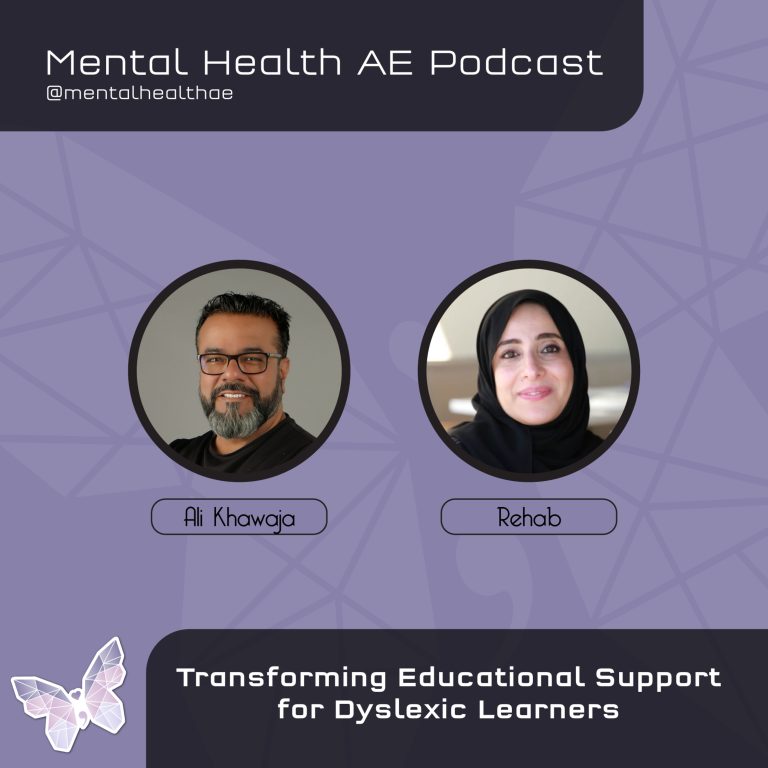
In this episode, Ali Khawaja hosts Rehab Shahbal, founder and CEO of DYStinct Learners, an online center that provides support for children with dyslexia and other learning challenges. Rehab shares her journey from a high-ranking corporate role to establishing a center dedicated to personalized learning support after her son was diagnosed with dyslexia. She discusses the emotional impact of navigating stigma and advocating for her child’s needs, underscoring the importance of parental involvement and research-backed educational methods.
Rehab explains the services offered by DYStinct Learners, including tailored assessments, remediation, and diagnostic evaluations. She highlights the challenges parents face in securing effective educational support, the need for community awareness, and the evolving inclusion policies in the UAE. The conversation also addresses financial and institutional obstacles, encouraging a community approach for collective progress. Rehab’s story is a powerful reminder that every child deserves an education suited to their needs and abilities. She emphasizes that it’s never too late to start helping children learn in the way that’s right for them.
#DyslexiaSupport #SpecialEducation #InclusiveEducation #DistinctLearners #LearningDisabilities #ParentalAdvocacy #EducationReform #CommunitySupport
Podcasters-
https://www.instagram.com/talktokhawaja/
https://www.instagram.com/dystinctlearners/
MHAE Website | https://www.mentalhealth.ae
MHAE Instagram | https://www.instagram.com/mentalhealthae








Summary
In this episode, Ali Khawaja hosts Rehab Shahbal, founder and CEO of DYStinct Learners, an online center that provides support for children with dyslexia and other learning challenges. Rehab shares her journey from a high-ranking corporate role to establishing a center dedicated to personalized learning support after her son was diagnosed with dyslexia. She discusses the emotional impact of navigating stigma and advocating for her child’s needs, underscoring the importance of parental involvement and research-backed educational methods.
Rehab explains the services offered by DYStinct Learners, including tailored assessments, remediation, and diagnostic evaluations. She highlights the challenges parents face in securing effective educational support, the need for community awareness, and the evolving inclusion policies in the UAE. The conversation also addresses financial and institutional obstacles, encouraging a community approach for collective progress. Rehab’s story is a powerful reminder that every child deserves an education suited to their needs and abilities. She emphasizes that it’s never too late to start helping children learn in the way that’s right for them.
#DyslexiaSupport #SpecialEducation #InclusiveEducation #DistinctLearners #LearningDisabilities #ParentalAdvocacy #EducationReform #CommunitySupport
Podcasters-
https://www.instagram.com/talktokhawaja/
https://www.instagram.com/dystinctlearners/
MHAE Website | https://www.mentalhealth.ae
MHAE Instagram | https://www.instagram.com/mentalhealthae
Outline
Introduction and Welcome (00:06 – 01:10)
- Ali Khawaja introduces the episode’s focus on family and children’s education.
- Briefly introduces guest Rehab, founder of Distinct Learners, setting the context for the conversation.
Rehab’s Background and Journey to Founding Distinct Learners (01:11 – 02:10)
- Rehab introduces herself and provides her professional background.
- Shares her transition from corporate banking to founding an educational support center for dyslexic children.
Personal Story and Motivation Behind Distinct Learners (02:10 – 04:18)
- Rehab’s personal experience as a mother to a dyslexic child.
- The discovery process, initial struggles, and the journey that led her to establish her organization.
Navigating Stigma and Emotional Impact (04:19 – 09:05)
- Rehab discusses the emotional journey as a mother of a dyslexic child.
- Conversations on stigma, societal perceptions, and the challenges of acceptance within the family and community.
Advocacy and Importance of Parental Involvement (09:05 – 11:06)
- Rehab emphasizes the need for parents to advocate for their children’s learning needs in schools.
- Shares her own experiences of working with schools and encouraging parental involvement.
Distinct Learners’ Model and Services (11:35 – 14:21)
- Overview of Distinct Learners’ services, focusing on online assessments, personalized support, and diagnostic evaluations.
- Details the importance of individualized education plans (IEPs) and ongoing assessments.
Challenges and Key Milestones in Establishing Distinct Learners (14:41 – 18:29)
- Rehab recounts the early challenges and significant milestones of establishing her center.
- Emphasis on building a global team and expanding to Arabic language support.
Raising Awareness and Building a Supportive Community (18:30 – 24:39)
- Rehab and Ali discuss the need for community awareness and support networks for families with dyslexic children.
- Highlights the UAE government’s efforts in inclusion and education policy for children with learning challenges.
Importance of Research-Driven and Evidence-Based Approaches (24:39 – 27:55)
- Explanation of why research-based methodologies are essential for educational interventions.
- The value of measurable progress and long-term impact on children’s learning abilities.
Addressing Financial and Structural Challenges in Educational Support (28:25 – 32:25)
- Discussion on financial and institutional challenges faced by parents seeking special education resources.
- Potential solutions, including government and community support for affordable services.
Community Building and Future Goals for Distinct Learners (32:39 – 36:29)
- Rehab’s vision for fostering a supportive community and the long-term goal of transforming education in the UAE and the Middle East.
Final Thoughts and Encouragement (36:29 – 39:11)
- Rehab encourages parents to seek help early and focus on their children’s unique learning needs.
- Closing remarks on overcoming stigma, building a supportive community, and taking proactive steps in children’s educational journeys.
Transcript
00:06
Ali Khawaja
All right, welcome back, everybody. We are on season. Oops. I should have checked this three. I think if not, I’ll change it. Don’t worry about it. Starting off this season is going to be very interesting. I have with me in the studio today, Rahab. I’ll have her introduce herself in a second. But just before we get into it this season, I want to particularly focus not, you know, aside from the things that we generally talk about, I want to particularly focus this season on things that are kind of hitting home. We have a lot of different things that are happening around the world. We have a lot of different things happening at home. It’s very hard to kind of bring the two together, and I think it’s important to kind of have focus on family.
00:51
Ali Khawaja
So things that impact family, things that impact our children, things that impact the children and our family together kind of going to be the broad theme for this season. So I’m not going to introduce her initiative. I’m going to have her introduce herself and then talk about her initiative. So, rehab, thank you for being here. Tell us a little about yourself.
01:11
Rehab
Hi, Ali. Thanks. Thanks for having me over. So I’m rehab Shahbal. I’m the founder and CEO of distinct learners. It’s an online center that helps children with learning challenges, particularly dyslexia, through personalized assessments and one one tailored intervention therapy.
01:30
Ali Khawaja
Fantastic. Tell me a little bit about your professional background before we get into distinct learners.
01:36
Rehab
Sure. So prior to focusing on distinct learners, I was an executive in one of the top tier banks here in the UAE, having worked there for 26 years, predominantly in the auditing, risk management and governance area, overseeing a team in 22 international jurisdictions, and a member of various board audit committees in the UAE as well as overseas.
02:04
Ali Khawaja
It was fantastic. And then one fine day, you decided to quit. What’s the story? I feel like there’s a story.
02:10
Rehab
Yeah. So distinct learners really was born out of my own personal journey. I’m a mother of three children. The second born is dyslexic. From early years, my son Khalifa, I could tell that there was something unique about him, you know, from his OCD tendencies to sensory processing disorder to his developmental challenges. From milestones perspective, you know, he wasn’t a big fan of reading. He spoke late, nursery rhymes were a challenge. And I could always see that there was something wrong with him. Not wrong, but something different about him. And it’s not until a year or two where I stumbled onto a teacher who happened to be dyslexic, and she could see that he had inclinations of being dyslexic. And that’s when my journey started. At age seven, he was confirmed to have a diagnosis of being dyslexic.
03:06
Rehab
And at that point in time, I decided that I needed to help my son. Looked out in the market. I’m based out in Abu Dhabi, in the UAE. Struggled in finding the right intervention or remediation or support, you know, just in order for our audience to be able to relate to the concepts. And it’s not until then that I decided, you know what? Let me look out for what’s out there. That is research and evidence based in order for me to help out my son. And that’s how my journey with distinct learners started. I started helping out Khalif, and I thought to myself, you know what? There are many parents out there who have a similar struggle. And I’ve been in the country for a very long time. Let me do something for the community, too.
03:50
Ali Khawaja
Well, first of all, thank you for sharing. And at any point, if I ask a difficult question, you’re welcome to skip it. It’s perfectly fine. Before we get into distract learners, and I know we’re here for that, but you’re a mom who does not have training or education in this field. You’re your corporate hotshot, and then all of a sudden you have things that don’t seem to be adding up with your son. How did it feel as a mom?
04:19
Rehab
Well, to be quite honest, I am a high achiever individual. Right. So you have certain expectations in terms of your role as a mother and in terms of how your children turn out. So there is a phase of denial and complacency at the beginning, particularly, you know, if you’re not surrounded by people who are familiar with the conditions that your child is exhibiting. But really, I think the denial phase was very short lived because one of the key things that helped me speed up the whole support for my son was during the pandemic, to be quite honest.
04:56
Rehab
I know a lot of people were not fond of the pandemic, but it was a blessing in disguise because through that experience, I was able to see how my son, sitting next to me and attending his online sessions, how he couldn’t even type or spell or even his executive functioning skills were not up to the mark. So at that point in time, I think the focus was not me anymore. You know, the motherly instincts kicked in, and it was about what help can I offer my child and ask the right questions from a school? Because he did go to one of the best schools in the UAE. And, you know, the team has, were very supportive during, you know, his entire journey.
05:34
Rehab
But it was at that point that I decided just to ask the right questions, do the research on my own, and find the type of support that would be the most efficient for my son.
05:44
Ali Khawaja
That was great to hear. I mean, I’m sure there’s a lot of moms out there and dads also who are kind of understanding what’s going on with their kids. Parenthood is not easy in this discovery phase when you realize that there was something off the normal path, so to speak, and there’s certain learning difficulties that are presenting themselves and, you know, you automatically, you said, you kind of went into solve mode and said, okay, let me. Let me research, let me read, let me learn. How did you find the knowledge that the people around you had? Was there awareness of this in the family and the community around you?
06:19
Rehab
Sadly, not the level of awareness, although it has improved over time, but it’s not up to the mark. So honestly, I had to do my own research by joining various Facebook pages that are out there. In terms of, in the market, yes, you do have the ancillary support, such as your educational psychologists and what have you, but in terms of the how to solve now the issues, such as the remediation, this is where the challenge was and it is where then I had to almost, you know, look around and see what else. Where else can I find, you know, the support that I needed. However, having said that, Ali, in the last few years, the awareness has improved.
07:02
Rehab
We’re still not there, but people are starting to become aware in terms of, you know, the challenges that our children face, including even in the school system. The schools also have become more forthcoming in terms of building that awareness with parents.
07:19
Ali Khawaja
It’s very good. I was actually going to just ask about the school. So, you know, for those of our regular listeners, you know, we started mental health AE just a little over five years ago, and it was essentially for literally two purposes. One, there was no awareness of anything. And the second, there was a lot of stigma. Were you afraid of the stigma?
07:40
Rehab
Yes. I mean, I won’t lie to you. Even sometimes, you know, the comments from even family around, you know, they’d be like, he’s a smart boy. You know, he’s not slow. Unfortunately, you get those comments. But I think as a parent, it’s not about you. It’s not about your parenting style. It’s not about how your child, what you need to do is just stay calm and just correct people’s information. You know, in terms of my child’s iq is average, there’s nothing wrong with him. Dyslexia has nothing. So it’s just a matter of staying calm and correcting people’s information. But you are right, it is still a learning curve.
08:22
Rehab
The stigma is there because the minute somebody has their child labeled as having diagnosis of dyslexia, or even in schools where the inclusion team or the special ed department team would ask a parent, can you please go and look into your child? We see him struggling. You have a pocket of parents who still don’t want to have their child go through that journey and be confirmed as having a particular diagnosis just because they don’t want their child to be labeled, just because society is not kind, and they’ll start associating things like intelligence and developmental issues just because, you know, they have their child being supported in terms of addressing their needs.
09:05
Ali Khawaja
I think the key word you said here is label. And this is the struggle that I’ve had. You know, after speaking to thousands of people over the last five years, there’s shame that has been associated with it, you know, and the stigma is very cultural. And like you said, the solution is in education. And this is, you know, literally why we do what we do and is to raise awareness and open conversations and again, have guests like you to come share their story. You talked about the schools. I’ve always gotten very mixed feedback from parents. Schools have been absolutely ignorant of the issue, and they say, we can’t help you. We don’t even know what’s going on. You’re welcome to move your child to a different school.
09:48
Ali Khawaja
And the other spectrum that I’ve had is the school is the one who’s identified it and said, hey, look, you need to go get a professional assessment. We have an entire team and a department and people in place to help with these things. And after an assessment and diagnostics has been reached, then they help with building special learning plans and such. Like I said, full spectrum that I’ve heard back from. What was your experience?
10:13
Rehab
So I must say I was one of the fortunate families, you know, in terms of my experience with the school, although the school, you know, were quite resourced thinly, you know, in terms of the type of qualifications that they had. But they’ve always been supportive. But that’s because I’ve been advocating for my child. So what parents need to understand is when faced with situations whereby they cannot find support in the school, they need to make their child’s learning journey more comfortable in order for him to access the curriculum in comparison to his peers. So parents really need to advocate. And by advocate, I mean go in and fight for your child’s rights in terms of the modifications or accommodations, you know, to make his learning journey comfortable.
10:59
Rehab
So I’ve been lucky in that my child did go to a school that was quite supportive, but that’s not the case for everybody.
11:06
Ali Khawaja
Okay, great to hear. Great to hear. He lucked out on that. But I think you’re right post Covid. I have seen a significant increase in wanting to have awareness and then actively trying to seek awareness, both at the individual level and mostly at the institutional level, whether it’s corporate or in education. Let’s talk about distinct learners. So expand a little bit to exactly what it is, and then I want to talk about why you stepped up to do it.
11:35
Rehab
Sure. So, distinct learners. The operating model is online and it targets two customer segments, the parents and schools and educators. Why? Online was predominantly because, one, I wanted to be able to attract the right type of talent in order for me to bring the best value to the families in addition to it. It was a learning curve for me. You know, as you had rightly mentioned, I’ve come from a corporate world, no entrepreneurship experience. So I really wanted to test the viability and the receptiveness of the market towards my services.
12:09
Rehab
Now this is, I’m going into my fourth year, and the first two years was almost like a proof of concept phase and to be quite honest, online, with the right type of technology and the right type of specialists who are qualified and trained to engage children through the right type of research and evidence methodologies, it works. However, it does come with its challenges. If the child has developmental issues and we do take that call sometimes at an entry level and tell a parent, look, your child is not a right fit for our online modality. So one aspect, like I said, is we help our parents and through support for their children in terms of the remediation that they need, which is personalized and tailored to their needs. We also offer diagnostic evaluation.
12:59
Rehab
I have assessors who are qualified by the British Dyslexia association to carry out diagnostic evaluations that run standardized assessments in order for them to pinpoint if the child does have dyslexia. But the extra value that I offer, as opposed to the traditional education psychologists, is these assessors come from special education. So the type of report that comes out also has then recommendations for what does this diagnosis mean and how can I then be able to tailor it for the child in the school system, in terms of the remediation and accommodations. So that is the value add from distinct learners. We also then support families through consultation, through advocacy.
13:43
Rehab
We go in with them to speak to schools to help work with the schools in shaping up the individual education plans, advise the teachers in terms of the accommodations that they can have in place for the children based on their learning needs. Now, if we move on to the schools and the educators, we offer professional development and training to educators and schools. We also do offer in school services. So this is one of the breakthroughs that we’ve had whereby our services, our online services can be done during school hours in terms of the remediation for the child.
14:21
Rehab
And if a school wants us to help them, because a lot of schools are resourced very thinly in terms of qualified special education practitioners, we can go in there and offer training and do a handhold stage whereby we can help them then basically deliver literacy and numeracy remediation programs.
14:41
Ali Khawaja
Wow, that’s a whole lot. I’m going to have to go to your website and read it all over again. I love it. I love it. This is fantastic. How did it start out? Because here’s, you know, I’m reflecting on my own journey with mental health AE. We initially started just as a concept and then a website for information and then an Instagram for a little bit more reach. And then we started doing, you know, awareness events and then support groups. We just crossed 101 events in the last five years. And now we’ve had organically shifted into becoming a podcast. It was never an intention to be a podcast, but just Covid, went into online, then online post. Covid was, hey, can you make the recording a little bit better? This resume recording sucks.
15:24
Ali Khawaja
And then, you know, like, okay, let’s buy a mic, let’s buy a recorder, let’s buy a camera, and then buy some lights. And we have our tiny little studio now. How did it start? What was. What was. What was first six months? Like, you know, like, okay, I want to do this. I’m not from this industry. I’m learning on the fly. This is not going to be whatever the new Dubai chocolate is that everybody wants. We have very nominal followers on our instagram because this is not a popular thing to share. Like, oh, you guys, check this out. Follow these guys. They talk about mental health. It’s still very taboo. How were the first six months, one year, like, for you?
16:06
Rehab
Okay, so what I did was at the beginning, I decided to go with an outsourced model, like you rightly said, I didn’t come from an education background. So I partnered with a us based outsource service provider who basically then I went through an advisory phase and they handheld me and we basically then set up the online platform, the website for the information, entered into a phase of digital marketing because again I’m online new. So a lot of awareness in terms of dyslexia and the services that we offer and as a brand, also a lot heavy marketing into that aspect.
16:45
Rehab
And then slowly in six months time, I was able to start onboarding children and as parents started seeing the value of the program in terms of, there were very small differences in terms of these are kids who didn’t even want to, you know, read and just giving them that hope. I think slowly parents started realizing the value of our research and evidence based approaches and word of mouth started kicking in.
17:19
Ali Khawaja
That’s excellent. What have been your big milestones? I want to drill down into the company and what you guys do in a second, but you know, just in this journey of the last few years, what have been your big milestones?
17:32
Rehab
Okay, so I think the biggest milestones is when I revisited my operating model. At the beginning of the journey, I was heavily a heavy believer in terms of the us research, but then, you know, I started expanding and talking more to educators in different markets and I realized, you know what, there’s no one size fits all approach. And that’s when I decided I need to basically connect all these experienced practitioners across the globe with various schools of thoughts in terms of how would you remediate children with different learning challenges? And I think I have a decent team now on board about 13 specialists who come from different backgrounds, from different parts of the world. And one of the key things that I’ve always wanted, I’m a social impact enterprise. So one of the key things is pay it forward type of approach.
18:29
Rehab
It’s not just about people working for me to help families, but also to be learning from each other and applying whatever they are learning from each other into their own special ed areas within their countries. So that is one of the key milestones achieved by distinct learners. The other one is for a very long time. In addition to currently, the remediation is for english language, but Arabic is one of the key things that I wanted to also support families, being that, you know, we’re in the Middle east. So I’ve had a breakthrough and I’ve identified a particular research and evidence based approach that soon, you know, we’re working on in terms of training and upskilling our specialists in order for us to be able to offer this service line and this option to parents.
19:16
Ali Khawaja
That’s wonderful. Sounds amazing. Before I drill in a little bit so I know there’s going to be all levels of listeners. Somebody who’s just like, oh, wait, this sounds familiar. I think my child might let me look into this. And then you have parents who already know what’s going on. They’ve already talked to the schools, they’re working with different support systems and they’re like, wait a second, let me explore these guys also. So I’m going to start with the basics. So if I’m a parent and I’m starting to see certain signs that are telling me things are just a little bit off, what would be my next step with distinct learners? Do I go to your website? Do I drop you a call? What do I do?
19:58
Rehab
Sure. On our website, in the assessment section, we actually have designed a screener for parents based on age groups. And this is just, it shoots at you the potential red flags that you need to be on the lookout. And your child may be having inclinations towards being dyslexic. So then that prompts the parent at least to then reach out to us in order for us to then advise them from a consultation perspective. Do you need to take it further?
20:26
Ali Khawaja
And how much does this cost?
20:28
Rehab
Oh, no, this is free. The screener is free on the website. A parent can go in based on the age group. And it’s very simple, very user friendly. You just need to populate the typical things that you’re seeing with your child and it’ll throw out to you basically in terms of. Okay, yes, there is an indication here. Now you need to probably seek some advice in terms of what are your next steps.
20:51
Ali Khawaja
So it’s not a diagnostic?
20:52
Rehab
No, it’s not.
20:53
Ali Khawaja
So it’s a screener that kind of just shows like a parent that, okay, hey, look, there might be something significant or the medium significance or. No, this doesn’t look like this particular. Okay. Okay. And then I. Next step, they would get on a call or book a call with you guys, correct?
21:10
Rehab
Yeah. And then what we do is we basically get some feedback in terms of background information on the child, developmental milestones, what they’re seeing, what the challenges that they’re seeing their child is having. And then we offer the parent a solution in terms of what are they really looking out for? If they are interested in just getting their child to solve the issue of, say, for example, reading challenges, we move on directly into the remediation. But prior to the remediation with every child, we do something called a placement assessment. And this assessment basically looks at what are the typical, if we look at literacy, for example, what are the typical building blocks that you would expect to have in order for you to be a reader.
21:51
Rehab
So things like from phonological awareness to letter sound correspondence, high frequency words, writing comprehension and so on, then that will help us also then design the lesson plan. What we offer, unlike, you know, other service providers, is everything is customized to the child’s learning needs. And this is a process that’s quite dynamic. You know, although you do a placement assessment at the beginning and we design lesson plans for the child on a weekly basis, we revisit those lesson plans and we do progress monitoring on a quarterly basis whereby we set targets for the child and revisit those and even involve the parent in terms of what are the areas that they think, other than the academic, that they would like also their child to be evolving in.
22:38
Rehab
Now, if a parent, on the other hand, is looking for a diagnostic evaluation, and typically a parent would need a diagnostic evaluation for the following, they really want to understand what are the underlying cognitive challenges that their child might have, and they need that official documentation so that they can then take it to the school for the child to receive, for example, in school support. So we offer the diagnostic evaluation route. In addition to that, we always tell parents, if you suspect your child has some, you know, moderate to severe developmental challenges, you need to start getting the documentation in place.
23:17
Rehab
And by documentation I mean things like diagnostic evaluations because it’s a formal document done by a qualified, licensed practitioner that gives you then evidence for you to be able to later on as your child moves through their learning journey, to be able to get modifications, or rather not modifications, but accommodations in the school system and even later on during exam times, university application and so on and so forth. So these are the two journeys, the routes that we basically advise parents. In addition to that, Ali, sometimes through our assessments, we can also see that the child might need other assistance. And by other assistance, I mean other multidisciplinary support. For example, if they have sensory issues in terms of hyperactivity, inattentiveness, or they have fine motor struggles in terms of writing.
24:11
Rehab
At the moment, distinct learners does not have this service, but we are partnering with other service providers in terms of, you know, you need to seek help, for example, from an occupational therapist or from, say, for example a behavioral therapist or a speech therapists. So we do also offer that parent the advice in terms of it’s not just the academic you also need to look at these other aspects which are impacting your child’s learning milestones.
24:39
Ali Khawaja
That’s great. It’s very comprehensive. You know, you’re addressing all the stakeholders, the child, the parent, you know, the educators also. This is, this is lovely. You mentioned, you know, in our conversation today, you know, the various approaches, you know, seems that all of this is very research driven. I’m not gonna drill too much into that part, but I want to ask, why is it important to look at research driven type of approaches? Like, if I’m a. Let me restructure my question. If I’m a parent, I’m shopping around for a solution provider, right? Why should I look at somebody who has this type of approach?
25:17
Rehab
Okay. Essentially, number one, you don’t want to waste your time. You know, you’re taking your child off, say, for example, extracurricular activities, or let’s say, for example, if you’ve caught it very late, because some parents have a tendency of being complacent or, you know, they’re just being hopeful that the problem will go away. It’s not a problem. The challenge will go away or they’re being in denial. Yes, exactly. So what you want to do is you want to offer something that will really help your child. I mean, if we go to basics, if your child cannot read as they move up the school years, they need to be able to read to learn. Majority of the parents that I get, Ali, are for children who are at the age of eleven or twelve, which is grade five, six.
26:02
Rehab
It’s no longer about can you read? It is about are you able to read to access the curriculum? You know, so you don’t have that luxury of wasting time. And research and evidence based methodologies are basically approaches would have been tried and tested, run over a period of time, and they’ve given results. The data speaks for it. There is data behind it, and that’s what you need. You know, you really want programs and approaches that have data and evidence that support that. You can see progress in terms of the child’s capabilities in terms of reading, spelling, writing comprehension and so on, so forth. And it comes at a price.
26:46
Ali Khawaja
Yeah, I would assume so. But then, you know, that’s where the value is.
26:49
Rehab
Exactly. No, but what I mean is when parents have to be looking out for programs, why they need to be asking about research and evidence based, it’s because you’re paying an arm and a leg, you know, in terms of what is out there. You need to do your research and make sure that you’re paying for something that has been. So you need to ask the questions. You know, you need to. You ask for the numbers behind. If they tell you this program does this, they need to show you the evidence in terms of the data and the progress.
27:18
Rehab
And this is why, you know, with distinct learners, we’re very mindful that on a quarterly basis, we give that visual to the parent in terms of this is what the targets were, and this is where your child is today in comparison to, say, for example, in an area of phonemic awareness, you know, letter sound, correspondence, fluency. You know, fluency has to do with the capability of a child being able to read and express and relate to the content, you know, so we’re able. We’ve got numbers behind it that shows the progress to the child. And this is only. We’re able to do it through research and evidence based methodologies, not an off the shelf type of a program that you just run.
27:55
Ali Khawaja
Sounds fair. Sounds fair. I mean, at the end of the day, you want what’s best for your child, and you want to make sure that, you know, wherever you’re going to spend a lot of time, energy, and money, you’re getting value for. Sounds really good. I like it. You mentioned a little bit earlier about language, and this was something I wanted to also talk about. And, you know, we’re, you’re a UAE based organization. What have been the challenges? You know, what have been the potential opportunities that you have seen being in the UAE?
28:25
Rehab
Okay, so one of the key challenges, I would say, is, first of all, getting parents to accept that there’s no luxury of waiting. There is clear need for you to be able to address your child’s challenge. So that buy in is one of the key things. But I think lately, because we’re building a community, and as a result of building that community, we have the luxury of having parents talk to each other. You know, some parents are open to receiving, what do you call it, recommendations or referrals from parents in terms of what they’ve seen, the value delivery. Other parents are still complacent. So, I mean, there’s so much that you can do at the end of the day, right? I mean, they’re the parent of their child. They know best, and it’s all about choices.
29:15
Rehab
I think the other challenge that we have seen is in terms of the accessibility of the parent to be able to advocate for their child in the school. Having said that, there has been great progress in the special education and inclusion area in the UAE, particularly driven through the Department of Education, be it ADEC or KHDA. You know, the inclusion policy in the UAE has just been revamped. It’s coming into effect in 2025. And they’ve upped their game in terms of all these inclusion and special ed departments shaping up, you know, in terms of how they are staffed, how they develop the ieps, the progress monitoring and what have you. So there is that challenge in terms of, you know, parents being able to work with schools.
30:05
Rehab
You know, we have over 55 curriculums, I believe over 20 plus curriculums, and you’ve got schools ranging from private to government to charter schools. So there are challenges with each of these different types of schools. The other challenge that we have is predominantly in terms of the financial resources and the capabilities of these parents. You know, I’m not a non for profit, although it’s a social impact. And the key thing that I have seen from a lot of parents, some of them don’t have the financial resources, you know, and what I would love is to have a model whereby the insurance companies, perhaps, you know, they need to revisit these cognitive ability challenges as to whether it can be covered by insurance or not.
31:01
Rehab
So, you know, I’m getting in contact with people as I educate myself more and more in terms of how we can go about it in order for us to be able to subsidize for these families, you know, so if something can be done at a central government level, for us to be able to subsidize services like this, I mean, that would be wonderful. Another challenge is schools and the type of qualifications that they have. Look, a lot of schools are trying their best and they’re all putting up their hands and say, you know, we’ve got limited training. We’ve had got limited qualified people. The attrition rates sometimes tend to be higher in some of the schools. So to up to what level can schools invest in the training and development?
31:46
Rehab
So I think if we can have mainstream schools, having people trained on research and evidence based methodologies and not applying a one size fits all approach, although there are great schools out there, you know, in fact, yesterday I attended the british school Middle east summits, and there are some schools that are doing great work, you know, in terms of really trying to support regular learners in addition to children who learn differently. So the challenge continues. But the good thing that I can say is people are putting up their hands and acknowledging that, you know, this is what we have to work with. You know, Rome wasn’t built in one day.
32:25
Rehab
We all have to work together and as long as that awareness is there and the purpose and drive is there, I think we’re looking at potentially things progressing in the right direction over time.
32:39
Ali Khawaja
Fantastic to hear. I think the two key things that I want to kind of emphasize on is one is community. In all the years that I’ve run mental health ae, I’ve always found a constant, it’s very sad, but constant theme that every single person thinks they’re alone. Majority of our events that we’ve had, it’s been very interesting because people have made great friendships. Oh, you too? ADhd. ADHD. Really, really high five. Literally. Some, they high fived each other. I’m just sitting there like you all thought you were alone. No, you know, so I think community is very important because we have cultural stigma, because we have associated shame with these things. You know, parents don’t want to talk about it.
33:24
Ali Khawaja
And I think community is very important for them to realize that most definitely not only are they not alone in this, but they have support in this. I think community is key. And it’s wonderful that you guys are working on this also, you know, and I was going to ask you more about the UE government, but you already answered that. And it’s amazing to hear that there is involvement at the governmental level to actively look at this, to actively address this. And it’s not just talk, but it’s also action. So very excited also for that. Anything parents can do to get more involved, to help out with schools or policymakers and government, to kind of, you know, I don’t know, move things along or provide feedback, provide help. I mean, given that you’re. You’re in the industry now.
34:10
Rehab
Yeah, I think like you mentioned. So in terms of community, you know, we are working on having more community events, creating that support group for parents. And I think education is key as parents start working together, sharing each other’s experiences, I think word of mouth and just enlightening each other in terms of what’s out there, what have you seen, what works, what service provider are you aware of just that initial direction? Obviously, there’s so much that we can do as parents in terms of changing the system, but for me, I believe it’s educating yourselves, building the awareness, advocating for your child, and just working on creating that ecosystem that you can share with your other family groups, educators, parents and advocates in order for us to be able to at least build that awareness now, will we be able to change it or not?
35:09
Rehab
Hard to say. But at least I think if we continue building that awareness, spreading the word you know, getting people to realize it’s no longer about stigma and taboo. You know, you need to help your child get over yourself. It’s not about you. You know, the focus is on the child. Slowly but surely, I think change will happen.
35:33
Ali Khawaja
Michelle. We can all be hopeful and we can be active. A lot of people ask me, why did you start mental health ae? And my answer is very simple. Since I was a child, you know, my mom has been always giving me great advice. And one of the things that she told me very early on, it stuck with me. She goes, if something needs to be done, do it. Don’t wait for somebody else and don’t complain about somebody else. You do it, and I’ll do it in whatever my capacity is in the best way that I can. And what’s been interesting is I’ve had such amazing people help me over the years. Volunteers came out of nowhere. We have massive amounts of content that got translated to Arabic for free. Volunteers like, yeah, you know what? I got a couple hours.
36:18
Ali Khawaja
Let me help you out with this. So it’s been wonderful. So, you know, you walk the path and the path will appear for you. And talking about path, tell me, where is distinct learners headed? What’s in the future?
36:29
Rehab
Okay, so like I said, we’re online at the moment. We’re soon also going to basically launch our professional development and training programs for educators. In fact, today we’re having our first community event, one of many to come webinars for families, parent coaching and what have you. Also, I’m planning to partner with a number of service providers in order for us to basically plug in the need that the child might have from various other areas. Physical, definitely something that we’re looking at. Inshallah. And that is something maybe perhaps next year and, yeah, I mean, let’s just see. Distinct learners vision is to really transform the special education in the UAE and hopefully the Middle east. So by Allah’s will, inshallah, will be able to realize that vision.
37:28
Ali Khawaja
Inshallah sounds fantastic and all the best for you guys. It’s wonderful what you guys are doing. Final thoughts? Something to share with the audience before we wrap up.
37:37
Rehab
It’s never too late. It’s never too late. Just give your child the opportunity that they deserve to learn the way their brain is wired to learn. There is no shame. You know, I think you just need to get over yourself and think about the child. It’s no longer about you. Don’t take that opportunity from your child to basically be able to enjoy his learning journey. At school.
38:06
Ali Khawaja
That’s absolutely wonderful. And for those listening, where can they find distinct learners?
38:11
Rehab
Visit our website at www.distinctlearners.com. We also have an Instagram and Facebook page. And, yeah, reach out anytime. Even if it’s just for advice, you don’t necessarily have to use our services. We’re happy to help.
38:27
Ali Khawaja
Thank you so much. It’s been wonderful having you. I think the audience learned a great deal. And for those parents out there who are not sure what’s going on, but they feel like something’s up, go get it checked. What’s the worst? You get the help you need. Think about it. Right. I think the worst thing you could do is leave your child in a position where they’re struggling.
38:48
Rehab
Correct.
38:48
Ali Khawaja
And I think that’s. That’s just. That’s heartbreaking. But I like what you said. It’s never too late. So get on the website, guys. If you’re thinking something’s going on, run the free assessment screener. And then, you know, the team, I think, is happy to hop on a call and discuss further and then, you know, next steps as needed. Thank you very much for being here.
39:11
Rehab
Thank you, Ali, for having me.