
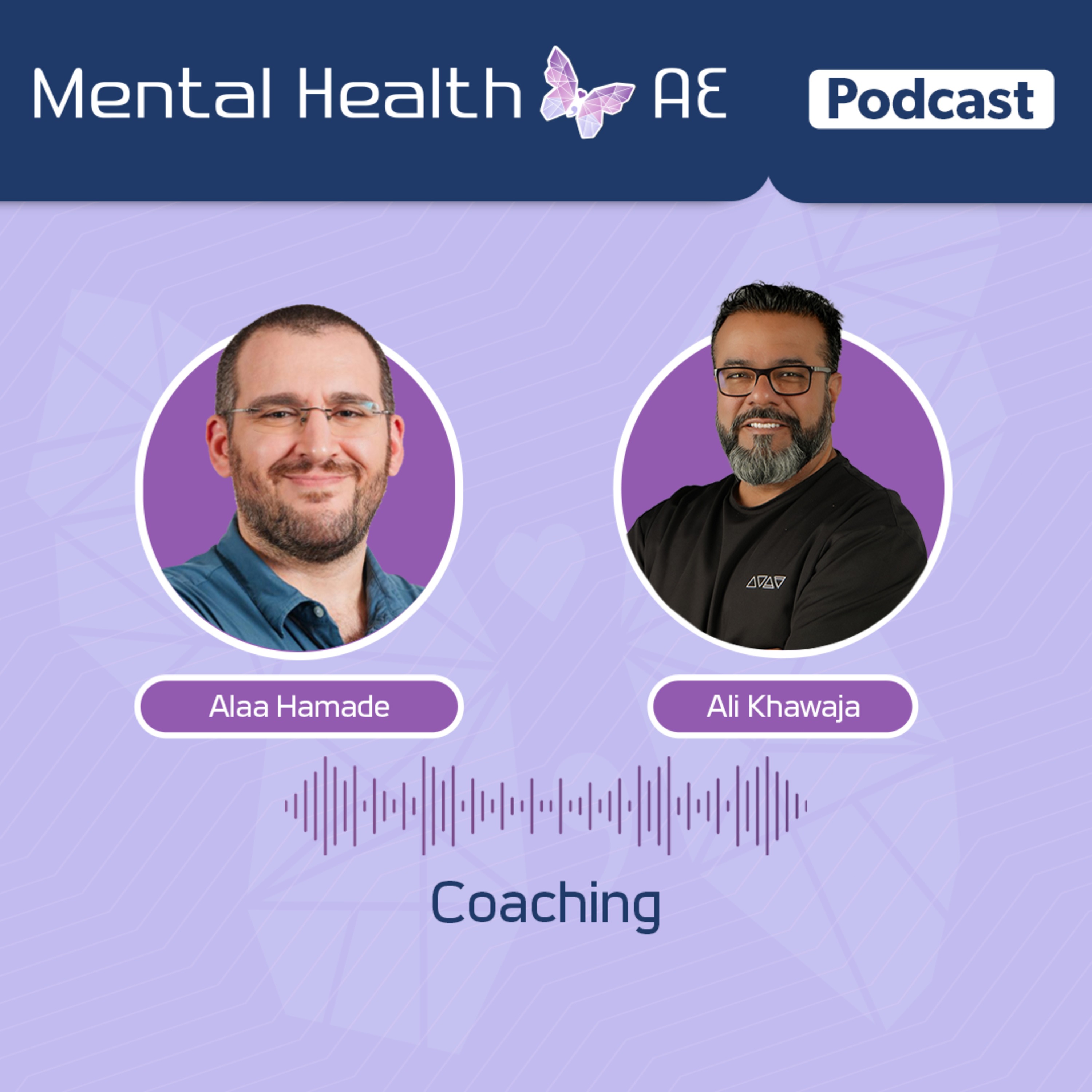
S04E07 – Coaching – Alaa Hamade

MHAE is a UAE based mental health and wellness initiative, with the aim to create awareness and provide a safe space as well as access to information and resources. Follow us on our Instagram and check out our website.
https://mentalhealth.ae/
https://www.instagram.com/mentalhealthae/
In this episode, Ali Khawaja sits down with Alaa Hamade, an ICF-certified professional coach, educator, and entrepreneur, for a practical and honest conversation about what coaching really is and what it is not.
Together, they unpack the difference between coaching, therapy, mentoring, and consulting, while exploring why coaching is not about “fixing” people, but about helping them gain clarity, shift perspective, and uncover their own answers. Alaa shares how coaching changed the way he listens, teaches, leads, and communicates, while Ali reflects on his own journey into coaching and the powerful role of curiosity in meaningful conversations.
The episode also covers who coaching is for, how to know whether you need a coach, what to expect from the coaching process, how to choose a properly credentialed coach, and what it takes to become one. Whether you are curious about getting coached, becoming a coach, or simply learning how better conversations can create real transformation, this episode offers a clear and grounded introduction to the world of professional coaching
Podcasters:
Ali Khawaja | https://alikhawaja.com
Alaa Hamade | http://alaahamade.com
MHAE Website | https://www.mentalhealth.aeMHAE
Instagram | http://instagram.com/mentalhealthae








Summary
In this episode, Ali Khawaja sits down with Alaa Hamade, an ICF-certified professional coach, educator, and entrepreneur, for a practical and honest conversation about what coaching really is and what it is not.
Together, they unpack the difference between coaching, therapy, mentoring, and consulting, while exploring why coaching is not about “fixing” people, but about helping them gain clarity, shift perspective, and uncover their own answers. Alaa shares how coaching changed the way he listens, teaches, leads, and communicates, while Ali reflects on his own journey into coaching and the powerful role of curiosity in meaningful conversations.
The episode also covers who coaching is for, how to know whether you need a coach, what to expect from the coaching process, how to choose a properly credentialed coach, and what it takes to become one. Whether you are curious about getting coached, becoming a coach, or simply learning how better conversations can create real transformation, this episode offers a clear and grounded introduction to the world of professional coaching
Podcasters:
Ali Khawaja | https://alikhawaja.com
Alaa Hamade | https://alaahamade.com
MHAE Website | https://www.mentalhealth.ae
MHAE Instagram | http://instagram.com/mentalhealthae
Outline
00:00 – Introduction and Guest Welcome
Ali introduces the episode, welcomes Alaa Hamade, and sets up the conversation around coaching, personal development, and their shared experience in the field.
01:19 – Alaa’s Journey into Coaching
Alaa shares how he accidentally entered the coaching world, became ICF-certified, and built experience coaching students, graduates, managers, executives, and government and private-sector clients.
02:44 – How Coaching Changes the Coach
Ali and Alaa reflect on their early experiences with coach training, including learning how to listen deeply and letting go of the urge to immediately solve people’s problems.
05:49 – What Is Coaching?
Alaa defines coaching as a conversation rooted in curiosity, listening, and helping people think clearly without taking control or assuming the coach knows better.
07:34 – Coaching Is Helping, Not Fixing
The discussion explores how coaching helps people who feel stuck by asking questions, opening new perspectives, and allowing clients to discover and own their own solutions.
09:56 – Coaching vs Therapy, Psychiatry, Mentorship, and Consulting
Ali and Alaa break down where coaching fits alongside therapy, psychiatry, mentoring, and consulting, emphasizing that coaching is not about healing trauma or giving expert advice.
16:09 – Who Is Coaching For?
Alaa explains that coaching is useful for functioning individuals, leaders, professionals, and anyone seeking clarity, change, better decisions, or a sounding board during periods of pressure or transition.
20:48 – How the Coaching Process Works
They discuss what clients need to bring into coaching, including honesty, real issues, confidentiality, trust, and the importance of the work that happens between sessions.
24:06 – How to Choose the Right Coach
Ali and Alaa explain the importance of credentials, ICF certification, chemistry meetings, ethical obligations, and red flags when choosing a coach.
35:57 – Getting the Most Out of Coaching and Becoming a Coach
The episode wraps with practical advice on session frequency, coaching agreements, maximizing the coaching experience, and the pathway for anyone interested in becoming a credentialed coach.
Transcript
0:06 – Ali Khawaja
Welcome back guys. Yes, I’m doing good this, this season, as you can see. Oh wait, let me get my hat. Somebody asked me what do you always wear a hat? In the podcast, I’m like when I remember. So them, them asking me reminded me, one sec, let me look at me now. I’m ready. I’m fully geared up.
0:24 – Alaa Hamade
You’re in uniform.
0:25 – Ali Khawaja
I’m in uniform, yeah. Sandals and a hat. Uniform, good. So today I’ve got a really good friend of mine with me. He’s also a colleague. We have many ventures and adventures I think is the, the way to put it together. We’re both big time foodies, so do not be surprised. You know what’s that thing when you have a TV show and another TV show comes spin off, spin off. Don’t be surprised, ladies and gentlemen if there’s like a whole foodie vloggy spin off situation ship happening because food is life. So let’s get into it. I’m going to ask him to introduce himself and then I’m going to get into the topic of discussion. Both of us have been in this field for a decade now. I think more. Yeah. So yeah, a decade and change and it’s been very interesting. So before I drill in, kindly introduce yourself.
1:19 – Alaa Hamade
Sure. Thank you, Ali. So yeah, my name is Allah Hamadi. As you can tell from the title screens, I have been a coach since 2014. This is a field that I stumbled into accidentally. I was needed as an Arabic speaking support for some program and one thing led to another and now I’m certified from ICF as a professional certified coach with close to 700 hours of experience. I’ve coached people from different backgrounds. You can like high school students is probably the youngest that I’ve coached or at least the least experienced. I’ve done university coaching, fresh graduates, career coaching, mid managers, C suite managers, you name it. The majority of my coaching has been in the government sector, but I’ve done a lot of private sector coaching as well. In addition to that, I teach at a local university here. I am also working on several ventures and adventures as you mentioned, that are related somehow to self improvement, academics, that kind of field.
2:44 – Ali Khawaja
So I like how you started because my story is somewhat similar that I accidentally fell into it. And I’ve mentioned this on so many of my other episodes. I was just sitting and chilling in my office and and Linda, who was our trainer kind of passed by and said, hey, I’m doing this training thing. You, you should do it. I was like, what are you talking about? Like I didn’t say that. That was my inside voice. Like, what are you talking about? I’ve been teaching for ages now. I don’t need no coaching. And I remember she was so chill and she like, just come, just check it out. If it’s not your thing, it’s not your thing. It was my thing. And I remember the first. Not even the first day, the first hour I was there, like, questioning myself. Have I ever listened? Did I ever listen to anybody? How have I never, like, oh, my God, I don’t know how to listen? Like, that was the sort of stuff that was going on in my head. It was hilarious. But, you know, fast forward, you know, over a decade now and again, hundreds of hours experience for myself also. It’s, I think, been one of the most fulfilling experiences of my life.
3:46 – Alaa Hamade
What’s interesting is it’s not just fulfilling for me, it’s been life changing. So my first impression was a little bit different than yours. I’m naturally a good listener, so I didn’t have that shock. But my shock was in the process. Like, I naturally want to solve problems. Male thing.
4:12 – Ali Khawaja
It’s a guy thing. Yeah. We’ve had these discussions before.
4:14 – Alaa Hamade
So someone comes to me, talks to me. Okay, how can I solve your problem? XYZ, do the Step 1, Step 2.
4:19 – Ali Khawaja
Fix your hat is the default hat.
4:21 – Alaa Hamade
Exactly. But when we went through the coaching training, we had to abandon that mentality. And that was the most difficult thing for me. That, no, you’re not here to fix. You’re here to listen. You’re here to guide, you’re here to support. And that’s really the biggest challenge at the beginning, but also the biggest thing that changed my life because it made me view the world in a very different way. It made me viewed my conversations in a very different way. It made me view my teaching in a very different way. At that time, I was also in the courting slash engagement phase. And. And that also helped me in that phase as well. So it was very much lifechanging. And the way that every coach training goes is we’re not being trained to be coaches. We’re being trained to be better people. So that then we are ready to be coaches. Because being a coach, once you’re ready, it’s natural.
5:23 – Ali Khawaja
Yeah, I hear you. And I was like, as you were talking, I’m like, oh, man. There’s like 10 different tangents we could go on. We’ll be here for 10 hours. But I’m going to keep today’s discussion a little bit structured because you know, you and me both have a habit of just going on and blobbering.
5:37 – Alaa Hamade
Yeah.
5:38 – Ali Khawaja
There’s just so much to talk about. So I know we already jumped into, you know, coaching and where you got kind of started and. But I want to kind of circle back and help our audience with some clarity.
5:48 – Alaa Hamade
Yeah.
5:49 – Ali Khawaja
What is coaching?
5:52 – Alaa Hamade
Well, it’s. I mean, I can pull up a textbook definition for you. Not going to. Coaching is a conversation. It’s the right way to have conversations. It’s a conversation where, A, you’re listening, B, you’re not taking control, C, you don’t think you know better than the other person, and D, you’re helping them think clearly, make stronger decisions. You’re helping them see things in different perspectives through one tool. Really? A coach has one tool. Curiosity.
6:33 – Ali Khawaja
Oh, yes.
6:34 – Alaa Hamade
All you need is just to be curious.
6:37 – Ali Khawaja
I love how you put that.
6:38 – Alaa Hamade
And you’ve watched Ted Lasso.
6:41 – Ali Khawaja
Yes.
6:42 – Alaa Hamade
Remember that scene with the darts? Just be curious. That resonated so much with me, resonated so much with my coaching that now my natural instinct is to ask a million questions. I’m like an older version of my son. I just continuously ask questions because of my coach training. But that’s basically what coaching is. You’re asking questions, you’re having a conversation through curiosity to help them find something out. What that thing is doesn’t matter to me. It’s about them. Everything revolves around the person sitting in front of you that you’re trying to help, and it doesn’t mean that there’s something wrong with them. That’s also a key thing that coaches have to get out of their heads, and that helps in getting out of the fix it mindset.
7:34 – Ali Khawaja
Well, now that you mentioned it, if you’re not fixing, then what are you doing?
7:39 – Alaa Hamade
Helping. Supporting.
7:42 – Ali Khawaja
How is it helping if you’re not fixing? I mean, I know I’m coaching also. Right. But I know my audience is thinking this right now. Like, wait, you just said you’re listening, but then you’re coaching and you’re helping when you’re coaching, but then you’re not fixing. So how are you helping? So I come to you with a problem, you’re not going to fix it?
7:56 – Alaa Hamade
No, I’m not going to fix it, but I will ask you questions about it to learn more about it. Most of the times when. When a client comes to me, it’s not because. Or a client who understands coaching will not come to me and say, I have a problem, fix it. They’re going to tell me I’m stuck Now, now that they understand coaching, they identify the stuckness. But early on in their coaching endeavor, let’s say they think it’s a problem, but it’s actually they’re being stuck. They’re stuck in a place and they need someone to help them find their way out. And my questioning, my curiosity is going to let them figure out what tools do I have? What is the actual problem? Because sometimes they might think the problem is one thing, when in reality it’s something completely different. And when I ask them questions, I’m looking at things from different perspectives. I’m helping them look at things from different perspectives. One of the tools that we learned in coach training is the Johari window, where you can look at a thing from different perspectives, different windows, and you see completely different things. I’m helping them see that perspective. When they get there, many times you will re. You will realize that there is an aha moment that the client reaches where they figure something out. A light bulb comes up, and it’s that moment that is the fulfilling part for us, where we get them there.
9:21 – Ali Khawaja
Yeah.
9:22 – Alaa Hamade
I don’t want to give you a solution. I might have a solution. I’m not going to.
9:26 – Ali Khawaja
I was just about to ask.
9:27 – Alaa Hamade
I might have a solution. And by the way, it’s very painful to keep that to yourself, but you keep it to yourself. Because when they realize the solution on their own, they own it.
9:37 – Ali Khawaja
Yep.
9:38 – Alaa Hamade
They’re accountable for it, and it resonates much more with themselves. Whereas if I’m telling them what to do, they’re always going to be like, he’s telling me, is he my boss? Does he know better than me? Subconsciously, it’s not yours. Yeah, it’s not yours. But when they reach it, it’s much more powerful for them.
9:56 – Ali Khawaja
I like that. I like that. Well, this is going to naturally lead to the next question. I’m sure you’ve been asked this a gazillion times, but then, you know, there’s a lot of curiosity. Well, if coaching is not fixing and coaching is conversational and you know, all the things that you just mentioned, then where does coaching fit in? In the coaching? Coaching therapy, psychiatry, all that type of mix. Because when somebody’s looking for help, you know, and if it’s. Especially if it’s some sort of mental health struggle, even stress at work, a lot of times they’re told, okay, you need to go talk to therapists or you need to go see, you know, a medical professional. Where does coaching fit into all of this?
10:37 – Alaa Hamade
So the way I see it, and this is not something that a lot of people might agree with, but I see. Imagine a Venn diagram of three circles. The three circles aren’t connected to each other. There’s a circle in the middle and two circles on the left and right. Coaching is in the middle. And I’m gonna cluster therapy and psycho psychiatrists together is on one side, and then consulting, slash mentorship is on the other side. These vent. These circles represent the people, the coaches, the therapists, the consultants. So you see a lot of overlap between consultants and coaches. So a lot of people who are consultants also become coaches. A lot of people who are psychotherapists or psychiatrists might also dabble in coaching. So that’s from a user’s point of view, let’s say from a conceptual point of view. Each one is tackling different things. Therapy tackles more the past, the trauma. It tackles more the healing and emotional repair and psychiatric repair. I’m here to help you. I’m here to give you solutions for your mental state. Consulting mentorship is also giving you solutions, giving you answers, directions. From an expert point of view. Here also, it’s from a health practitioner point of view. Here it’s from an expert point of view. I am a consultant because I am an expert. I am a mentor because I’m an expert in my field. I’m giving you the honor of listening to. Coaching is none of that. I am not a psychiatrist. I am not medically trained to treat you. I am trained to listen to you. I am trained to be curious. I am not an expert in my field or I am an expert in my field. But you’re not here for my expertise. You’re not here for me to give you solutions. Like, a lot of times people come to me like, oh, I saw your profile. You’re an academic. Do you have a master’s? You’re in business. I want your entrepreneur. I’m like, no, no, in coaching, I’m not going to touch any of that. You want that? Let’s go for a consulting meeting or a mentorship meeting. In a coaching meeting. You’re here because I’m a good listener. You’re here because I am curious. I will ask you questions. I might have some expertise in some tools, maybe some assessments that would help us dig into more information. So as a coach, we need to have a lot of tools in our toolbox to pull up whenever the need comes. But the idea is, as a coach, I’m a listener and I’m curious. I’m not here to heal you, and I’M not here to give you solutions. I’m here to guide you, to support you. I’m here to be curious. That’s the difference. It’s difficult. The nuance is difficult, but it’s there.
13:30 – Ali Khawaja
I like that. I think that’s interesting how you said it. One of the things that I talk about in my onboarding with my clients and the way I try to explain it is, you know, I’m like Google Maps. You pick the destination. I’ll give you a recommended route. You don’t have to take that route. You know, you can take whatever route you want, and then I’ll reroute based on that route. So my job is to kind of help you optimize your journey, but not tell you your journey and not take your journey for you. And I think you’re 100% right. It’s not telling. It’s conversing. And that hierarchy that we experience with consultants or doctors or, you know, trained and certified therapists, you are approaching them for their level of expertise. So it’s not a level conversation, but in coaching, we’re always having a level conversation. And the other thing I always joke about with my clients, and I say it lightly, but there’s a lot of depth to. And I tell them, look, you’re the only one who’s the expert in you, because you’re the only one who’s been living with yourself 24 7. I just met you three minutes ago, right. So I can help you from perspective. I can help you discover, I can help you sometimes untangle. But at the end of the day, you are complete with your questions and your answers.
14:55 – Alaa Hamade
One of the biggest triggers for coaches, and if any coaches are listening to this, they will jump up and down, is when you are in a coaching program, let’s say, for a leadership development program, and they ask you at the end of the program to do a professional development plan or an IDP or whatever. Whatever acronym they want to call it. It’s very uncoaching.
15:19 – Ali Khawaja
Yeah, that’s like anti coaching.
15:21 – Alaa Hamade
You’re asking me to judge or clarify or certify or. That’s not what we do. If I was a consultant, I can judge all day long. If I’m a psychotherapist, I will judge all day long. I’m not here to judge. I am here to listen. I am here to be curious. Because judging someone comes from a place of. I don’t want to say superiority, but it comes from a hierarchy that I am looking at you from above and judging you as a Coach, that is a complete. No, no, that I don’t know more than you. You’re the expert in this room. I am learning from you. I’m the expert in asking questions, let’s say. But I’m not the expert in you.
16:09 – Ali Khawaja
I love how you put that. People find it so funny when I tell them, listen, my job is to ask questions. But what’s your expertise? I’m like, in the context of today’s conversation, asking questions.
16:17 – Alaa Hamade
Yeah, but.
16:18 – Ali Khawaja
But. I’m like, yes. There’s no but. There’s no. I’m going to fix it. I’m going to solve it. I’m. I’m with you on the journey, and that’s kind of it. So. Okay, good. I like that. I like that. I think that’s. That’s a very, very appropriate way to put it. Nicely structured. And of course, you know, again, guys, there’s tons of resources online that you can read out, read on. And of course you can approach Mr. Allah. We’ll have his contact details and whatnot posted somewhere. Depending on which platform you’re listening or watching this on, I think the next big question that always pops up is, who. Who’s coaching for? You know, they’re like, okay, I’m having some major struggles, you know, and the varying mental health struggles. And I’m like, okay, I need to go see a therapist or I need to see a psychiatrist or whatnot. Okay, there. There’s like, I don’t want to say clear, but there’s like specific indicators where say, okay, now you need to go see this professional when you need to go see a coach.
17:15 – Alaa Hamade
Okay, so the way I like to look at this is, first of all, let me tell you what I’m going to give my clients and then I’ll tell you what types of clients should come to coaches. The worst case scenario of any coaching session is you have me as a sounding board, is you’re just venting and I’m just listening. That’s okay. So you just need someone to vent to. That’s okay. Best case scenario is you come with a issue, a problem, something that you’re stuck in, and you want someone to listen to you, to ask you questions, to uncover something that you might think you’re missing. So I’m not going to tell you coaching is for everyone and anyone, because it’s not. Because there are certain people who need consultants, there are certain people who need mentors, there are certain people who need psychotherapy. I might get a client, and in the chemistry meeting, I might say, you know, What? I’m sorry, but coaching is not for you. What you need is a psychotherapist or what you need is a mentor. There’s also personality types where they’re not comfortable being in a conversation of equals. They want someone to tell them what to do. Yeah, that, that’s completely normal. So I would tell them you need a mentor, you don’t need a coach. So coaching is basically leaders who want to make complex decisions, who want someone to help them out, to listen to them. Because usually leaders might be in a room where they’re sought after for their expertise, but they also want someone to talk to, to listen to them, to bounce ideas off of, to have them ask them questions so that they can uncover things that they might not have read, recognized. It might be anyone that is looking for more clarity, more intention, something specific in their life. Someone who’s going through change, who’s going through pressure. Basically you’re a well functioning individual, but you’re just stuck. That’s really the word here, stuck. You’re, you need to make a decision, you need to make a call, you need to make a change. You want someone to help you unwrap this. You want to launch a new business, you want someone to talk to, to bounce off ideas. Again, you’re not going to get ideas back from me, but you will get someone to help you dig deep and uncover some information.
19:44 – Ali Khawaja
I like that. You know, a lot of what I also communicate to my clients is that it’s not complicated, it’s simple. And the objective for you to be here is not to necessarily fix big problems. It’s an optimization discussion. How do you see your life, how do you see your life being better? And just out of that kind of framework and perspective, conversations explode.
20:11 – Alaa Hamade
We always say that the client is not broken, the client is whole, the client is complete. We’re not there to add to the client or to fix the client or to improve the client. We’re there to support them. We’re not adding information, we’re uncovering information. We’re helping them discover things that they already know, that they already recognize, that they already probably see or they will see in the session. But it’s not something that we’re going to add to them. We’re adding value, but we’re not adding knowledge or information.
20:48 – Ali Khawaja
Okay, I get you on this. I think the next part of what I want to talk to you about, and you already explained a lot, but you know, just if you were to structure and tell me, tell us, the audience, how does it work? How does coaching work?
21:04 – Alaa Hamade
Well, I’ve talked about the curiosity. So that happens in the session. An important part of coaching, I think, happens before a session where a client needs to have a real problem, a real situation that they need help in that they want to talk about. Especially in professional development programs where you have, like, a bunch of 10, 15 clients assigned to you, some have not chosen to be coached, so they start coming up with fake problems or things that they’ve already resolved, but they want something to talk about.
21:44 – Ali Khawaja
Yeah, Pre work is very.
21:46 – Alaa Hamade
Yeah. So come with something that you actually want to talk about, something that you actually want to discuss. I think that’s. That’s key. And then be honest with me.
21:56 – Ali Khawaja
Oh, that’s a hard one, man.
21:58 – Alaa Hamade
Be honest with me.
21:59 – Ali Khawaja
I’ve seen a lot of clients struggle with that one.
22:02 – Alaa Hamade
Like, especially again, in. In. The majority of my work is in corporate coaching, professional development as part of professional development programs where they worry that I represent the man, that I represent their boss, the company that they work in. Now, yes. In chemistry meetings and onboarding meetings, we make sure to break that assumption that, no, I’m here for you. Confidentiality is a key component of our professional relationship. Yes. I am bound by what you tell me. I am not allowed to utter to a single individual. And when they get that, when they trust that, that opens the floodgates. But sometimes they don’t trust that, so they want to. Oh, no, everything is great, everything is good, then there’s no problems. No, I need you to be honest and open with me. When you are able to do that. I’ll help you reframe. I’ll help you understand. We can uncover new things, and the biggest outcome of the session is you leaving with a clearer mind, maybe a different way of thinking, a different direction, a different perspective. But this is. This is what many coaches might not explicitly say, but the real value is not in the session. The real value is what happens between sessions.
23:32 – Ali Khawaja
Yes.
23:32 – Alaa Hamade
Because the client will leave and their brain is just.
23:36 – Ali Khawaja
Is cooking.
23:37 – Alaa Hamade
It’s cooking.
23:37 – Ali Khawaja
Things are cooking.
23:39 – Alaa Hamade
The. My biggest joy is when I get the client come back, and I’m like, so, how are you?
23:45 – Ali Khawaja
Yeah, not gonna lie. I wait for that.
23:46 – Alaa Hamade
And then they’re like, you know what happened? I did this and I did that, and I did that because of what you said, because of what we did. That means coaching is working.
23:54 – Ali Khawaja
Oh, yeah.
23:55 – Alaa Hamade
Because coaching is a process. It’s an hour, but then the week or two weeks or month between sessions, that’s where the gold happens.
24:06 – Ali Khawaja
I like that. I think what you said is very apt. It’s important to understand that coaching is not a one time thing. You know, it’s a, it’s a framework that you work within. There’s obviously huge confidentiality and ethics things to consider. And that’s part of our coach training, like a big part of our coach training. And it’s actually for everybody. It is. Right. But in order to get the best out of coaching, I think, and this I want to kind of tangent into the getting the best out of coaching, but in order to better understand the best out of coaching, I think the prerequisite to that question I have is how do you select a coach? Because we are currently globally plagued with people who attend a weekend course and then claim to be a coach.
24:51 – Alaa Hamade
Yeah, yeah. Credentialing is a big part, is very important. Now there’s a couple of credentialing bodies. I think there’s like two or three. I personally follow icf, the International Coach Federation. They have three levels. Associate certified coach, Professional certified coach, Master certified coach. So if you look for these acronyms, acc, pcc, mcc, from icf, then that is someone who is credentialed by this body. And from my research, from my experience, this is one of the top bodies in coach credentialing. But as long as there is some credentialing that is not a certificate in coaching. Yeah, that I’ve done a two day training. No. In order for me to get a credential, the first credential, I am required to have a minimum of 100 hours of coaching experience. So imagine the pain you have to go through to get 100 hours of coaching with no credential.
25:49 – Ali Khawaja
Been there.
25:50 – Alaa Hamade
And then go through a 60 hour training program.
25:54 – Ali Khawaja
Been there. Okay. Exactly.
25:56 – Alaa Hamade
And then go through a three hour exam. I think that was probably the most annoying part of the process. But anyway, so credentialing is key. Now where do you find someone who’s credentialed? There’s many platforms. The ICF themselves have a platform called Find a Coach if you go to ICF Internet.
26:16 – Ali Khawaja
So first we want to make sure that we’re, you know, any coach that we’re looking for because sometimes it’ll pop up on your instas and whatnot. You want to make sure they’re credentialed.
26:23 – Alaa Hamade
Yes.
26:24 – Ali Khawaja
And you know, well, you and me both are ICF credentialed because that’s the body. We, when we did our research, we’re like, okay, these guys are the most credible, the most legit. Okay. So that’s kind of Like a prerequisite to making sure you’re not digging in the wrong place. You were mentioning a directory.
26:39 – Alaa Hamade
Yes, there’s a directory on the ICF website. It’s called Find a Coach. You can search for qualifications, you can search for by language, by country, online, face to face. There’s different criteria that you search there. You can Also search on LinkedIn, you can also search on Instagram. But again, those are going to be very tricky because there’s a lot of wannabe coaches, there’s a lot of life coaches that have no certifications, they just wanna talk hear themselves. But the key thing, the key thing, if any coach does not offer you a chemistry meeting, then that is a red flag. Yeah, you have to have a chemistry meeting before every, before any coaching engagement because you wanna know if there is a fit. A, you need to know if there’s a fit and B, I wanna know if there’s a fit because when I meet someone who I want to coach, I might see, you know what? No, I’m not the right coach for you or you’re not the right client for me. I’m not going to be able to help you. Because part of our ethical obligations is to always be helpful. And if we notice that there is no more help or that there is no more that we can do or that the benefit of the coaching is not there, we are obligated to end the engagement. And this is the financial outcomes of coaching not only come second come, probably 10th after a lot of other criteria that are revolving around the client’s well being. The client’s well being always come first. So you want to find a coach that when you meet them, you can sense that they are the right coach with you for you, that they will listen to you, that there is a, that’s why they’re called chemistry meetings. That there’s chemistry between the two of you. The conversation feels easy. You’re able to take off your mask. I think that is a key component for every coaching session for it to work. Because A, the coach takes off their mask, B, the client takes off their mask. And being vulnerable in sessions like these is important because that’s part of honesty. Being able to be honest with me and with yourself is to be able to be vulnerable.
28:58 – Ali Khawaja
See, for me, I’ve always kind of broken it down into a checklist in my head. So the chemistry meeting, 100%. Without a chemistry meeting, no bueno, no deal. We’re not moving forward. So in my onboarding or my chemistry meeting, when I have with my clients My internal checklist. The first thing is, do they need coaching or do they need something professional? Because a lot of times, you know, they need professional help. And that’s again, part of our ethical obligation. And, you know, it doesn’t happen very often, but, you know, every now and then I do get a client and I tell them, I’m like, listen, I don’t think coaching is right for you at this moment. Based on what you’ve been sharing with me, based on, you know, what you just mentioned, I think you need to definitely speak to a therapist or a couple’s counselor or sometimes even significantly more. And so that’s kind of like my first. Like in my head, my flowchart. That’s the first exit. The second is in the exploratory meeting. I want to know if the person is coachable and by. If the person is coachable. This is where I’m like, are they actually here to get. To get actual coaching, to be open, to be vulnerable, to listen, to change? Or are they here to just validate whatever thing is stuck in their head? And that doesn’t mean that I will kind of say no. I will kind of flag it. The first one is an out. I will tell them, look, this is my recommendation. This is not right. Maybe once you’ve resolved that stuff, then we can always come back to coaching. But this is the wrong service for you. The non coachable aspect. I will mention it in the chemistry meeting and say that I’m feeling I a lot of resistance from you for being involved in this process, you know, and then that kind of catches them like, oh, crap, he can see what I’m saying. I’m like, yes, I can hear what you’re saying. I can see what you’re saying. So let’s talk about that. More often than not, it unravels. And then they get to the real. The issue behind the issue, so to speak, every now and then. And it’s happened. I think honestly, my decade worth of coaching, not more than a handful of times where I’m like, this person is literally not actually interested in coaching at all.
31:18 – Alaa Hamade
See, you’re a little bit more direct than I am.
31:20 – Ali Khawaja
Yeah.
31:21 – Alaa Hamade
For me, when I sense this, especially when I get the sense that they’re there to validate themselves, to have someone tell them, yes, good job, you’re correct. They’re not there to question themselves. I just, I just. Don’t bother, you know, I hear you. I don’t want to be. I’m not there to be a yes man. Yes, okay, exactly. I’M not there to be their cheerleader. Yeah, I will support them.
31:56 – Ali Khawaja
Yeah.
31:56 – Alaa Hamade
Through whatever they want to do. But they need to be open to learning, to understanding, to seeing things in different perspectives. And if they’re not, they’re not.
32:10 – Ali Khawaja
See, but I think what you said right there, they need to be open to it. That doesn’t mean they need to already know how to do it or be good. That’s what we can work on coaching. But that mindset of, look, I’m open to something new, I’m open to being open, you know, if that’s locked, that’s troublesome. If it’s, hey, I want to, I don’t know how. No problem. We can figure this out together. So. Okay, I like this, I like. So we know, we know we need to look for credentialed coaches. We have a great directory. If you find somebody on your socials or your LinkedIn, go look up their credentials, ask them. You know, there’s, there’s no reason to be secretive about credentials. If somebody’s being secretive or feeling offended, how dare you ask me my credentials. Red flag, walk away.
32:53 – Alaa Hamade
Plus, we were all very proud of our credentials.
32:56 – Ali Khawaja
I was just going to say I’ve got my credentials plastered all over my
32:59 – Alaa Hamade
LinkedIn, my email signature, work and personal has PCC next to it. My website has PCC everywhere. My LinkedIn has PCC everywhere. So no, we are proud of it because we’re proud of the association with icf.
33:15 – Ali Khawaja
It was a lot of work.
33:16 – Alaa Hamade
We worked hard. Yes. So getting to ACC was difficult. Getting to PCC was much more difficult.
33:23 – Ali Khawaja
Yep. Yep. Well, you know, Allah’s talking about bumping up on the levels. But what he didn’t mention, I just realized that we hadn’t spoken about again since we know coaching, it’s like to us it’s implied. You’re even if you stay at the same coaching credentialing level, you have to renew. Oh yeah, you have to renew. So you can’t just do it once and Khalas, I’m coach for 50 years.
33:44 – Alaa Hamade
When I, when you first get the credential, you get it for three years.
33:47 – Ali Khawaja
Yeah.
33:48 – Alaa Hamade
It’s not a all you can eat buffet of coaching.
33:51 – Ali Khawaja
It’s. There’s an expiration date, there’s an expiration
33:54 – Alaa Hamade
date of 3 years. In order to be renewed. They require, they, I mean ICF that you go through 40 hours of coach specific training within these three years. So for 10 years that taught it 12 years. Now I’ve done 60 hours to get the ACC. I have done an extra 80 hours to get the PCC. So that’s 140. And then for 12 years, each year I’ve done 40 hours. Shall we quickly do the math on that?
34:27 – Ali Khawaja
Too much math, man.
34:28 – Alaa Hamade
480, 140. 620 hours.
34:32 – Ali Khawaja
That’s training.
34:33 – Alaa Hamade
Training. 620 hours of training.
34:38 – Ali Khawaja
If you ratio that for your actual coaching hours, it’s surprisingly close so far.
34:44 – Alaa Hamade
It’s one to one.
34:45 – Ali Khawaja
Exactly.
34:45 – Alaa Hamade
Almost one to one.
34:46 – Ali Khawaja
You know, this is why I tell a lot of my clients and they’re like, oh, why is it important? I’m like, look, this is the, all the stuff we do. Would you go to the, the hospital and go to a doctor who’s taken a weekend course in becoming a doctor? You wouldn’t. You wouldn’t. Okay, forget a doctor. You wouldn’t even go to a mechanic who’s like, yeah, I watched a YouTube video. I’m a mechanic. You’re going to give him your car. You’re not. So the verification of credentialing is important. And like you said, we’re all very proud of it. We busted ass to get it done. So you will see again, same thing for me. It’s in my signature blog, it’s in my LinkedIn. It’s plastered everywhere. You can’t search for me without finding my credentialing attached to it.
35:27 – Alaa Hamade
100%.
35:28 – Ali Khawaja
We’re proud.
35:29 – Alaa Hamade
It’s a badge of honor.
35:29 – Ali Khawaja
It’s exactly. It’s a badge of honor. I think it’s very good. Now, I think the last piece I want to talk about in terms of coaching process. So if we’ve got, let’s say somebody started out coaching and they’re like, okay, look, we did the onboard chemistry meeting. It looks good. Let’s, let’s start with, you know, like, sessions, whatever. Once a week or once every two weeks. Let’s do a block. What can the person who is the coachee, what can they do to maximize that experience?
35:57 – Alaa Hamade
Yeah. So first thing, do not just ask for one session.
36:04 – Ali Khawaja
Yeah. It’s not a one session thing, guys. That’s 100%. Yeah.
36:08 – Alaa Hamade
The minimum that I accept usually is three. Same minimum is three. Because in three, session one is the appetizer. Session two, there might be an aha. Session three is where we bring things together. So you need a minimum of three. Depending on the overall goals of what the client is trying to achieve. You might go up to five or 10 session blocks and then renew those as things progress. I know people who have, like, indefinite agreements with their coaches for a weekly meeting. Kind of like having a therapist that they go to every single week. But they do that with a coach. I’ve seen that a lot, especially with leaders with CEOs, with C suite managers where they want this, they need this one hour a week to unpack everything that they’ve gone through that week and to prepare for the next week. And that takes me to the, the spacing between sessions. The minimum is a week. I usually like two weeks. Two weeks is the sweet spot, depending on the situation. Like if it’s someone like a CEO or top level manager, it needs to be weekly probably, but mostly it’s two weeks to a month, not more than a month.
37:39 – Ali Khawaja
Agreed. So what I do similar, I tell them, let’s start with weekly and we’ll adjust because they don’t know exactly the level of depth of involvement. We don’t know how much we’re going to be unpacking. And it’s like layers, man. It starts to peel out and they’re like, okay, okay, so hey, what do you think if we shift to every two weeks? So again, literally, as we discussed, this is all process, but I think the key thing that you said, it’s definitely not a one meeting.
38:12 – Alaa Hamade
No, no. And one key thing to have with any coaching engagement is an agreement.
38:23 – Ali Khawaja
Oh, I love how we totally skipped the coaching agreement. We’re almost out of time. So tell us what a coaching agreement is.
38:30 – Alaa Hamade
It is a glorified contract, but basically in a coaching agreement, it will stipulate how many sessions, how often the sessions are going to be payment, all the financial terms. But most importantly, it should also have my obligations. Your obligations. My expectations of you. Your expectations of me. How will I act in a session? How will you act in a session? My obligations to you, to support you. My obligations to you. That if I sense that things are not going anywhere, that I have to end it. If you feel that you want to end it, you have an out. So all of this needs to be in writing. Nothing should be left for the mind to assume and think and wander. So it is a contract, but I don’t like to use the word contract. It’s an agreement between you and I to create this relationship. To co create this relationship.
39:28 – Ali Khawaja
I like that. I like that. Fantastic. I think that’s been good and I appreciate you taking the time to come talk to everybody today. It’s been a great snapshot into what coaching is. You know, you and me have had tons and tons of conversation and you know, we have other ventures that we’ve delved into a Lot of depth when it comes to this so tiny tangent. And then we’ll wrap it up. What if somebody is interested in becoming a coach? What’s the pathway?
39:58 – Alaa Hamade
Well, they have to do the, what is called the level one training.
40:02 – Ali Khawaja
Okay.
40:02 – Alaa Hamade
That’s the 60 hours of training that they have to develop, that they have to go through any provider.
40:10 – Ali Khawaja
And where can we find providers?
40:14 – Alaa Hamade
The ICF website, there is a link, there’s a section there called ESS where you can find level one providers. There’s a filter, full directory. Yep. A directory. Level one if you want to become an acc. Level two, if you want to become a pcc. If you’re already a coach, you can click on in the same directory instead of level one. Level two, you pick CCE and you’ll find the directory of providers. Also for these training programs, the 40 hour, every three hours, even the.
40:45 – Ali Khawaja
So just, just to be clear for the audience, even the training providers and coaching credentialing providers have to be certified.
40:54 – Alaa Hamade
Yes.
40:54 – Ali Khawaja
To do it. So it’s not just like, oh, I feel like I’m going to be doing ICF training and I’ll authorize people.
40:59 – Alaa Hamade
No, and when, when you, when I am taking the training, I need to find someone authorized by ICF because they’re providing me with hours. They’re called cces. Continue course, Continuing education, something, whatever. Cces. And I need them to be cces in core competencies, cces in resource development. We’re not going to get into technicalities, but these programs are certified by icf. So ICF has a directory of all of the providers, certified providers and all of the courses, certified courses that these providers are offering.
41:34 – Ali Khawaja
And then that’s your shop around list.
41:36 – Alaa Hamade
Exactly. You go in there, you look at the different options, you look at the prices.
41:40 – Ali Khawaja
By country.
41:41 – Alaa Hamade
Yep. You can filter by country, by language, online or offline. There are several programs that are completely online, self paced. Those are usually my favorite. When I find something that is self paced, I can do it at my own leisure, my own time. I don’t have to attend a class. Some might work. Yeah. So it just depends on what you’re looking for.
42:03 – Ali Khawaja
Okay, fantastic.
42:05 – Alaa Hamade
And this, this directory, if you’re going to look for it on the ICF website, it’s called the ess. Okay, look for something called ess and that’ll basically be the directory for level one if you want to be a coach. Level two for PCC and cce, if you’re already a coach.
42:20 – Ali Khawaja
Excellent. I think that’s fantastic. So guys, if you’re listening and you’re interested in coaching because you’re like, wait a second, I kind of do this for my family and I kind of do this for my friends. That’s because you probably a coach and you don’t know it yet. So explore that pathway. It might be something you’re interested in. And you know, for everybody else who thinks that, oh, I don’t know if I need coaching, I think the easiest thing I can tell you is try it.
42:42 – Alaa Hamade
Yes, you will.
42:43 – Ali Khawaja
You will be very pleasantly surprised. Okay. So with that, I think that’s all the time we have for today. It’s been fantastic. A lot. Again, thank you very much for coming and talking to the. To my peoples.
42:55 – Alaa Hamade
Thank you for having me.
42:56 – Ali Khawaja
How. And quickly give me the plug. Where can everybody find you?
43:00 – Alaa Hamade
So I have a new website.
43:01 – Ali Khawaja
Oh, congratulations.
43:02 – Alaa Hamade
Yes, thank you very much. How do you spell A L, A A H, A m a d e dot com. Say, look for me on LinkedIn. You’ll find me there. And a plug for one of our ventures, OneMind AC.
43:24 – Ali Khawaja
Fantastic. Looking forward to that. I think this is very exciting. I will make sure to mention all of the things he just said somewhere. Again, depending on which channel media that you’re looking in. And like I said, feel free to reach out. You always reach out to me anytime. And now you have Mr. Allah’s website, Allahamadi.com. so drop them a message, say hi and listen. Coaches are a community. Everybody in. I have yet to meet a coach who’s not friendly, who’s not approachable, and everybody is ready to help everybody. So if you’re interested in finding a coach or help to find a coach, they’ll help you. If you’re interested in becoming credentialed and certified as a coach, that’ll also help you. They’ll also help you. Okay, awesome. And with that, thank you very much.
44:06 – Alaa Hamade
Thank you, Ali.