
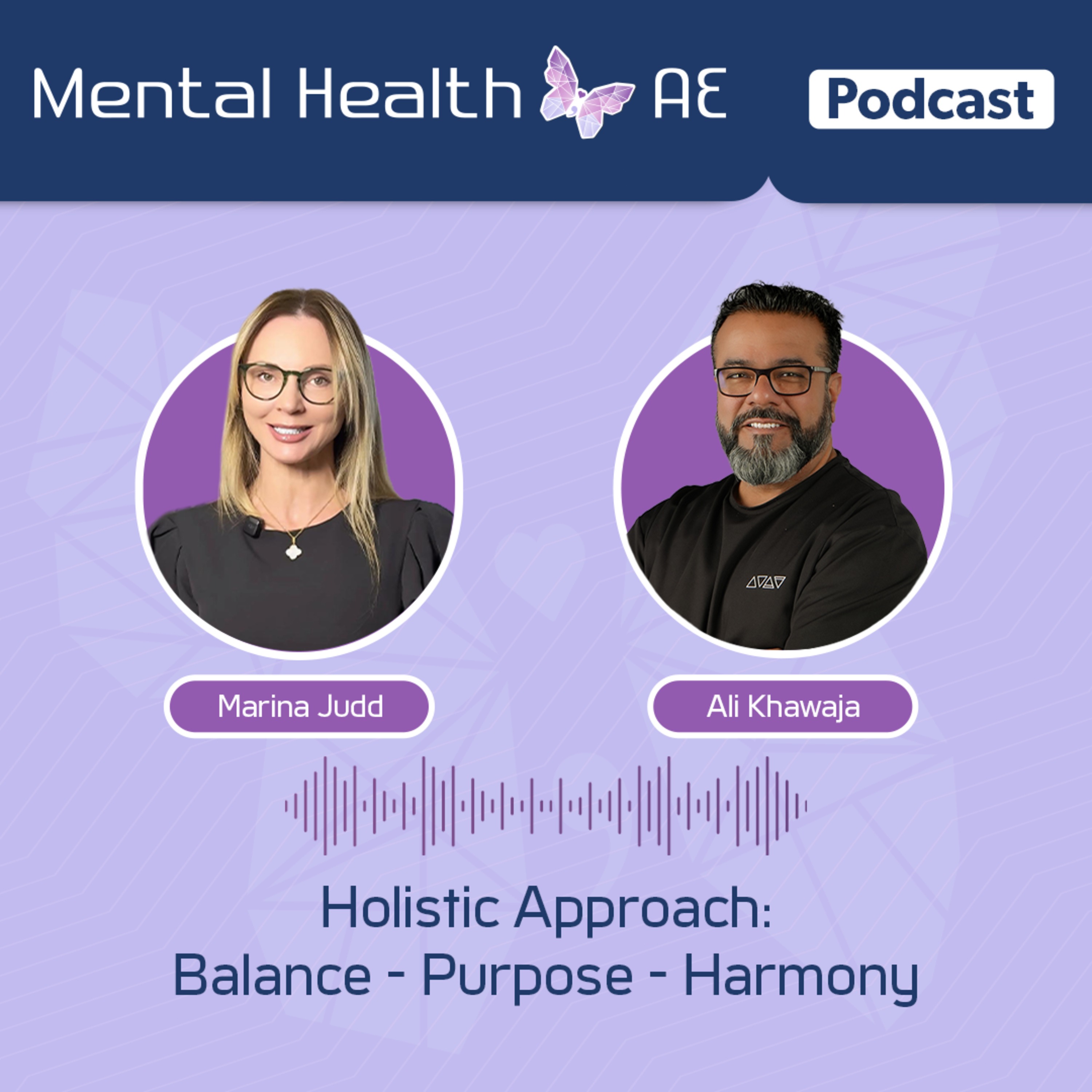
S04E02 – Holistic Approach: Balance – Purpose – Harmony – Marina Judd

MHAE is a UAE based mental health and wellness initiative, with the aim to create awareness and provide a safe space as well as access to information and resources. Follow us on our Instagram and check out our website.
https://mentalhealth.ae/
https://www.instagram.com/mentalhealthae/
In this episode, Ali Khawaja is joined by Marina Judd, founder of the Holistic Academy in Dubai, to explore a holistic approach to life, work, and personal transformation centered on balance, purpose, and harmony.
Marina shares her personal journey from a corporate career in economics into holistic education, a transition sparked by personal loss and deep self-reflection. After experiencing the limitations of logic-based approaches during periods of grief and emotional distress, she discovered the transformative power of art therapy and holistic practices, both for herself and her family. This journey eventually led her to establish the Holistic Academy.
The conversation dives into what makes Marina’s programs unique. Built on four core pillars, personal transformation, scientific understanding of stress and the nervous system, structured ethical tools, and professional accreditation, the academy emphasizes that true change takes time and must be lived, not rushed. Participants are guided through extended programs that allow space for reflection, integration, and growth.
Ali and Marina discuss the importance of slowing down in a fast-paced world, rebuilding community, and creating safe group environments where people can reconnect with themselves and others. The episode also explores gender dynamics in holistic work, the need for more men to engage in emotional and personal development, and how nurturing leadership benefits families, relationships, and society at large.
The conversation closes with reflections on transformation as a ripple effect, how personal change impacts households and communities, and why sustainable growth can only happen when people give themselves permission to slow down and reconnect with purpose.
#HolisticWellbeing #BalanceAndPurpose #PersonalTransformation #MentalHealthAwareness #ArtTherapy #StressManagement #EmotionalWellbeing #HolisticLiving #PurposeDrivenLife
Podcasters-
https://www.instagram.com/talktokhawaja/
https://www.instagram.com/mrn.judd/
MHAE Website | https://www.mentalhealth.ae
MHAE Instagram | https://www.instagram.com/mentalhealthae








Summary
In this episode, Ali Khawaja is joined by Marina Judd, founder of the Holistic Academy in Dubai, to explore a holistic approach to life, work, and personal transformation centered on balance, purpose, and harmony.
Marina shares her personal journey from a corporate career in economics into holistic education, a transition sparked by personal loss and deep self-reflection. After experiencing the limitations of logic-based approaches during periods of grief and emotional distress, she discovered the transformative power of art therapy and holistic practices, both for herself and her family. This journey eventually led her to establish the Holistic Academy.
The conversation dives into what makes Marina’s programs unique. Built on four core pillars, personal transformation, scientific understanding of stress and the nervous system, structured ethical tools, and professional accreditation, the academy emphasizes that true change takes time and must be lived, not rushed. Participants are guided through extended programs that allow space for reflection, integration, and growth.
Ali and Marina discuss the importance of slowing down in a fast-paced world, rebuilding community, and creating safe group environments where people can reconnect with themselves and others. The episode also explores gender dynamics in holistic work, the need for more men to engage in emotional and personal development, and how nurturing leadership benefits families, relationships, and society at large.
The conversation closes with reflections on transformation as a ripple effect, how personal change impacts households and communities, and why sustainable growth can only happen when people give themselves permission to slow down and reconnect with purpose.
#HolisticWellbeing #BalanceAndPurpose #PersonalTransformation #MentalHealthAwareness #ArtTherapy #StressManagement #EmotionalWellbeing #HolisticLiving #PurposeDrivenLife
Podcasters-
Ali Khawaja | https://alikhawaja.com
Marina Judd | https://www.instagram.com/mrn.judd/
MHAE Website | https://www.mentalhealth.ae
MHAE Instagram | https://www.instagram.com/mentalhealthae
Outline
0:00 – Episode introduction & setting the theme
– Ali reflects on burnout, returning to the podcast, and the need for balance
– Introduction to holistic living and intentional pauses in life
0:48 – Meet Marina Judd
– Founder of the Holistic Academy in Dubai
– Overview of holistic education, stress management, and art therapy programs
3:13 – From corporate life to self-discovery
– Marina shares her background in economics and corporate work
– Personal loss as a catalyst for reflection and life change
8:10 – Discovering holistic and art therapy
– Using creative practices to process grief and emotional pain
– Realizing the limits of logic during emotional distress
9:19 – Inside the Holistic Academy programs
– Focus on personal transformation before helping others
– Long-term programs designed to support real change
12:32 – The four pillars of the holistic approach
– Personal transformation, science, tools, and accreditation
– Importance of structure, ethics, and professional credibility
15:28 – What participants gain from the program
– Improved relationships, emotional awareness, and confidence
– Ripple effects on families and home environments
18:15 – Practice, community, and real-world application
– Working with real clients, workshops, and community projects
– Building confidence through experience and support
21:08 – Community, group dynamics, and belonging
– Small group sizes and deep connection
– Creating long-term support networks beyond graduation
34:58 – Gender dynamics and holistic growth
– Why more women enroll and why men are needed in this space
– Nurturing, leadership, and emotional intelligence for everyone
40:56 – Slow is fast: redefining success and growth
– Slowing down to unlearn, rebuild, and realign
– Final reflections on purpose, harmony, and transformation
Transcript
Ali 0:00
Foreign. Guys, welcome back for another episode. We definitely got this season rolling now. Apologies for the big gap. I think I mentioned in the previous episode. I was working with Shimmer for a year, really didn’t allow for a lot of flexibility and time. I was just constantly burned out. But we’re back now and hopefully we get this season going with some amazing, amazing content for you guys. I have a wonderful guest with me today. I’m going to ask her to introduce herself in just a moment. But for those of you listening, don’t forget to like, you know, wherever the buttons are, subscribe, click, follow, share all that wonderfulness. All right, excellent. Tell, tell us about yourself.
Marina 0:48
Hello, Ali. Thank you very much for having me. It’s a pleasure to be here. My name is Marina Jat. I’m the founder of the Holistic Academy here in Dubai. And what we doing, we are helping people to get professional, which they like, which is connect them to themselves and to people. Meaning in specific, our main courses and most popular ones, it’s creative art therapy practitioners, stress management specialists, corporate stress management and holistic counselor. So this is the mind most in demand.
Ali 1:30
I like this, I like this. This is, this is wonderful. One of the, for those of you guys who know me, I teach, I’m full time faculty amongst many courses. One of the courses I teach is in, is in career management specifically. And I always find it so interesting when I talk to young people, it seems that not only do they not know what they want to be doing, they it seems they’re just constantly doing what somebody else has told them that this is what you’re supposed to do in life, this is what you’re supposed to do in life. And they’re like, okay, okay, let me just get busy doing it. And nobody pauses or stops to think that, wait a second, what do I want to do? What is the change I want to make? What is the impact I want to leave. So, you know, life doesn’t seem to give you a lot of those pauses simply because we’re just too busy chasing, you know, when we’re in school, your objective is past the grade to get to the next grade and pass that grade to get to the next grade. You get to high school, get good grades so you can get into good college, then you get into good college, then you just survive, survive, survive. Don’t burn out, don’t die, just survive. And then as soon as you graduate, or rather even before you graduate, job, job, job, find a good job, work a good job, career. We’re always like on the Run. So that’s why I was like, okay, this is going to be a great conversation to understand because we missed the holistic approach completely. We’ve completely missed it. 99% of the people I speak to, we’ve missed it straight. I’m being honest with you and this is after talking to hundreds if not thousands of people on this subject. But before, before we delve in, give me a, you know, share a little bit of your background. What got you to where you are today?
Marina 3:13
Well, as you mentioned, when we grow up, we don’t know what we’re doing. So my parents being both economists and economics, they push me in this direction. So they say, okay, Marina, everyone in the family is economists. We want you to become economists. You always will have money, you always will have profession. So of course I go this path. So most of my life I been working in finances and in economics for big corporates. As you know, it’s a targets, it’s meeting expectation and very slowly I was disconnecting from myself. But little sparkle me always was interested in psychology, in people because I remember from very young age I wanted to be work with kids, okay, but my parents say okay, if skits come on. There is no money in this professional. So I went in economics and I was okay until some tragic event happened in my family. As you know, good things happen, usually big changes after some great event which make you stop in sync and reflect. Otherwise we like in a rat race, right? I lost my sister in car accident.
Ali 4:37
I’m sorry to hear that.
Marina 4:39
That’s part of life. So this really make me stop and think what I am doing. Realize how life is short and unpredictable. So this was the first bell which made me stop and think and go inside, reevaluate life. And then how did I come up with the holistic academy with this approach. So I was helping my mother that time because I’m the only daughter left. So I was supporting my parents. My mother, she lives in Australia. So once in a while I come and support her, spend time with her. And in my visit I find her super depressed on the phone. She doesn’t talk about it because she doesn’t want to upset me. So everything is good, Marina. But what I found, she doesn’t leave the home, she doesn’t want to drive, she afraid to go and sit in a car. She refused get any help and in very she stopped eating properly. So in very, very poor state. And I start thinking what can I do? What can be done? You know. And I start searching and I come across being In Australia across art therapy practitioner course before, keep in mind, I studied transpersonal psychology. I studied family constellations. I studied many modalities. But you cannot justify and talk to people in a logic way when they in this state. Okay, I understood that nothing will work. No reasoning. I have to do something else. I come across this art therapy course. I start doing it with my mother. Okay. I could see changes in her. And the most what amazed me, I saw my state. I saw and realized that I am depressed too. I didn’t realize it because I was copying, trying hold it all together all my life, you know, disconnect from my feeling completely. But when I start this do this art therapy exercises with my mother, I have to do it myself with her as well. I saw what is happening to me. It helped me to disconnect from this sorrow which I was saying and understood that first of all, what is happening and I am not it. What is happening to me, okay? And I was flabbergasted. I thought, wow, this is working instrument. I approach this founder of the of this course. Connect to this woman. She’s amazing. Isabel Kuningan. She’s been writing these programs for over decade and they have amazing structure. So I approach her. I get the right for Middle east to represent this course. I’ve been trained. I undergo this course myself and I decided I need to take it to the people.
Ali 8:09
Very nice.
Marina 8:10
And the COVID happened. So though I was still in corporate world juggling my boss job and I decided, okay, I start training doing this course people online. And that’s how I started.
Ali 8:26
Wow. Wow. But you’re very right. You’re very right. Sometimes it takes a, you know, a huge event to kind of push and shake us from the, you know, the path that we’re put upon and really question why we’re here, really question what we’re. And you know, first of all, thank you so much for sharing. It’s very brave of you and thank you so much for sharing. And it really does mean a lot. And you know, ultimately all we can hope for is that from our own journeys, somebody can take some something positive, you know. Good. All right, so tell now I want you to get a little bit more into the program itself and then I’m going to talk to you more about reflections on the program and the impact that you’re creating. But tell me a little bit more about the program. What is it? How does it work? What’s the structure?
Marina 9:19
Okay, so why. Why I felt in love with this program and why is it transformative? Because first of all, the big emphasis they do on personal transformation. So if you would like to work with other people, you need to be able first help yourself and know yourself, right? This is the holistic approach. To have instruments on hands, it’s not enough. You need to live through that, you need to work through that. So it combine four pillows, which is make it very strong. Program number one, personal transformation. So the length of the courses, it’s not short. So it’s from three months, we have program three months, we have program six months, we have programs one year. And this is a very perfect time because transformation take time, know yourself takes time, right? And it’s a very, very good timing. Okay? It’s not short, it’s not too long. So number one, personal transformation, number two, scientific backup. Okay, so we learning from scientific point of view how the brain works, why we have stress reactions, what is the fight and flight response? How to take person out of fight and flight. Because if so the the main postulate in the holistic approach. First of all, you need to take person if. If you want to any changes to take place, right? If you want to absorb any knowledge, any information. If you want to get any result of the tools you using. If you want to explain anything to someone, right? And you want this information sick in, you need to take person out of fight and flight first. Because when person under stress, nothing comes through nothing. So and that’s what we learning teaching in through all our programs. First take person out of fight and flight. Understand what it is, what is the physical reaction with the body. What is hormonal reaction? So scientific approach number two, Number three, it’s instruments, great instruments which we given how to build the boundaries ethical approach, work with the client. It’s very important structure because the help has to be structured. If the professional is not trained and help is not structured, can bring the damage, right? So it’s given great structure. And number four, it’s accreditations. Accreditations are very important. Why? Because if you work with the people as a practitioner anywhere in the world, you have to have professional insurance.
Ali 12:32
Yes.
Marina 12:32
Right. So you cannot get professional insurance unless you undergo proper training. Right? So there is a accreditation body who in holistic industry, in holistic world, who checking all the credentials of the course with the material originated from what is effect have on end user, who is the teaching. And then so they give you accreditation so the specialist can be accredited and get professional insurance. Here in UIE we are credited with khda. Yes. So accreditation. This is four pillars and I call this holistic Approach.
Ali 13:21
I like this, I like this. And it’s very smart simply because of the way it’s set up. You know, a lot of times we, we lose quality and gaps. And I think that, you know, the four pillars that you talked about very aptly address all critical areas. And then, you know, if you look at all of those, then as you literally said, it’s a, this creates a very holistic approach. So I like this. I think the other big takeaway that I have is the time that you mentioned. I always kind of throw a red flag when somebody says, oh, I’m going to go do a one day workshop. I’m going to do two day workshop. I’m like, man, in a one day, two day workshop, it’s info dumping. They’re going to dump mountains of information your brain doesn’t have enough time to process. You know, forget change. Change is too far. It’s not going to have enough time to even process this information. What do you want? No, no, no, bro, you’re gonna see it. I’m like, I know I’m not gonna see it. I’m in the industry. You know, there’s a reason why our courses are for four and a half months. Our semesters are four and a half months. I can do the entire course in seminar style in two weekends. But I can tell you 100, 100%, 20 years of experience, 100%. I’ll tell you, nobody understands two full seminar days worth of material. It’s just too much for the brain to absorb. You need to give the brain time to absorb it, to process it, to think about it, to cook with it, to experiment with it. But now when you talk about change, this is big. This is definitely not happening fast. So I think that was the best thing that I liked is that the program is not quick, it’s not short. It is something that is by design going to have the right amount of time. Not too much and not too little, like you said. So I like that. I think that’s really, really good. Tell me a little bit more in terms of, you know, if, let’s say somebody enrolls into the program, what, so what, what is the expectation like, okay, if I start today and I, and I finish in, you know, X number of months, what am I walking away with?
Marina 15:28
Well, I give you an example. What I see.
Ali 15:32
Please.
Marina 15:33
Okay, everyone, first of all, everyone working with their own agenda, everyone takes different takeaways from the course. But there is the main threats, which I observe. Twice a year we have graduation days where different groups graduated in Six months next month they get together and they bring families, they bring husbands.
Ali 16:07
I like this.
Marina 16:08
They bring children, they bring parents, friends. It’s a big celebration of achievement. And what we hearing feedback on our graduation that husbands are super happy because I’m telling you, most of our students unfortunately woman they have few men.
Ali 16:32
This is going to be. I’m going to come back to this. I will let you finish. Then I’m going to come back to this because this has always been a point that I’ve always had. I’ll address the gender issue after.
Marina 16:41
Okay.
Ali 16:41
But continue.
Marina 16:42
So the husband come to us and they say be so happy my wife enrolled to this program. Why? Because the whole atmosphere in the house change. She is more relaxed, she is more kind and it’s reflect on relationship with children, on relationship with the husband and of course whole weather in the house changing. So the most important takeaway from my perspective and what make me very happy that it has ripple effect.
Ali 17:19
Very nice.
Marina 17:20
Okay. Because when you change everything around changing this is the main, main effect which I very happy. You know, if they don’t have any others effect, I. It’s okay with me as long as they have this one. So number two, of course confidence as a practitioner because what happening many times and I have this experience when you undergrow program. You have all these tools but you’re not sure what to do with that. Okay. What we doing we cover this is in academia. We give them a lot of opportunity to practice. I’m giving you example. We have collaboration with elder house. You know in. In here, in uae in Dubai. You have elder house?
Ali 18:15
Yes.
Marina 18:15
You. You know, right?
Ali 18:16
Yeah, yeah.
Marina 18:17
So what we’re doing, we’re sending our students there to work with elderly people.
Ali 18:22
Very nice. It’s amazing.
Marina 18:24
So whatever they learn in the program exercises many modalities. So they apply it with all three people. Also what we ask them to do to gain the confidence. We have open days in academy. So people coming from all of every background and we ask our students who is willing to. To conduct workshop. Okay. So what it gives, it gives them also they doing workshop in their groups. Okay. So first step in front of the group. Second step in on the open day and third step when they’re ready they send into elderly house. So we have different as well, different projects outside of the academy. And it’s not. We also recognize that this confidence it’s not only practice but these days you need to build social media profile. It’s very important. So what we do and we helping them to do that so in these workshops also not only we teach in part of our course how to build your business. It’s a part of our program. What do you do next with how do you approach the company’s clients? What do you want to do? How to structure your workshops and work so also how you position yourself on the market. It’s very important we helping with that. So social media profile confidence, that’s what they taking. And of course peer of group of people. Because community is very important.
Ali 20:09
Oh, I’m so happy you mentioned this.
Marina 20:11
It’s very important the support the people you surrounding yourself with. And our graduates, they stay friends connected forever after graduation. They are and you know, why is it happening? It’s also part of the structure. Our groups are very small. 8 people maximum 10 people. If someone really, really needed. You know, we’re not taking more than 10 people in the group. Why? Because as I mentioned, it’s a personal transformation. So people can get connected in a group. Okay. And they have journey together. They share their pain expectations. So it’s like working therapy group become. Right. And now facilitators are trained to hold the space for them.
Ali 21:08
Wow, very cool.
Marina 21:09
And so they have this journey together let’s say for six months. They become family. And also we recognize that the group dynamic is stepping in. Right. So when the group created the group dynamic starting working and the triggers bouncing off each other. It’s very interesting to observe. And we’re not allowed without taking anyone else in a few classes. We’re not changing the students because we are very conscious about their group dynamic. Why I was saying that. So on top of what are they coming out with? It’s a group of friends as well and community and as well what happening in our academy we always have something for graduates and for students. We keep in community life. So they have. We have gatherings, we have book club, we have supervision meetings, we have sport activities. Particularly now it’s a nice weather outside. So we keep community thriving because surroundings it’s very important. It’s give you power.
Ali 22:26
No, I like this and this is very important. You know, it’s. I think the world we’re in now, it’s moving too fast, you know. And two things, two, two little feedbacks or top ups I have on what you were saying. I think the first piece is that I think is very important for everyone to kind of understand is we need to slow down. We’re not living our life at the speed we’re supposed to. We’re living our life in a race that we’re not supposed to be in because of what we’re looking at around us. You know, as much as am I a proponent of, you know, social medias and channels and all of this sort of stuff, you have to understand what’s being posted is being posted filtered. You know, the best highlights of my life is what I post. I don’t post me sitting on the couch eating popcorn because I’m too lazy to go out this afternoon because I’m feeling sad, because I’m feeling upset. You don’t see this post. You only see the post of me on my motorbike having good time. You know, so what we see of others is curated content, not pure content. So, you know, with that understanding, we forget to adjust. And then also part of that is that we’re running in a race that we’re told by other people that this is what you’re supposed to do and then we’re going there. So, you know, earlier when you mentioned that this is the personal transformation, it’s a journey of transformation. It needs time and we need to pull back and we need to slow down. I think that’s one very big aspect. The other very big aspect, which I love that you mentioned, is community. You know, we always have that saying, it takes a village to raise a child. It doesn’t take a village to raise a child. It takes a village for a human, not just a child, for a human’s whole life. We’ve lost this. We’ve lost this for many reasons. Part of the reasons we’ve lost it is, you know, we’re expats in different countries, our families are somewhere else. Part of why we’ve lost it is we’ve gotten this mentality to cluster and not hang out with the neighbors or I don’t know where this neighbor is. I don’t know what this neighbor wants. You know, this, this negative mindset has come into play. I think social fabric in many aspects has deteriorated over the last few decades not to allow a positive space where you can have this community. So the fact that you lock in the groups and you keep it tight and you’re very actively aware of building good group dynamics, of course this is going to create a healthy environment and of course it’s going to build this nice little bond. So I think that’s amazing. I love it. I love it. And you know, you’re literally addressing all the big missing pieces. So I’m liking, I’m liking what I’m seeing. This is very nice. This is very nice. How, how is, how is the, the, the program Going now. How long have you had it running?
Marina 25:22
So we have enrollments few times a year. The programs. We have different programs starting from three months and up to one year. So we have open enrollments.
Ali 25:38
No, no, that’s fine. Oh, sorry. Let me rephrase my question. How long ago or how long has it been since you started in 20.
Marina 25:45
20.
Ali 25:45
20. 20. So five years now.
Marina 25:47
Yes.
Ali 25:48
And how. And. And do you have like students or. Or graduates or however you want to call them from four years, five years ago. Still active in the network?
Marina 25:59
Of course. Moreover. Okay, I want to tell you.
Ali 26:03
This is what I want. I want to pull this piece. Tell me more.
Marina 26:06
Yes, of course. So we keep. I know. What is everyone doing? It’s hundreds of graduates.
Ali 26:14
Wow.
Marina 26:14
We have graduates not only from Dubai. We have people who come in from Saudi Arabia. It’s once a week classes. They come in flying.
Ali 26:24
Wow.
Marina 26:24
Some of them. I love it, you know, such a fit. And when people tell me, oh, I will not drive to JLT because there is hard to find parking.
Ali 26:35
And you have somebody flying in.
Marina 26:37
I have someone who flying from Saudi Arabia, Oman. I know this woman. We have one student, she fly from Oman. She is so much courage, you know, for her, she took the flight which is very inconvenient timing. So she has to take hotel. She has to make huge effort. And now she opening center in Oman.
Ali 27:05
Wow, that’s amazing. That’s wonderful.
Marina 27:07
It’s such a blessing to see this.
Ali 27:11
This is very nice.
Marina 27:13
And you know, she’s this lady. She not used to travel alone, always with husband and sons. But she’s overcome this fear and what she was sharing people helping her. How to navigate through airport.
Ali 27:32
Very nice.
Marina 27:34
All these little things. It’s beautiful. What was the question?
Ali 27:40
I think you answered it. I think the thing I wanted to ask was most programs, you know, and I’ve been in academia for a very long time, two decades. Most programs, once you’re. You’re out, you’re out.
Marina 27:52
But also I want to add, we have this option, okay. For students who graduate to become teachers. Facilitators.
Ali 28:02
This is excellent.
Marina 28:03
I tell you why we not taking teacher from outside who didn’t undergo this program. And the reason is because the facilitator has to need to be able to create this space for transformation for the students to pass the knowledge through their own experience. Okay? Not just reading from the book, not just reading from the material. It’s all about personal transformation. Main.
Ali 28:34
The main objective. I like it. I like it.
Marina 28:37
So the. The student graduates who choose to stay in Academia further. And we have many students who come for one course that they do, they don’t want to leave and then eventually they become facilitators. So Wednesday, this Wednesday, we had a annual meeting with our facilitators. From four, we grow to ten.
Ali 29:03
Wow, very nice.
Marina 29:06
So what happening when students graduates choosing to stay in academia as a facilitator? We giving them extra training and then they become facilitators. So they passing the knowledge. And I believe the knowledge is. Has to be passed through not through what you read and what everyone can read, but through personal experience.
Ali 29:30
Yes.
Marina 29:31
My first student. My first students. When I teach myself now, I don’t do. I teach in only supervision sessions after week seven for the students. My first students was Shock. So she’s a local lady, young girl, super smart. She has a background and education and now she’s studying masters in us. So she, she was marvelous. How I come up with this idea? Okay, you want to know?
Ali 30:10
Yeah.
Marina 30:11
Okay. To, to, to. To take teacher from the students. I didn’t even have it in mind before I met Shock.
Ali 30:18
Okay.
Marina 30:19
So Shock, I could see that she went first of all through, through personal transformation. Tremendously, tremendously. She’s so diligent focus and she has background in education and I can see, I could see that she can teach better than me. She has this training and ask Shock, Shock, would you like to teach in the academy? She said yes. So she was my first teacher.
Ali 30:52
Wow, I love it. It’s amazing.
Marina 30:54
Then she start. She took first group. Of course I, I will help you. But she become very independent, fast independent. And she set up this template, let’s say. Right? So the legacy. Yeah, legacy of how to teach.
Ali 31:13
Wow, very nice.
Marina 31:15
And so then she teach train another facilitators. And then these facilitators come on board. They have their own group. And then now we have this great community of facilitators who. Helping each other who. Because they have. With these students, they have different experiences.
Ali 31:36
Right.
Marina 31:37
Different ideas. So the programs become enhanced over the years, though their structure is the same. Right. But all these little addition from personal experience. First of all, personal transformation experience and then experience of transformation of the students creates this unique, unique signature of the academy.
Ali 32:03
Oh, this is, this is beautiful. And I think this is why I really, really wanted you to be on the podcast to discuss this. Because most platforms, most, whether you want to call it training or education or whatever it is, they don’t have this. This takes a lot of effort. This takes a lot of heart. This takes a lot of energy to Be able to build something that is full circle. You know, you would think that it is only logical that your students of today become your teachers of tomorrow. This is the most logical thing to think, but that’s not how it’s done. So the fact that you’re bringing all of this back in is brilliant. If we look in, you know, a thousand plus years ago, into the golden age of learning, this is how it was. And then we move to this factory model of education, which is just so wrong. It forces you in a very competitive, constant, competitive mindset, which is negative. It’s not a positive growth mindset. It’s a negative survival mindset. So I like it. I like how it’s set up. I think the program itself, as you’ve described it, is brilliant. The proof is always, you know, as they say, the proof is in the pudding, and the proof is in the results that you’re seeing. If you’ve got students circling back and not just becoming the trainers and the facilitators and educators, but are bringing their own essence into the program and then multiplying it and adding so much value, I think this is absolutely brilliant.
Marina 33:37
Ali, can I add something?
Ali 33:38
Yes, yes, of course.
Marina 33:39
So the feedback which I’m hearing from my facilitators, they saying, so though they undergo programs themselves, but what they saying? When we teaching, we learning again. It’s the next level. They’re learning from the new, new students.
Ali 33:58
This is what I tell my students, you know, and I tell them like, guys, I learn from you all the time. And they look at me like, what? What do you mean? Yeah, I’m like, listen, if I walk into a classroom, you know, with a mindset that I know everything, it’s game over. This is the wrong mindset for any educator. Every educator’s mindset needs to be, I am forever a student. And that’s it. I’m like, I learned from you guys. I learned from the questions you ask. Makes me think, this isn’t a very interesting question. This is a very interesting perspective that you’re bringing. And then together we’re going to find answers. And I think that type of mindset is very important. And Yes, I mean, I 100 understand when you say educators through that process are also still growing and learning. I love it. So the thing I told you I was going to circle back to, and this has always been a sticking point for me, I always get, I don’t want to use the word upset, but it creates some friction. You mentioned that majority are women and very few men.
Marina 34:58
Yeah.
Ali 34:59
Why do you think that is.
Marina 35:02
Okay, so why so to to say why I need to reflect who is our students. Right. Okay. So we have several. Let’s say groups majority. No, not majority. So one group it’s a women mothers who been looking after family support family now children grew up and they still they have this K inside they would like to be helpful to society. It’s a one group of people.
Ali 35:43
Very nice.
Marina 35:44
So second group of people it’s a like me coming from corporate background. The ladies who it’s. And it’s very interesting so who achieve in. In a career most of the things they wanted to achieve. And they asking them same question and then what. What’s the next and they feel not satisfied inside. So. And I think the nature of a woman it’s nurture. Okay. So nurture care. It’s our nature. And that’s why they naturally link to. Also we have teachers who work with people. We have psychologists who need to extra tools to work with people. So helping professional women who by nature they want to get into this field.
Ali 36:47
I like this. You know and I’m when we constantly in today’s society are being told otherwise. But I think the reality and the biology speaks for itself. Women are more nurturing than men are. You know and that’s part of biological design. And there’s a whole separate discussion and debate. But it seems the more logical profile of your potential students. Now dig one more level in. So you do get some men.
Marina 37:22
Yes.
Ali 37:23
Tell me about these men. Why are they there?
Marina 37:28
Okay, so we didn’t have much. Okay. I tell you over these years we had three. Okay. Three men. One of them he work with trauma. He already was in the field so he need to get extra tools and qualifications. The other person he came with his wife. He was in corporate but he wanted to. So in the corporate he was in human resources. He want to get the tools to get into the corporate apply in a corporate world. So. And the second and the third person he was from America also already in this field.
Ali 38:21
Okay. I like how you. You only had a handful and you know very clearly why. So here’s. Here’s my pushback on this. I think and again a versal humble opinion. I think more men need to come into this. Yeah, I think so. And I’m. I’m not sure if they are hesitant because they feel that it’s not maybe nurturing. The holistic is just too soft. It’s not manly enough. I don’t know if that’s what’s going on in their head. I Don’t know. But at the end of the day, you know, if I reflect back to, you know, if I look at my parents, generation, all their friends, and if I look at all the marriages that are successful marriages, I’m talking 40 years married, 50 years married. The man is also nurturing.
Marina 39:10
Yes.
Ali 39:11
I have never seen a successful marriage. 40, 50 years where the man is just tough.
Marina 39:17
Yes.
Ali 39:18
Never. I’ve never seen it.
Marina 39:19
True.
Ali 39:20
I think this is a gap.
Marina 39:22
Yes.
Ali 39:22
In my humble opinion, I think this is a gap. I think there definitely need to be more men enrolled. And I think this is a fantastic opportunity for all you listeners out there, you know, get off your lazy bum, you know, and reach out. This is a fantastic thing that you’ve put together. And I like the fact that it’s slow. And I’m going to just. I know we’re almost out of time. I’m going to expand on what I’m saying when I just said that last theme. I like that it’s slow. When I. When I work with my clients in my coaching practice, we spend about an hour, hour and a half on the first onboarding meeting because I want them to take their time and not feel rushed. And then once our weekly meetings get set, then we have things that we need to do and goals and things that we need to work towards. And that’s fine. But on that onboarding, amongst many things that I discuss, I make it a point to discuss strategy because I do have a business background in consulting. You know, things obviously overlap. So I tell them the strategy for coaching is simple. Slow is fast. Ali, what do you mean, slow is fast? I’m like, slow is fast. We have been too busy running to stop and look around us and look inside us. So until we slow down, we cannot unlearn the bad habits. We cannot stop to listen to our own voice. We are running so fast that our own voices behind us.
Marina 40:56
Yeah.
Ali 40:57
So slow is fast. And I think your entire program, and even when I was, you know, having early discussions with you and I was going through some of the content that you had, and I was like, I think I love this program without even having the details, because, you know, you shared so much details now, but without having the details, when I looked at, I was like, this is a slow is fast program. I love this. I love this. And I think this is the single biggest gap, opportunity and strategy. And that’s why I think. I think one of the key pillars of success of your program is the slowest fast, because you set the right amount of time for People to, you know, to, to break down the smaller pieces and to rebuild and then that’s where the change comes from. You cannot change unless you’re willing to stop and observe, undo, unlearn, then build and then relearn and then grow.
Marina 41:51
Yeah.
Ali 41:52
So congratulations. This is fantastic. And I hope, I hope I’m reaching more guys. Listen up guys. More guys who really, really need to actively participate. I definitely would like to, you know, perhaps have a follow up conversation with you to understand couple dynamics because I think couple dynamics, especially today with the ridiculously high divorce rates, is important. I think not just people. And you know, you very aptly profiled your, your client base. I think that young couples definitely could benefit from this because I feel a lot of the young couples are more lost and are just doing things because that’s what their friends are doing and their cousins are doing and their neighbors are doing. So we should also be just doing whatever. And then there are a couple of kids in and then they realize that they’re not happy, they’re not satisfied. What is the purpose of my life? What am I doing here? Who is this person that I’m married to? So I think there’s massive opportunities, you know, but thank you, Marina. Thank you very much for sharing. Thank you so much for taking the time to come and talk to me. I am super excited to explore the program more. Before we wrap up, can you share a little bit about, you know, where, where people can go to get more information. Your website, your Instagram.
Marina 43:11
Yes. The website academicholistic.com. if you Google the holistic academy, you’ll pop up Dubai. We pop up.
Ali 43:23
Perfect.
Marina 43:24
Welcome. We’re located in JLT cluster F. Our doors is always open. Comment see us. And by the way, we have program for men.
Ali 43:34
Oh, okay. We definitely have to have a follow up discussion now. I’m very interested. I, I have been fighting, you know, like, like breaking through brick walls, fighting to get rid of this toxic masculinity mindset that exists.
Marina 43:51
It’s poisoning, it’s horrible.
Ali 43:54
It’s destroying men, it’s destroying relationships and families. So I love it. I love it. We’ll definitely have a follow up discussion on this. I will guys post links to all the resources and links and websites and instas and everything Marina has mentioned. Do reach out to her and I think let’s help her help you and help everybody else.
Marina 44:16
Alice, thank you so much. It was such a pleasure.
Ali 44:19
Thank you so much for being.
Marina 44:20
You’re doing great things.
Ali 44:21
I’m trying.
Marina 44:22
Thank you, thank you.