
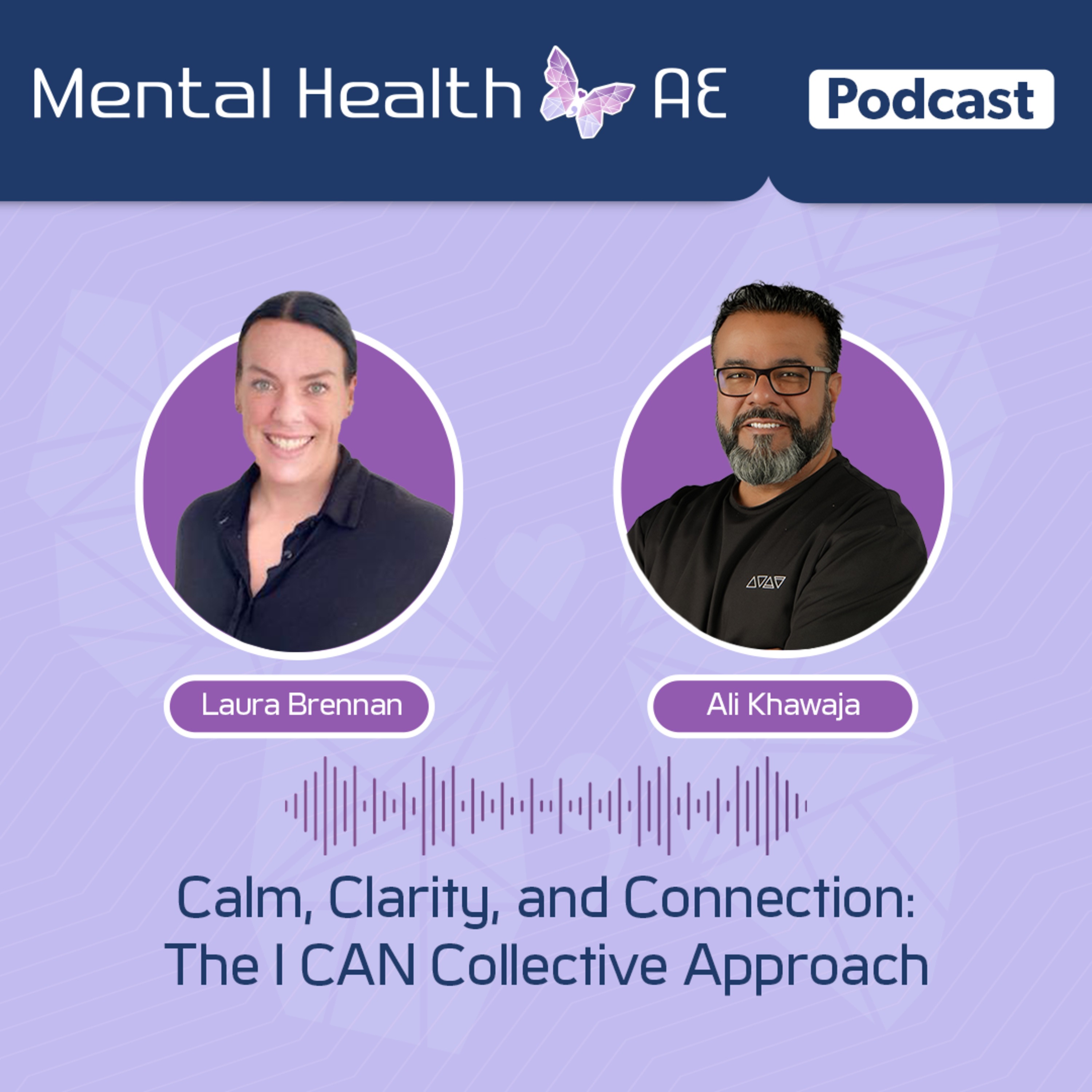
S04E03 – Calm, Clarity, and Connection: The ICAN Collective Approach – Laura Brennan

MHAE is a UAE based mental health and wellness initiative, with the aim to create awareness and provide a safe space as well as access to information and resources. Follow us on our Instagram and check out our website.
https://mentalhealth.ae/
https://www.instagram.com/mentalhealthae/
In this episode, Ali Khawaja is joined by Laura Brennan, a family wellbeing and behavior specialist and founder of the ICAN Collective, to discuss a systems-based approach to calm, clarity, and connection in children, families, and schools.
Laura shares her extensive international journey across education, therapeutic settings, and family environments in the UK, Japan, Australia, the US, and the UAE. Through this work, she observed a common global issue: children’s behavior is widely misunderstood, and responsibility is often misplaced on the child rather than on the environments surrounding them. Her experience working across education, therapy, movement, and family systems shaped her holistic perspective.
The conversation explores the structural challenges within education and mental health systems, including overdiagnosis, lack of communication between schools, families, and service providers, and the pressure placed on children to adapt to systems not designed for them. Laura emphasizes the importance of early intervention, environmental awareness, and consistent strategies across home, school, and community.
Ali and Laura discuss cultural dynamics in the UAE, the role of caregivers, stigma around mental health, and the risks of waiting until crisis points before seeking support. Laura introduces the ICAN Collective as a collaborative model that empowers parents, supports schools, and connects professionals to create aligned, child-centered solutions.
The episode concludes with a focus on connection, advocacy, and collective responsibility. Both speakers highlight that meaningful change requires shared language, early action, and collaboration across all stakeholders to build healthier systems for children and families.
#FamilyWellbeing #ChildMentalHealth #Neurodiversity #Inclusion #EducationReform #EarlyIntervention #ParentingSupport #MentalHealthAdvocacy #CommunityCare
Podcasters-
https://www.instagram.com/talktokhawaja/
https://www.instagram.com/ican.collective.family/
MHAE Website | https://www.mentalhealth.ae
MHAE Instagram | https://www.instagram.com/mentalhealthae








Summary
In this episode, Ali Khawaja is joined by Laura Brennan, a family wellbeing and behavior specialist and founder of the ICAN Collective, to discuss a systems-based approach to calm, clarity, and connection in children, families, and schools.
Laura shares her extensive international journey across education, therapeutic settings, and family environments in the UK, Japan, Australia, the US, and the UAE. Through this work, she observed a common global issue: children’s behavior is widely misunderstood, and responsibility is often misplaced on the child rather than on the environments surrounding them. Her experience working across education, therapy, movement, and family systems shaped her holistic perspective.
The conversation explores the structural challenges within education and mental health systems, including overdiagnosis, lack of communication between schools, families, and service providers, and the pressure placed on children to adapt to systems not designed for them. Laura emphasizes the importance of early intervention, environmental awareness, and consistent strategies across home, school, and community.
Ali and Laura discuss cultural dynamics in the UAE, the role of caregivers, stigma around mental health, and the risks of waiting until crisis points before seeking support. Laura introduces the ICAN Collective as a collaborative model that empowers parents, supports schools, and connects professionals to create aligned, child-centered solutions.
The episode concludes with a focus on connection, advocacy, and collective responsibility. Both speakers highlight that meaningful change requires shared language, early action, and collaboration across all stakeholders to build healthier systems for children and families.
#FamilyWellbeing #ChildMentalHealth #Neurodiversity #Inclusion #EducationReform #EarlyIntervention #ParentingSupport #MentalHealthAdvocacy #CommunityCare
Podcasters-
Ali Khawaja | https://alikhawaja.com
Laura Brennan | https://www.instagram.com/ican.collective.family/
MHAE Website | https://www.mentalhealth.ae
MHAE Instagram | https://www.instagram.com/mentalhealthae
Outline
0:00 – Episode introduction & context
– Ali welcomes listeners and introduces the focus on coaching and wellbeing
– Setting the stage for calm, clarity, and connection
0:52 – Meet Laura Brennan
– Family wellbeing and behavior specialist based in Dubai
– International work across education, therapy, and family systems
1:19 – Laura’s global professional journey
– Experience in the UK, Japan, Australia, the US, and the UAE
– Learning how systems impact children with complex needs
7:32 – Behavior, education, and systemic gaps
– Why schools struggle with neurodiversity and behavior
– Factory-model education vs individual needs
14:18 – Inclusion, culture, and communication breakdowns
– Cultural differences and mixed-family dynamics in the UAE
– Lack of alignment between schools, families, and caregivers
19:26 – Overdiagnosis and environmental factors
– Why not all behavior issues require labels or diagnoses
– The importance of context, environment, and adult responses
25:37 – Burnout across education and mental health systems
– Pressure on teachers, therapists, and families
– Commercialization and system-wide failures
33:37 – Introducing the ICAN Collective
– A collaborative model for families, schools, and professionals
– Advocacy, empowerment, and early intervention
38:53 – Why collective action matters
– Long-term planning vs crisis management
– Building shared language and aligned systems
45:55 – Where to find Laura and ICAN Collective
– Website, Instagram, and ways to engage
– Closing reflections on connection and impact
Transcript
Ali 0:00
Foreign. Welcome back everybody. Yes, I have managed to get more than one episode of this season. Yes, again, my, my ever so humble apologies for dropping the ball last season but as I mentioned before, I was, you know, on a side quest with, with Shimmer. I love the platform. I love it for anybody adhd, go check out Shimmer Care. I believe they’re fantastic. They’re absolutely fantastic. The profile of coaches that they have are amazing. Talking about coaches and talking of bringing things full circle, I have an absolutely wonderful guest today in my tiny little studio. We’re working on expanding. I’m going to let her introduce herself and then we’ll just kind of get into the swing of things.
Laura 0:52
Hi everybody. I am Laura and I am a family wellbeing and behavior specialist in, based in Dubai, but I work internationally and I have been fortunate enough to be invited on onto this show today. Very excited.
Ali 1:10
Well, thank you very much for being here. I appreciate it. Laura, before we get into what you’re currently working on, give me a little background. How did you get to where you are?
Laura 1:19
Okay, so I have come from a bit of a, an all over the place person platform. I started in education about fifth, no, over 15 years ago working in your in the UK, what’s called a pupil referral unit, which is kind of a school system for children who are struggling in mainstream schools and they get kicked out of school and this is where they end up with the promises that they’re going to go back into a different mainstream school somewhere. That’s not always the case. So it’s a lot of different dynamics of children who have a lot of needs and they’re struggling and the academic system doesn’t work for them. And then from there I’ve trained up into being a teacher and into leadership in quite a unique education system called an independent therapeutic school system. Which is the next stage is beyond the pupil referral units for children who are very high risk and have extremely complex needs. And they are, they need a lot of support and a lot of care. So that, that’s where I primarily spent most of my career in teaching. I was fortunate enough to become leader in those schools. I’ve worked in running them. It’s been very interesting dynamics just how the education system doesn’t fit those children. And then alongside that there’s been therapists on site. So you’ve had your occupational therapist, your speech therapist, music or you name it, it’s been there. And part of the non negotiable of those sites was that the educators had to understand what therapists do and the purpose of therapy and the therapists had to understand the education side and what that was. Everybody had to understand each other to work seamlessly to support the children and their needs. So I’ve been very fortunate where I’ve had educational experience, but I’ve also learned the therapy side of things and the importance of that just as much as what goes on from a day to day of curriculum expectations. And it’s, it’s really changed my whole mindset and the way that I view educators and also children and what goes on for them. From the UK I went to Japan. I worked as a English as a second language teacher in schools that didn’t speak English. So I didn’t speak Japanese, they didn’t speak English, but I had to teach them. So again, I learned a lot from kind of just how body language is extremely important in communicating and how important play is in learning because I can’t stand here and give you an instruction. You have no idea what’s going on. From there I went to Australia, I worked in Australia. I actually ended up in the fitness side in Australia in swimming where I learned more about neurodiversity in the water and how again, the systems in Australia are very different to the systems in the UK around teaching swimming. And I was a nanny as well. I live in nanny. So different dynamics again, this one was more in person or in the family home itself and seeing the dynamics of what goes on on the ground. So so far we’ve kind of had the in school experience, the movement experience and the family experience. I worked in America within a city, children, that was the next step. I love to move around, I love to experience different cultures, I love to, to see how different people manage day to day life. I worked in America with inner city children again from the fitness movement side of things. And again that was very interesting to see how funding and support and the needs were very different culturally to that of Japan, Australia and the uk. And then from there I have finally arrived to the UAE where I’ve worked in government schools with Emirati children only. And then I’ve worked in private schools with different cultures and different dynamics. And again that’s brought a whole different perspective for me from a mental health, a cultural and an understanding perspective. I think from families through to children through to educators. And I think the one thing I’ve learned through moving around so much is that behavior worldwide is a huge. It’s a problem is the bottom line. It’s a problem and it’s very, very misunderstood. You know Everybody’s talking about whose fault it is, where it’s coming from, and the child always seems to be the person that ends up carrying the burden and the family ends up carrying the burden and people are afraid of it. When you talk about it, it’s not, it’s not for me. You go speak to inclusion, you go to speak to the counselor, and no one wants to actually deal with it head on. And it’s become something of a massive interest to me as I’ve traveled around the world and I’ve seen how different cultures deal with it. I see the impacts that it has and also understanding kind of where it’s come from and unpicking it. I’ve learned a lot myself in terms of how I reflect, I think in situations and how I work with situations and my own mannerisms. But I’m also learning to look at individuals very differently as well, particularly children that struggle a lot. And that’s. Yeah, that’s kind of now how I do what I do. I realize there’s a lot of support needed out here and not many people want to delve into that world of behavior or address family well being and the impacts that that has on the families that have to carry that every day. So here I am.
Ali 7:32
Well, thank you very much. I think it’s amazing that you come with such a vast and diverse experience and I think that’s what really adds value. And I remember when I was even going through the documentation when I was kind of shortlisting guests and I was like, I definitely have to have her. I need to have her across the table. We need to have a conversation. And you know, as my listeners and even my students and all my friends know, I have a lot of complaints, you know, being in education my entire life. I’m 20 plus years in higher education. And I was just saying this on a previous podcast also that it’s very weird. I work in the fountain of youth where I’m the only one who gets old. My students are always 18 to 22, always. As soon as they cross that, they graduate and leave. And I have new students rolling in every semester. I’m the only person who gets old in my job. It’s very surreal, but my complaint has always been towards education as a whole. And it’s not a single point of fault. It’s an overall system fault. It’s because we need to, or at least we believe we need to be able to educate masses in a bulk factory type of setting, which takes away from individuality, it takes away from the personality of every student. It takes away from so many things. And once you kind of sprinkle neurodivergence on top of that, now you hit a wall. These schools and educational institutions globally are barely keeping up with just getting the kids educated to get them competitive enough so they can survive life. And that’s become more and more of a struggle day to day. We’re seeing the job market getting smaller, we’re seeing hyper competition coming up. Even if you go back without getting into too many specifics, but if you look at so much of the material and curriculum that high school students are required to cover, and you’re like, why so much of this is either irrelevant or too advanced. And then you realize, well, it’s in order to adjust that distribution curve of grades so we have a fixed number that can get into the elite schools and then so on and so forth. So I’m in disagreement with the whole model. I unfortunately don’t have a one stop solution for it just yet. But it needs to be addressed. It needs to be addressed in a lot of different ways. And one of the areas that I think that definitely in my mind is low hanging fruit, because it can be addressed, but there is a lot to do. There is exactly the area that you’re working in. My mom was very, very involved with me as a kid. You know, she, she wanted to know what my homework was, what I was learning, was I having fun, what was going on. My dad was the exact opposite. He’s never seen a report card in his whole life. His philosophy on my education is, it’s your life, do what you want. You want to stay in school, stay in school. You don’t want to stay in school, don’t stay in school. I remember one time my mom says, listen, you can be anything you want. You want to be a farmer, go be a farmer. There is no, there is no job that is not respectable as long as you do it right. But if you’re going to be a farmer, you still need to get a university degree, then you can go be a farmer. She was kind of funny like that. I was like, okay, well, I’ll work on that. But my dad was completely the opposite end of that spectrum. And he’s like, no, not you. Do you. My job is to make sure there’s a roof, there’s food, and you know, the bills are paid. And whichever college school you want to go to, you know, I’ll cough up the tuition and, you know, let me be. I think both worked. I had freedom and I wasn’t Too kind of umbrella parenthood. But at the same time, I had accountability, which. Which was from my mom’s side of stuff. And I think I was very fortunate in that mix. But once I got to university, as in working at university and teaching, and I would work with a lot of students, I work with advising also about, you know, which majors to take, what courses to take, you would see young minds completely lost. Completely lost. And this is a young person who is not particularly, let’s say, struggling with dyslexia or ADHD or any of the neurodivergent side of things, you know, and as soon as you throw that in, this world is not designed for them. The systems are not built for them. And I think it’s only been relatively recent that it has gained popularity in the UAE. This whole inclusion thing. I remember my kids are 20 and 18 now, you know, so when they were little, there was nothing called inclusion or department or division or teacher or inclusion person. Like, what do you mean, inclusion, everybody? What. What is that? I literally didn’t know the term. I think I caught onto it post Covid, and that was because other parents were talking something. Oh, yeah, yeah, we have something, something inclusion. I’m like, excuse me, bro, what’s this? You don’t know what this is? No. Tell me what this inclusion thing is. And then explained it to me. I was like, oh. In my head, I’m like, finally, finally, we’re catching up. I’m not saying it wasn’t there. It was very, very few and far between. And definitely those gaps are now starting to get filled in. But now we’re starting to uncover a lot of the family dynamics, you know, and we have that saying, it takes a village. Well, the village is everybody. It’s the family. It’s the brothers, the sisters, the mom, the dads, your friends, your neighbors, everyone at school. And we’ve always kind of also seen that the family tends to disconnect in a lot of places, and they, in essence, pass the buck that, well, teaching is a school problem, not a me problem. And then within the school, everyone also passes a buck. Well, my job description said teach geography. You know, if the kid is struggling ever so politely, not my problem, it should be somebody else’s problem. I used to. Early, early days, I used to kind of blame them. Then I realized they don’t have the training to be able to handle it. They only have training for a, B and C, and they can only do a, B and C. And it’s. If anything, it’s wrong for them to do something that they’re not trained in. So there’s gaps on all sides. On all sides. So part of why I wanted you to come here is to talk to me about, you know, the holistic kind of approach, what’s going on in its entirety, and then we can kind of go layer by layer and drill in a little bit.
Laura 14:18
I mean, it’s, it’s a huge umbrella in itself. I mean, inclusion means including, which is everybody. So technically, whether you have a diagnosis or not, everybody is still under that umbrella. So one thing I find quite difficult from a department perspective in schools is this inclusion department exists, which means that they deal with it. And actually something I’m trying really hard to work with schools on is this whole thing of they’re there to support you with implementing it across the whole system. And I think it comes from, obviously there’s, especially in the UAE and around the Middle east, the cultural differences is huge. In Dubai you have so many different cultures where the standard norms at home, back from wherever home is, can vary vastly from, from one country to another. So finding a platform where everybody is speaking the same language within the school systems, particularly in Dubai, that in itself is, is a challenge because you’re bringing so much different knowledge. And then from that you have families again culturally, particularly now in Dubai, you’re getting a lot of mixed culture families. So not only do you have kind of your, your locals who have been here for a long time and have been taught a certain way of dealing things, the, the confidentiality, the community, the, the privacy that goes around that as well. And then on the flip side, you have Westerners who are coming in, you have Americans who are told you should have a therapist for everything. And again, you’ve got the complete different extremes in terms of how we talk about things and how we don’t talk about things and the taboos and the non taboos, so you have those dynamics before you even add in or split things up from a family side, a school side, a therapist side. And then another thing that I’m noticing as well is because people are struggling to kind of, schools are struggling to find the, the dynamics in terms of who is responsible for what, because unlike some countries like the uk, where you have your mainstream scores, then you have your specialist schools for children that are struggling, then you have your more unique, specific schools for your higher risk children, and then you have your special schools for those who are physically not able to access. Here everybody kind of gets put into the same system, which again, teachers are not specialized in. Whereas in the uk you would get those specialized depending on the provisions that are relevant for them. So already you have mainstream schools here that are told, teach a class of 30 children, but your 30 children come from every different background you can imagine. They carry every single different need that you might imagine. Some you will see, some you will not. Some you may think you know, some you have no idea about. Some don’t exist yet in terms of the. The medical world that we live in. But you have to teach them this curriculum. This is your deadline for teaching it. And if you don’t teach it and you don’t get the grades and you don’t figure it out, you are the one as the educator that we questioned as to whether or not you’re good enough at your job and whether or not we should continue with your placement here. So that’s the pressure that goes on there, which then obviously feeds into the mental health of the staffing systems. You have the mental health of the parents who are struggling. You have parents who travel a lot. So you’re adding in dynamics of other caregivers from different backgrounds. You know, in the uae, nannies are a big dynamic. You have your chefs, your drivers, your. You add those into the family mix as well. So not only have you got the way the parents want them raised, you have nannies who spend significant amounts of time with these children who may or may not have the same boundaries and expectations as the parents. You then have drivers who, again, work with the nannies, who work with the parents, and you see different personalities with the same child. You’ll see when mum and dad come in to a meeting, how they behave versus how they behave with the nanny versus how they behave with the driver. And then no one understands why these behaviors are so different. But then you look at the way each person is talking and communicating and the expectations and all the rest of it, you. It makes sense why they’re running circles around people. And then schools are holding parents accountable. Like you said, parents are holding schools accountable. People are then throwing children into the system of getting diagnosis and assessments. I have actually spoken to a few therapy centers out here. I’m not going to name names, but one of the questions I do ask them is, how long are your programs for children? How long do you expect a child with XYZ to be here? Because the idea is, is that it shouldn’t be forever. They stay.
Ali 19:26
Well, yeah, they stay because it’s. Oh.
Laura 19:29
And then I have another question, which is, if a child comes to you for an assessment, but they don’t meet the criteria for a diagnosis, what do you do? And they say, well, we’ve never turned a child away. And again, those alarm bells for me go off. Because if a child is coming through your door, not every child that has a behavior or is showing a certain behavior actually has a diagnosis or a need. It could be that the environment at home has changed, or it could be something traumatic has happened to them and they’re dealing with that. And again, my concern is, is that, and again, this is probably why I do what I do is that everybody at the moment seems to be putting everybody in this boat of, oh, it’s a diagnosis, they need an assessment, they need therapy. When actually. Have you considered the environmental factors that these children are going through? Have you considered any experiences that these children might have gone through that could have put them where they are? Have you thought about it? How do the adults interact with them? Are the adults the trigger? Are the adults the problem? Is the learning environment accessible? Is the curriculum accessible? Are teachers? And there’s so nobody seems to put it back on that whole self reflection or what can we do about it. It’s very much the child is the problem. The child has an issue, they now need to go and deal with it over here. And I don’t agree with that. I don’t agree with that. I don’t actually agree that having a piece of paper that says this child has autism or this child has dyslexia actually changes anything for that child. Yes, it gives strategies and helps the educators understand it better. But actually, in theory, if people are on the same page and implementing a series of strategies across the board, everybody thrives through that. It’s not a case of, oh, we need to do this for this one child and this for this one child. And then we still need to teach a class of 30. No. I have seen some of the best educators that implement every strategy in the sun for their whole class. And that class is one of the happiest, most comfortable, thriving classes you will see. But a lot of people have it in their heads, oh, well, then I need to do completely separate for this child. And I need to do completely. And Now I have 20 different separate things to know. Doesn’t work.
Ali 21:50
You touched up on a lot of very interesting things and very important factors. The disconnect on how kids are being raised these days is absolutely ridiculous. And you’re 100% right. The child with their parents is different than with the nanny, is different with, you know, their friends network is different than at school is different. Shouldn’t be the case. You know, this is, this is just lack of. If this was a business situation or if this was a company that I would walk into that I’m consulting or advising. I’d say you guys have terrible communication. How do you not know what each other is doing? You have one directive. How are you lost on this? It doesn’t make sense, but that’s the reality of what’s going on. So it’s a constant compounding effect. We’re seeing, as you rightfully said, we’re seeing people come from different cultures, different countries, different biases, different stigmas, different. All of that. Different expectations of performance. And the systems are either they’re designed, everybody falls under the same umbrella, or everyone needs to be special and we don’t know what to do. Go get a shadow teacher and then let the shadow teacher deal with the gap. And it’s ridiculous.
Laura 23:04
And, well, that’s another thing in itself. Is this the shadow teachers is. Is. Does that child action. And there’s so much around that one, particularly for older children, mental health and socially, that has such a negative impact on them and their identity and who they’re becoming. But also parents already paying a lot of fees for children to go into schools. And you’ve now turned around and said they need to pay for another adult. Because we as a school don’t have the time or the staff to be able to understand what your child needs. So therefore we, we want you to pay for someone to follow them around all day. And don’t get me wrong, there’s some incredible staff, but their knowledge is, is. Is no different to that of the schools. But you’re expecting these people to work with children who have, that they have significant needs that do need addressing. What are they doing?
Ali 24:04
Systems? Most systems are broken in different ways. You know, I, I keep talking to, well, a lot of people, but I definitely, I’m always actively in touch with teachers and educators. We hear kind of the same thing. We’re underpaid, we’re overworked, we’re not properly trained. We just kind of said, make sure you get these number of hours every year. And then we go to whatever is the cheapest place that gives us those hours. You know, take a nap, have two coffees, get the certificate of attendance to get those, those hours and whatnot clocked in. I’m like, this doesn’t work, guys. And then you talk to school administrators and they’re like, oh, yeah, budget’s tight, budget’s tight, budget’s tight. But end of year, oh, this many Hundreds of millions in profit. And I’m like, huh, I’ll see what happened here. So, you know, this, this hyper commercialization of education, this is bad. And, but then again, you mentioned earlier, this hyper commercialization of the medical industry, also bad. You know, why do they not turn kids away? Because kids are billable. And, you know, a kid is never going to be in a situation to say, oh, I don’t think I need help anymore. They’re going to trust the service provider to say, okay, yeah, this kid doesn’t need our help anymore. Well, who’s going to turn a kid away? That’s unlimited billing forever. That parents only stop when they’re like, we can’t afford it anymore. So, so there’s systematic failures across the board. So now, now I want to now, now that we’ve kind of dumped on.
Laura 25:37
Everything, go to those people that are doing amazing. And there are like, there. There are 100%, but not everybody is there yet.
Ali 25:44
There’s. There’s a lot of amazing people. There’s a lot of amazing institutions. There’s a lot of awesome work being done. But sadly, they get. They get left out in the noise. And it’s very hard. A big part of what, you know, I do as part of mental health AE is replying to messages and DMs about, can you refer somebody good for this, this or that? And then in my head, I’m like, there’s a, you know, post Covid a lot of these service providers, these Googles, the search abilities, the directories listings, they’ve all popped up, but people are still trying to figure out who the good people are in this noise. So a lot of the stuff that I’m doing is just making connections. I say, yeah, yeah, you know what? Actually, I have somebody who is good for this. Let me make an introduction, and then I’m out. Just, just a couple of weeks ago, I had a mom reach out. Her son is potentially on the spectrum. She’s not sure. She doesn’t want to go to any of the mainstream, you know, hospitals and whatnot to get an assessment because she’s worried about, you know, they’re just gonna.
Laura 26:52
Rope me in and the label that goes with it.
Ali 26:54
Yeah, bill me to death, and then I’m gonna be stuck with this. Can I get it done with somebody that you trust? I didn’t know anybody directly. I said, but give me a minute. I reached out to some people I know in the industry. I said, listen, this is the situation. This is the mom. Here’s the text that she Sent. I have permission to share. Do you know somebody you trust? You know, and then that’s literally my opening line. Do you know somebody you trust? And then I’ll explain it. And then, you know, people come back and say, sorry, man, don’t have anybody in this. Or, hey, I actually have somebody who I think would be really good. I’d be like, thank you. Here’s the contact. Now you carry on. So there’s, There are. So. I know we dubbed on it a lot, but there are a lot of great people operating, but the system still don’t support them.
Laura 27:37
And a lot of people leave eventually because that burnout, because they are carrying the weight of so many people. And the job that they do is amazing that, like you said, people come to them, they’re overloaded, the expectations are huge. They have families, they have things going on in their life. Their time then gets spent engrossed in work. So their families then suffer and then we’re back into that cycle again of you’re helping other people’s families, but what’s going on with yours or what’s going on with you and your mental health when you’re trying to hold everybody else’s up? Like, it’s. That in itself is a whole.
Ali 28:11
No, and I’m, I’m guilty of this. I’ve reached out to some amazing people and I’m kind of like, listen, so and so, person needs support, they need help. You’re the right person. And I’d hear a. I hear a sigh and I’m like, I know you’re already, you know, overbooked, overworked over everything, but. And I, I know it’s wrong, but I will still be of like, listen, I really appreciate it if you could just make space for just one more. But the problem is it’s never just one more. It’s many, many one mores. And yes, it takes a toll. It takes a toll.
Laura 28:47
That’s why you have to love what you do, I think, as well. And you can see that as well. A lot of people, again, particularly out here, they come out here because of the lifestyle that’s sold on social media. And going into the education system is one of the easiest ways. And the packages are very nice. And again, are you doing it for the right reasons of understanding the needs? And there are some schools that they’re very hot on that with their recruitment, and there are some that are a tick box for fee purposes, as we’ve said before. So.
Ali 29:18
Yeah, well, I think we can safely conclude that there’s a lot of work that needs to be done across a lot of different variables and a lot of different stakeholders. And I always, you know, kind of double down on the parental involvement. Again, not comparing to any industry average or global whatever. I just think parental involvement needs to be significantly more active and not passive, and it needs to be more advisory than, you know, telling. And this is again, from my mom, and one of the things she told me when, you know, I was expecting my first, first. First kid 20 some years ago, and I was like, mom, I don’t know how to be a dad. And her answer was, well, from your parents and your friend’s parents, do what you thought was good and don’t do what you thought was not good. And I’m like, that’s it. She goes, yeah. And then. Then the next thing she said was, you need to be involved in your children’s life. You need to be actively involved. You hear that in passing. You’re like, yeah, sure, thumbs up, I’ll do it. But in that moment, I was like, no, no, no. There needs to be like a guidebook for. I’ve gone through 13 different books right now about parenting. But no, no, no, I need to understand from you. And she said something. She said, look, when you were very young, I was your parent. I was telling you, do this, don’t do this. Then as you got older, that transition from parent to parent friend, and that transition from confidant and friend, and that transition to advisor. And she goes, now we are at a stage where I am not your advisor anymore, but you are my advisor because you understand more of the world than I do. And I was in my mid-20s at the time, and I was like, oh, this is interesting. So I applied the same philosophy with my kids.
Laura 31:10
But you know what’s interesting off the back of that? And again, something I see a lot of with the families that I work with is. And even myself for my own kind of healing journey that I’ve been on is. Is generational trauma is a real thing. And learning from what your parents did or didn’t do, obviously that’s the only way you know how. But a lot of that that’s passed down to you is it’s that projection of the only way we know how and the impacts that that has in terms of then how we parent and what we think is best based on how we were raised and the impacts that then has on behaviors, on learning, on how we see ourselves and who we grow in to be, unless we consciously make that choice to break that cycle and go do you know what?
Ali 32:00
It’s a lot of work.
Laura 32:01
Yeah, It’s. It never. But it’s. It’s, you know, it’s been like, what comes first, the chicken or the egg, you know, and you love your parents dearly for what they did, but it’s like, I don’t know. I don’t think that was the right thing to do, and I need to change that.
Ali 32:14
Yeah, well, it’s. It’s. It’s part of growing up, you know, and. And there’s a lot of parents who will hold their kids under their thumb and constant control their entire adulthood. And I’m like, oh, guys, this is just the wrong way anyhow. This is a whole separate sep.
Laura 32:28
Sorry.
Ali 32:29
Separate, Separate, separate discussion that we can definitely get into. So now I want to kind of get back to, you know, we’ve discussed what’s been going on. We definitely agree on. There’s a huge amount of work that needs to be done. And I remember early days when we started Mental Health ae my co founder, Latifah, she asked me, she goes, ali, it’s just two of us. What real impact can we do? We don’t even have any money. And I said. I told her, exactly. Again, thank you, mom, for all the great advice over the years. And I told Latifah, I’m Latifah. If everyone does a little bit, that adds up to a whole lot of bit. So how about we do what we do, and if because of us, even one person is in a little bit of a better place, mission accomplished, right? And if there’s two and three and four, and those two, three, four, further help somebody else. I said, you need to think of it as ripples. So I’m gonna. I’m gonna throw the rock in the pond, and I’m not gonna count the ripples, but I’m gonna know that they’re there. So tell me about your ripples. Tell me about what you’ve been doing. Tell me about what you’ve put together now.
Laura 33:37
Okay, So I think, and I obviously don’t want to say it and be wrong, but I think what I am doing is the first of its kind in the uae. But again, in terms of. The company name is I can Collective. In terms of. It has to be done collectively. Like, there’s no way that as a standalone, I can do this on my own. So, you know, I’ve been. I’ve been speaking to therapy centers, I’ve been speaking to schools, I’ve been speaking to educators, I’ve been speaking to Parents, I’ve, you know, trying to figure out where the need is and how I bring people together. Kind of being an advocate for people. So parents in particular, their voice and knowing what to ask schools, knowing what to say to therapy centers, knowing what to ask for in general with their child and where to push back and say, actually no, this is you and this is me. And helping them understand how that works from an empowerment perspective. Working with schools around, you know, again, empowering them in understanding and feeling confident when dealing with behaviors. One of the big things I realize as well is that everybody waits until it’s a crisis point. Oh my goodness. This child is currently hanging off the school. This is the, the sixth month that it’s happened. We need help. And I’m like, this didn’t just happen overnight. There have been signs. Why have you not picked up on this before? And again, like you mentioned on before, that accountability in terms of. People have been telling you when you unpick in schools, there’s always a member of staff that has identified this early on and said something to leadership or to their line manager or whoever that is. But it’s been a case of, oh, there’s no blood, there’s no danger, we don’t have to call the police, it’s fine. And then, and then, you know, it starts to build and build and build and then before you know it, there’s chaos is happening and then that’s when there’s a problem and then that’s when the parents get called in and then that’s when the kid gets excluded or there’s a plan. And, but again, it’s, it’s helping people understand and identify the earlier interventions. Schools need a lot of support around identifying early on the behavioral side, not the necessarily need or diagnosis. I hear a lot of stuff. Oh yeah, he’s got, he’s got autism. Where’s his papers? Oh, no. But his behaviors are. You can’t diagnose someone. Like there’s so many overlaps. Empowering scores, encouraging people to ask me questions, I think is a big one as well. Like it’s not just me going in and saying, do X, Y and Z. You need to challenge me and be like, well, why are you doing what you do? What’s the benefit of this for me? How does this help me? Where does it go? What’s the longer impact? Because ultimately this isn’t a short term fix. The whole purpose is, is that it’s a whole systematic approach. You need the government policies, you need the school systems and staffing in place you need the parents to understand what’s going on. Like, everybody needs to speak the same language, but that language has to be broken down so much that no different to a classroom where you’re differentiating or scaffolding. That’s exactly the same approach you need to be taking with the community, with the. The government engine. Like, everybody needs to speak the same language. And at the moment, people aren’t people. Whether that’s because they can’t access that language and they don’t know about it, or whether it’s because it’s a language that’s what is this unfamiliar, or I don’t want to hear it, or the doors get. It’s opening those doors. But to do that, you have to talk about it. If you don’t talk about it, no one’s going to listen, no one’s going to know any different. And don’t get me wrong, I’ve had doors closed on my face where they’re like, we’re not opening that door. And guess what? I’m going to come back and I’m going to knock on your door again and I’m going to keep doing it until you listen, because I don’t think people understand, especially again. Dubai is a very new country. It’s very safe, it’s very, you know, everything right now is under control, but the rate in which it’s growing and the diverse range of people it’s bringing in right now in the immediate is under control, but we’re not thinking immediate. You have to plan ahead. And if those interventions are not put in place now and those systems are not supported and fully unified, if we’re not all on the same page further down the line, what’s to say that we’re not going to end up in a situation like the UK with gun and life crime, like America, where the judicial system is filled to the brim and we’re literally fighting fires, like, Dubai is the perfect place, the uae, the Middle east, right now is the perfect place in the perfect time to really get that in place and sink the teeth in. And I know next year is the year of the Family and I know Abu Dhabi are doing incredible things from an early intervention perspective for children. Like there are things happening, but I just don’t feel that people are talking loud enough about it. So people are aware. Unless you dig and you ask your chat GTP or you ask your Google or you know what to ask for, you don’t know about it. And I think it needs to be, you know, you need to be Singing about it. Because people, parents need to know it’s coming, that support’s coming. Schools need to know. Yes, they’re listening, like, but right now I feel like people don’t feel like they’re being listened to. And I think that’s a big worry. Same with children. Children don’t feel listened to. Well, guess what? You’re going to get.
Ali 38:53
No, no, you’re. I agree with you 100%. You know, I originally came here January of 1999, for six months. I haven’t left. I haven’t left. And, you know, I have a lot of my friends all around the world and, you know, every now and then it pops up, well, why are you still there? I’m like, honestly, I can’t think of a better place to. A place to raise my kids. You know, we’ve got safety, we’ve got security, we’ve got law and order. And the, the biggest thing. And you know, being here, you know, well, over two decades, we have growth, we have mountains of growth. And the amazing thing is the support that kicks in at the government, well, all levels, but especially at the governmental level, you know, they don’t just, they’re not going to announce, oh, this is the whatever headline and just some fluff. No, there’s action behind it. There’s people being activated behind it. And when we talk about innovation in corporate and trying to create an environment and an ecosystem that fosters innovation, there has to be the ability to take risk. There has to be the ability to fall and get back up. And I’ve seen this across the country. So we’ve launched an agenda for the 2026. It’s about family. I love it. Yeah, I love it because I know it’s not just marketing. I love it because there’s going to be action. I love it because people and organizations like yours and mine are now going to further push and further leverage the cause. And I like it. So, but let me, let me come back to your organization. So how can people engage you or how do you engage? Like, what’s the system? What’s the modality of how things work.
Laura 40:35
In terms of a system? Right now, it’s basically me coming at you like if, if you work with children or you are involved in, with children’s lives, I am at some point going to be in your inbox and you’re popping up on your phone screen. I’m reaching out to people because people need to know that I’m here again. Me sitting around expecting people to be like, oh, let me Google and See if it’s not gonna happen. So I’m, I’m present, I’m, you know, I’m around. I do a lot for schools in terms of workshops and free, free parent support. I do a lot for families reaching out. It’s, it’s strange actually out here. Again, it’s, it’s very much about word of mouth. Like you could put all the marketing out in the world but if people don’t know you and they don’t know who you are as a person, they don’t want to know. But I love that because then that really does show that you care, if you care. And people are very good at reading on things. So yeah, it’s being present at events, it’s just talking to people. It’s still very new. It’s, I came out of education in March, I Can Collective was born in August. It is still very new. So it’s just for now it’s, it’s just, it’s just talking and just saying, hey, I’m here and if you want to know more, come and ask me. And if I can tell you more without you asking, I will also do that too. But I’ve, I’ve. In that time I think I’ve made already over 40 partnerships who understand what’s going on in different areas, different fields. Fields that I didn’t even know existed until I started digging around and, and finding what’s going on. But something that kind of does underline everything in terms of all the different organizations and communities is regardless as to what’s going on, on the surface, everybody’s intentions are the same. Oh, the intentions are always about the child. It’s just knowing what to do, what to do with those intentions and how to do it. And again, fortunately in the uk, the system of like, like you have the, what’s called MASH teams or the team around child teams in the UK which involve, you know, the social services, schools, any other external agencies involved and the parents. And that’s a non negotiable that is there. And that’s something very similar model wise that I’m trying to bring. But to do that again, I have to initiate that because people are not going to come to me. I need you there, I need a therapist there, the parent there. Everybody needs to be in the same room to know what to do for this little boy or this girl or whoever it is. But at the moment you’re talking one language, you’re told no one’s coming together. So I will, yeah, I like to talk to people at the moment, it’s good.
Ali 43:23
No, but what you said is 100, 100 accurate. You know, and as I said earlier, also, a lot of what I do with my platform is connecting people. Actually, quite honestly, probably 80, 90% of what I do is connecting people. Everything that you see is small.
Laura 43:40
Yeah.
Ali 43:40
You know, whether it’s the podcast or we’re doing some event or we’re doing some support group or whatever it is that honestly is maybe only 10, 15% of my time. The rest of it is I’m just connecting somebody to somebody. And the word of mouth is huge in, in this part of the world especially, and in UAE especially because we have a constant influx and, and very high turnover of various service providers, you know, across the platform. You don’t want to walk into the door to somebody new. And you know, I always give the example of my dentist, Noora. Well, I, I don’t know if I should because she’s going to be angry with me because I was supposed to see her a year ago and I’ve been ditching. But no, no, I love her. She’s fantastic. And it was literally one of those things that I was just kind of walking around, I saw a roller poster and said, dental checkup. And in my head I’m like, well, I haven’t gone in I don’t know how many years. Let me just do a checkup and see how bad the situation is. Because, you know, nobody likes to go to the dentist. And I just happened to walk into her clinic and oh my God, she is such a talker. I love it because now she’s explaining to me what’s going on, she’s telling me what this is. And I’m not getting yelled at. I’m not getting, you know, I’m, I’m being talked to really nicely. I’m being right, that’s the word.
Laura 44:57
You have to feel safe.
Ali 44:58
All of that made me surprisingly feel safe in that do dentist chair, which I’ve hated my entire life. And then, you know, I, after whatever was done, I left and I booked a follow up appointment for the treatments that I needed. And literally I texted on my family group. I’m like, guys, I found my new dentist. And then they’re like, who? And then my, my brother. Oh yeah, dude, I need to go. And then my, you know, other, oh, I need to go also. So, I mean, I’m not even counting referrals, but comfortably 30 to 50 people. Easy, easy. Yeah, because that, that word of mouth carries weight. So let’s definitely get the word out there. Let’s. Let’s push on. I’m. I’m aware of time. Let’s push on. More conversations. I’m so happy to have you.
Laura 45:43
Thank you for having me. I love this.
Ali 45:45
And, and now that I’ve got people listening, where can they find you? Drop me a little. What’s, what’s, what’s the links I’m looking for? What’s the website? What’s the instas. What’s the hand.
Laura 45:55
The website is. I can collective.com. the Instagram is at. I can Collective. Those are the best places to find me and what I do. Yeah.
Ali 46:08
Fantastic. I love it. I love it. This is really, really great. This has been fantastic. And you’ll see the links and guys, everything pops up somewhere. I don’t know where. They keep moving the menus around. Whichever platform you’re watching on or listening on, I’ll definitely have all the links available. This has been absolutely wonderful.
Laura 46:26
Thank you.
Ali 46:27
Great to have you here. And, and, and I know, guys, we spend a lot of time kind of hammering the, the, the issue, but the, the reality is that the issue exists and you need to have awareness and understanding before you can go towards building a solution. So hopefully we’re moving people towards building that solution and getting together.
Laura 46:47
I hope so.
Ali 46:47
Thank you so much.
Laura 46:48
Thank you.
Ali 46:49
This will be great.