
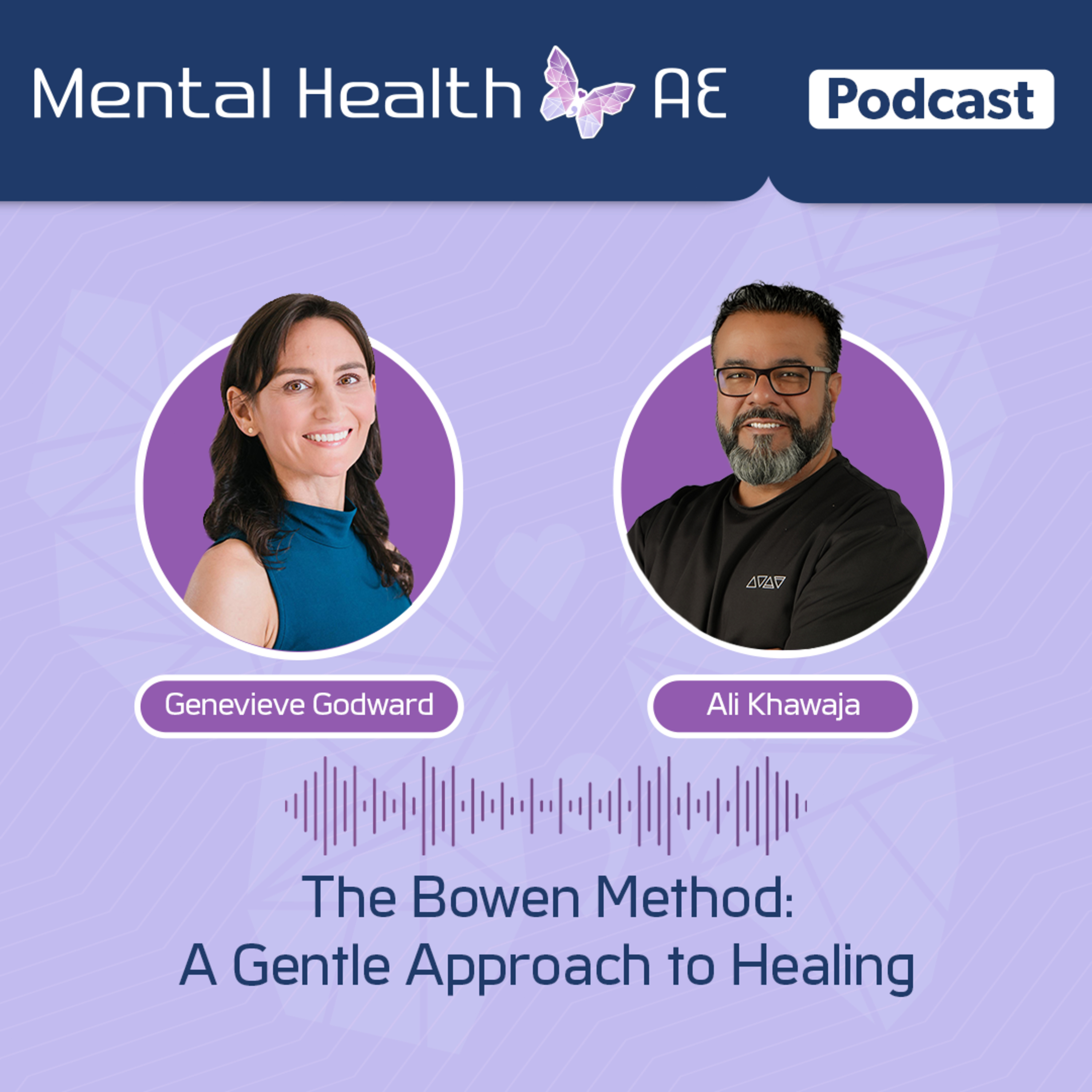
S04E04 – The Bowen Method: A Gentle Approach to Healing – Genevieve Godward

MHAE is a UAE based mental health and wellness initiative, with the aim to create awareness and provide a safe space as well as access to information and resources. Follow us on our Instagram and check out our website.
https://mentalhealth.ae/
https://www.instagram.com/mentalhealthae/
In this episode, Ali Khawaja is joined by Genevieve Godward, a Bowen therapist based in Dubai, to explore the Bowen Method, a gentle, non-invasive approach to healing that works by regulating the nervous system.
Genevieve shares her unconventional journey from the thoroughbred horse racing industry into alternative therapy, explaining how she first encountered Bowen therapy in Australia after years of physical strain and injury. Initially drawn to the method for its application with horses, she became deeply engaged after experiencing its effectiveness on herself and others, eventually training in human, equine, and small animal Bowen therapy.
The conversation explains how Bowen therapy uses light rolling movements over specific points on the body to stimulate the nervous system, helping shift the body out of chronic fight-or-flight mode and into a parasympathetic state where healing, repair, and regulation can occur. Unlike invasive treatments, Bowen works by prompting the body to heal itself rather than forcing physical change.
Ali and Genevieve discuss the wide range of conditions Bowen can support, including musculoskeletal pain, digestive issues, stress-related conditions, chronic illness, mental health challenges, and recovery support. The discussion also highlights Bowen’s effectiveness with animals, emphasizing shared mammalian physiology and the benefits of a gentle approach for pets and horses.
The episode closes with reflections on stress, modern lifestyles, mental health, and the growing need for preventative and holistic care. Genevieve encourages greater self-awareness, nervous system regulation, and proactive wellbeing practices, positioning Bowen as a complementary therapy for both physical and emotional health.
#BowenTherapy #NervousSystemRegulation #HolisticHealing #AlternativeTherapies #MindBodyConnection #StressRelief #ChronicPainSupport #MentalWellbeing #NaturalHealing
Podcasters-
https://www.instagram.com/talktokhawaja/
https://www.instagram.com/dubaibowentherapy/
MHAE Website | https://www.mentalhealth.ae
MHAE Instagram | https://www.instagram.com/mentalhealthae








Summary
In this episode, Ali Khawaja is joined by Genevieve Godward, a Bowen therapist based in Dubai, to explore the Bowen Method, a gentle, non-invasive approach to healing that works by regulating the nervous system.
Genevieve shares her unconventional journey from the thoroughbred horse racing industry into alternative therapy, explaining how she first encountered Bowen therapy in Australia after years of physical strain and injury. Initially drawn to the method for its application with horses, she became deeply engaged after experiencing its effectiveness on herself and others, eventually training in human, equine, and small animal Bowen therapy.
The conversation explains how Bowen therapy uses light rolling movements over specific points on the body to stimulate the nervous system, helping shift the body out of chronic fight-or-flight mode and into a parasympathetic state where healing, repair, and regulation can occur. Unlike invasive treatments, Bowen works by prompting the body to heal itself rather than forcing physical change.
Ali and Genevieve discuss the wide range of conditions Bowen can support, including musculoskeletal pain, digestive issues, stress-related conditions, chronic illness, mental health challenges, and recovery support. The discussion also highlights Bowen’s effectiveness with animals, emphasizing shared mammalian physiology and the benefits of a gentle approach for pets and horses.
The episode closes with reflections on stress, modern lifestyles, mental health, and the growing need for preventative and holistic care. Genevieve encourages greater self-awareness, nervous system regulation, and proactive wellbeing practices, positioning Bowen as a complementary therapy for both physical and emotional health.
#BowenTherapy #NervousSystemRegulation #HolisticHealing #AlternativeTherapies #MindBodyConnection #StressRelief #ChronicPainSupport #MentalWellbeing #NaturalHealing
Podcasters-
Ali Khawaja | https://alikhawaja.com
Genevieve Godward | https://www.instagram.com/dubaibowentherapy/
MHAE Website | https://www.mentalhealth.ae
MHAE Instagram | https://www.instagram.com/mentalhealthae
Outline
0:00 – Episode introduction & setting the tone
– Ali welcomes listeners and introduces a lesser-known healing method
– Framing holistic health and nervous system regulation
0:50 – Meet Genevieve Godward
– Bowen therapist working with people and animals
– Introduction to Bowen as a gentle nervous system therapy
1:37 – From horse racing to healing
– Genevieve’s background in the thoroughbred racing industry
– Discovering Bowen therapy in Australia
3:29 – Why holistic approaches matter
– Everything in the body is connected
– Mental health, physical health, and lifestyle alignment
4:40 – What is the Bowen Method?
– Light rolling movements that stimulate the nervous system
– Shifting from fight-or-flight to parasympathetic healing
6:19 – Stress, survival mode, and modern life
– Why the body stays stuck in survival mode
– Impact on sleep, digestion, anxiety, and chronic pain
10:31 – Conditions Bowen therapy can support
– Musculoskeletal pain, gut issues, fertility, asthma, and more
– Supporting the body’s self-healing ability
11:50 – Bowen therapy in the UAE
– Growing openness to alternative and holistic treatments
– Awareness remains the biggest barrier
17:30 – What a Bowen session feels like
– Non-invasive, gentle, fully clothed treatment
– Pauses between moves to allow nervous system processing
20:28 – Treating animals with Bowen
– Applying the same principles to pets and horses
– Injury recovery, arthritis, stress, and behavioral support
25:11 – Chronic illness and mental health benefits
– Supporting quality of life for long-term conditions
– Stress reduction and emotional regulation
28:42 – Everyday awareness and self-care
– Breathwork, relaxation, and nervous system support
– Preventative care before burnout and breakdown
30:44 – Where to find Genevieve
– Dubai Bowen Therapy website and social platforms
– Closing reflections and future conversations
Transcript
Ali 0:00
Foreign. Guys, welcome back for yet another episode. I know this season I have really stepped it up, you know, because last season I did one. Not a big number to beat, but it’s been good. We’re. We’re making do with our tiny little makeshift studio, you know, and hopefully more episodes to come. So today in the studio, I have a very interesting guest I think is the best way I can explain it. She works in areas that I’m probably willing to bet you have not heard of. So this is why I think today’s podcast will be really, really interesting. I’m going to ask my guest to kind of introduce herself and then we’ll kind of get into things.
Genevieve 0:50
Hi, I’m Jen. I. I’m a Bowen therapist. So I treat people. I also treat animals as well, horses, pets, and Bowen is a. Is a light touch therapy that works on the nervous system to rebalance and repair and heal.
Ali 1:06
See, I told you you wouldn’t know. This is one of those. How old were you when you found out about this? We will definitely get into this. I found out. I found out about this a little under a year ago. I did some research into it. I think it’s very, very interesting and fascinating. So I was super stoked that once I was able to get my podcast rebooted, that Jen was available to come today. So this is amazing. Before we get into things, can you share a little bit of background of, you know, what you have been up to up until getting here?
Genevieve 1:37
So my career started in a completely different field. I worked in the thoroughbred horse racing industry, so I always worked with horses. That was never actually my plan. I was going to go to university and say academic, but I took a gap year and then went into the industry and never left. So I’ve traveled, lived in the States, lived in Australia, obviously the UK is where I’m from, and then came here in 2012 and then. But when I was in Australia, I encountered Bowen therapy. There was a. Just a segment on the news I just happened to catch and they were saying, do you know what the most successful alternative therapies in Australia according to statistics. And I thought I tried them all because I’ve fallen off so many times, had so many, you know, knocks here and there. So. And they said, it’s not any of the ones you’re going to think of. It’s not osteochi, it’s not physio, it’s Bowen, and it’s a homegrown therapy. So I tuned in, I watched the episode, that segment rather, and then Sought out. My nearest therapist had the therapy, was really amazed that this tiny, tiny, gentle moves were going to have such a huge effect on my health. And I asked her. Well, she mentioned, you know, you can treat horses, and that’s what intrigued me initially. And I didn’t have time to study it whilst I was over there, but when I got here, I had a lot more time on my hands, so I embarked on the training. And yeah, so I had to do the human therapy side in order to start on the equine course. And I only ever thought it was going to be a means to an end. I would just tick the box and then go on to do the equine. But I, I just loved it from as soon as I started to treat people and get results, um, it was so rewarding, so exciting. So even after I subsequently did the equine course and then I did the small animal course, I’ve always maintained treating people as well. So, yes, I’ve been 10 years now, I’ve been doing the therapy here in the uae.
Ali 3:29
Well, fantastic. That’s amazing. Thank you for sharing. I think it’s important to understand, and we were, we were actually just discussing this before we started, you know, recording. I think it’s important to understand that a very, you know, kind of comprehensive 360 approach, holistic flow approach, you know, all of these need to be adopted into everybody’s life. You can’t just do a singular thing. You can’t just only go to the gym or only diet or only this or only that. It doesn’t work. Everything is connected, you know, and, you know, we’re on a mental health AE podcast and everything connects to your mental health also. Right. And this is why I always like to kind of have guests that I can talk to and share from their experience with all my listeners and get that wider perspective. And now more and more studies are coming out talking about gut health and its relation to so many different diseases and so many different chronic illnesses. But let’s, let’s get a little bit more into Bowen and kind of walk us through what it is.
Genevieve 4:40
So Tom Bowen was the one that developed this therapy back in the 50s. He was around in Australia and he was very interested in shatsu, traditional Chinese medicine, meridians, all of that kind of Eastern wisdom. And then I think he was also around other healers. So he, he just started to, I’m sure he was probably on the spectrum as well because he was very, you know, he was treating up to 80 people a day at one point. Huge practice and so he just developed this techni technique and then others learn from him and it’s a very gentle technique. So it’s non, not invasive. We’re stimulating the nervous system. So what we use is fingers and thumbs and we do a rolling type move over very specific points. And this move itself stimulates different nerve receptors under the skin. So we have like stretch receptors, we have receptors that respond to pressure. You know, we have obviously a huge range of receptors for pain, for heat, for. So we’re, we’re stimulating very specific nervous nerve receptors to send a message to the brain to rebalance and repair and heal. So and one of the main things the therapy does is shift the body out of that fight or flight, which is called sympathetic nervous system dominance, into parasympathetic. And a lot of the time we, we get stuck in that sympathetic nervous system dominance, unfortunately. Yeah, so that’s one of the key things that it does. And once you’ve, we’ve gotten to that parasympathetic, then the healing can take place.
Ali 6:10
I need you to expand on this piece. When I was reading it, I found it fascinating because I never realized that I spent all of my life on this side of that fence.
Genevieve 6:19
Yeah, yeah, I think most of us do. And you know, especially certain points in our life and you know, our ancestors would only have ever gone into that fight or flight response in an emergency. So it would have been when there’s a predator or where there’s a fight for resources or something. But predominantly we’re supposed to be in parasympathetic. That’s what most animals are in. And, and you just go into this emergency state to get yourself basically to fight for your life or to run for your life or there’s freeze as well. Fight, flight or freeze. And it’s a short term response and it’s really adaptive for that situation and it obviously saves your life. And what will happen is we will, our heart rate will increase to send more blood to the, to the muscle groups, our respiratory rate will increase, our pupils will dilate, we’ll release lots of adrenaline, lots of cortisol, the hormones that will just, you know, accelerate that response. So we can do what we need to do. But the problem is once the, in our ancestors time the threat would be over and then they would shift back to parasympathetic and the resources would go back into maintenance, repairing and healing. But we don’t really, our body can’t discern the difference between the concept of a threat and a real life threat. It doesn’t differentiate. So therefore to our body, the thought of us thinking about our boss at work, that drives us crazy or our, you know, our family stress or just traffic on the road or whatever, you know, bills, whatever the worry is that we have or maybe all of those things. For most of us, our body can’t discern the difference between that and the saber toothed tiger that would have been, you know, the predator. And then when we’re always thinking about these things, when we can’t switch off those intrusive thoughts, we’re always in this sympathetic dominance. So our body’s resources are constantly in survival mode. And if all of our resources are in survival mode, the healing is just put on the sidelines because we can’t, we don’t have the energy to heal, we don’t have the energy to repair, to rebalance, to digest. You know, all of those parasympathetics. Things that happen in parasympathetic are just shelved. But our body’s not designed to be to shelve those things on for long term. So we find people, by the time they get to come to see someone like me, they might be coming for a, you know, maybe muscular, skeletal, maybe a backache or a neck ache or something. But when you ask them about their general health, because I’ll send them a very in depth questionnaire, you’ll find that most of them have digestive issues, they have issues for sleep, they have issues with anxiety, with panic attacks. You know, there’s a whole gamut of different presentations and basically their body’s screaming at them, you know, we need a reset, we need to rebalance, repair and relax.
Ali 8:59
Well, thank you for sharing. And I think it’s very important for people to, you know, sit and google what you just said and understand it a lot better. And it’s amazing how our minds will physically manifest the thought versus the actual. And I was reading somewhere that it’s only humans that the placebo effect even works on. It doesn’t work on any other species, which means our brains are hyperconnected I think would be the term I would use. I’m not sure if it’s medical or not, but everything is connected. And the better you understand that connectivity, the better you’re able to, you know, kind of work with it. So. So I think again, very important to understand the two zones. Why are, is our brain into that zone when I don’t have a tiger that I’m facing? But if I’m constantly in that state of alertness, my body is prioritizing Something different. And it’s not prioritizing rest and repair where your whole body needs the rest and repair to be able to, you know, regenerate and fix itself. Good. Let me ask you a little bit more about what type of things it works with. So like, what are the symptoms somebody would have or what are the problems somebody would have and then they need to come to you because it’s always, everyone thinks, oh, if I have a toothache, I go to the dentist, if I have this, I go to this doctor, if I have this, I go to this. So I want to talk a little bit more about that and then I’m going to kind of circle back more into the technique.
Genevieve 10:31
Yeah, sure, yeah. I mean, it’s similar in the way that acupuncture can treat a massive range of conditions. Similarly with Bowen, we can treat pretty much basically if the body has any kind of dysfunction, Bowen can offer relief because we’re putting the body back into, basically Bowen is stimulating the body to heal itself. So it’s not the practitioner that’s influencing the outcome by, you know, breaking down muscle tissue or, you know, cracking a joint or doing something invasive. It’s more that we are inputting the brain to tell the body to, to heal and repair. So basically that means that anything can be helped. So we, we deal with everything from musculoskeletal issues, migraines, fertility, it’s fantastic. For gut issues, asthma is amazing, skin issues, childhood bed wetting, colic for babies, you name sounds too good to be true. But, but you know, but obviously when you logically think about it, if we, if we’re getting the body to fix itself and the body is capable of healing and repairing, then everything can be treated with this technique.
Ali 11:42
Good. I like what’s been, what’s been the feedback and adoption in the UAE. You’ve been here now practicing a little over 10 years.
Genevieve 11:50
Yeah, yeah. I mean, a lot of the time it’s just that the issue is people have never heard of it. So oftentimes people come to you where they’ve had a word of mouth referral from someone else that’s told them that they must go and try it, whether that’s from someone here in the UAE or even someone from England or Australia or America, somewhere where it’s a bit more established a lot of the time then they’ll say, oh, my friend back home told me to come, told me to find Bowen. But then I find that people here are pretty open minded, like everyone, it’s a very health conscious, wellness, conscious community I think on the whole everyone here is very interested in, in optimization, aren’t they? And being their best. So I feel like a lot of people here are very open minded. It’s just the, the issue is just lack of awareness and I think that’s such a shame because when they come to you, they’ve often tried so many other avenues first and therefore have suffered for so much longer than they needed to. And then they come to you and they say, oh my God, I wish I’d, I wish I’d found this earlier. So that’s the thing. I’d love to change.
Ali 12:47
Good, good. I like, I like that. And I think it’s important to understand the holistic nature of. This is very interesting. You know, you’re not, you’re not addressing the symptom, you’re addressing the cause.
Genevieve 12:59
Exactly, yeah.
Ali 13:00
Or not just the cause, you’re addressing the system that will initiate that regeneration and that improvement and that healing. So good. I like what I’m hearing. You actually kind of tangented into the next question I was going to ask, but I’ll ask you to expand on a little bit more. In the last 10 odd years, have you seen a shift, shift in the level of importance people are placing on, well, health and wellness?
Genevieve 13:24
I think so, I think yeah, just generally worldwide people are way more, way more conscious now of like we were saying before the podcast about nutrition, about mental health. You’ll see so many meditation classes, so many sound healing classes. Yes. Fitness classes everywhere, especially over where we’re living here in Dubai. So I feel like people are, and I think in the last few years particularly people have become very much aware of nervous system, of this fight or flight and it’s, it’s not, you know, it used to be so abstract to people, but now people, you explain to people and they’re like that makes total sense. It seems to resonate much more these days and they seem to have an awareness already of it. So I do think there’s a really good shift in that direction, which is really encouraging.
Ali 14:11
I like what I’m hearing. You know, in my research when I was looking into this a while ago, I did not find a whole lot of practitioners globally. So compared to other things, I think the movement in terms of active practitioners is still, still in its early stages. In some countries it’s a lot more popular. In some. How do you think the growth is going to be in the UAE and even perhaps in the Middle East?
Genevieve 14:39
I’m hoping that more and more people will become, that will train in the modality as well. Especially we have a couple of practitioners in Kuwait and the guy in Kuwait, I’m thinking of that, trained on my course 10 years ago. I mean he’s done phenomenally well. He’s got, I think he’s booked up weeks and weeks in advance, if not months. So you know, he was a PT and he, he engineer, then a PT and then a Bowen therapist. So you know, even in other parts of the region we’re seeing people doing exceptionally well. So yeah, my hope is that as people become more aware as they experience therapy for themselves, if it’s something they want to do, they’ll true the training because we do have a practitioner over here that qualified as a teacher as well. So we have, we have the option to train here as well.
Ali 15:19
Oh, excellent. I was, I was going to tangent to that question. So if somebody’s interested in becoming a trainer, you can sort them out?
Genevieve 15:25
Yeah, absolutely. Just give me a message.
Ali 15:27
How long does it take?
Genevieve 15:29
So there’s different levels. So you can do initial levels up to, I think it’s level seven or eight and that’s your to be, that’s you’re certified as a practitioner but you can continue your education all the way up to level 12, which I’ve done. But yeah, about a year initially maybe with different modules. But you can pace it as, as fast or slow as you want because you’re doing the case studies and then you’ve got to do an anatomy and physiology course as well which is pretty in depth so you can do that online. So yeah, it’s kind of. There’s some people that might start the process and then they might go off and have a baby or go into another job or do a different qualification and then they’ll come back to it again and pick it up. So there’s a lot of flexibility actually.
Ali 16:11
Okay, good. Follow up question on my follow up question because you know when I, when I start reading and researching my brain cues up questions and then I have to find my answers. So I’m just leaning back on that. I already have the answers but I want you to share. What’s the DHA’s opinion on this?
Genevieve 16:30
So actually we’re just looking into that now, me and a friend, because I think they already recognized it but I think they’ve just given it more of a designation. So we were going to actually like, you know, this month we’re actually going to go and speak to them and give our certificates and try and get under that designation I guess. But yeah, they do. We’re not Registered. There’s one insurance policy that kind of reimburses, but we want to get it so that it’s under a designation so that more and more people could then get health insurance reimbursement. So, yeah, I think we’re moving in the right direction.
Ali 17:04
But it’s already a recognized treatment.
Genevieve 17:06
Yeah, I think the Dwight Health Authority. Yes, as far as I’m aware. Yeah, we just wanted to go ahead and speak to them further and try and get it.
Ali 17:12
Excellent, excellent. So that direction is also being built up on. I like that. I like what I’m hearing about the treatment. And, you know, again, with anything, I always have the philosophy of going from least invasive to most invasive. Just expand on that. How invasive is this?
Genevieve 17:30
It’s very minimally invasive. You know, so much so that people, if you don’t explain to them in advance, they’re kind of like, what. What was that? You know, it’s very. It’s very gentle. You leave your clothes on. Just wear lightweight clothing. Just the moves. It’s just this rolling type move with finger and thumb over. Over the skin in specific points. And then what. The other thing, the key component of Bowen is we do a move on the person’s body and then we leave the room for two minutes. So we do this in order to allow the brain and the body time to process the input. So it seems a bit weird at first because someone’s coming and going in and out of the room, but it’s a really key point because when you’ve had the therapy, you’ll literally feel your body kind of, you know, exhale and slowly, slowly relax further and further. So you need that time to get that processing happening. So, yeah, it’s never painful. It’s about 45 minutes in length. And every session is different. So there’s all these different. We call procedures, which is a combination of specific moves. So I think we have over 100 of them. And. And yeah, you just apply them in different combinations depending on each individual. And each and every individual, every time they come to you, is. Is they’ll be different on every day. So it changes every week as well.
Ali 18:48
Okay. And how soon, you know, do patients generally see some sort of impact or result?
Genevieve 18:54
I always tell people to give it three or four sessions because, you know, if you’ve had a condition for five years, even five months, it’s not gonna. You’re not gonna, you know, wave a magic wand and it’s gonna be better in a session. But we do have a lot of times great impact just with one session. So. But if you. If you tell people to give it three or four, they can give it the full chance. It needs to. To really. Yeah. Make a difference. But it’s not one of those therapies. We say we need you to come for 10 sessions and then another 10 sessions. No, we try and fix things really, in three or four sess.
Ali 19:26
Okay, I like that. And usually how far apart of the session is like a week? 10 days?
Genevieve 19:30
Around a week. It’s five to 10 days. So, yeah, a lot of people come sort of about a week apart.
Ali 19:35
All right, I like that. I like that. No, this is very interesting for those who want to dig in a little bit more that leaving the room for a couple of minutes when I looked into it was very interesting. It’s got. It’s got to do with piezo, electrical neural activity, type of really, really cool stuff. So all your. All my nerdy listeners, you’re gonna. You’re gonna love reading this. I must have spent a couple of hours, like, digging, and I was like, oh, my God, that’s so cool. It’s so cool. So. So definitely very interesting. I like that. Now. Now the thing that really caught me off guard was, you know, when. When I saw horses and animals, and I’m like, wait a second, what’s going on? How did you become a vet? When did that happen? What am I missing? So explain, just explain what am I doing with this human treatment? And now how all of a sudden is this an animal treatment?
Genevieve 20:28
Well, physiologically, you know, mammals are pretty. We’re all pretty similar. You know, we’ve all got a nervous system, is basically the brain and the spinal cord and all the nerves that come off of that. So, you know, a horse, a dog, a cat, anatomically, okay, they’re. They’re quadrupeds and we’re bipedal. But, you know, you break it down. It’s the same. It’s the same physiology. We. The same muscles, the same bones, joints, ligaments, tendons. It’s very, very similar. So we just. I don’t think Tom. Tom Bowen did apparently practice on horses and pets, but primarily was on people. But there’s been people subsequently, people who were more involved with animals that took his work and translated it across to. To the animals. But like someone like myself that treats the pets, the horses, the people, it’s pretty much, you know, if you’re doing something. If we start the session level with L4, L5 on the spine, when we translate to the horse, we’re starting the session in L4, L5 as well. So, you know, you just. You’re just doing a very similar thing to the. To the larger animals or smaller animals.
Ali 21:33
And what sort of. What sort of problems do you see pets coming in with?
Genevieve 21:38
Well, you get a lot of arthritis with older senior pets, and then you get just injuries where, again, younger pets might have jumped for the ball or something. And a lot of people now have hardwood floors and tile floors, especially in this area, so they slip and slide and they can pull something and have inflammation post surgery if they’ve had an injury or an issue. Recovery, sometimes behavioral as well. Stressed pets. Yeah, all sorts of things. Basically same as us, really. Yeah, the whole range.
Ali 22:09
That’s fascinating. I absolutely found it fascinating. And then even, you know, like you said, when I started reading into this, I was like, you know what? This actually makes sense. This actually makes a lot of sense. Why would it not?
Genevieve 22:21
Yeah, and the nice thing with the animals is they. You can’t explain to an animal. Look, I’m gonna. I’m gonna really do a deep tissue massage on you. They don’t want that. It’s painful. It’s not. It’s not pleasant for them. But, you know, once you do these very gentle moves, they. They respond so much nicer because it’s not invasive and not painful for them. So especially once they’ve had one session, because they’re so intuitive and so clever, they’ll recognize you. You know, you might have only seen them for 40 minutes, but when you come back next week, they’ll know. They’re so happy to see you again because they remember that what you did helped them have felt nice.
Ali 22:54
Oh, that’s amazing.
Genevieve 22:55
So they’re a lot more. Then they’re even more open to it as well, so.
Ali 22:58
Yeah, that’s amazing. So do you primarily work independently or do you work through other clinics and centers? Or what’s the. What’s the model?
Genevieve 23:07
Yeah, I work with people. I work for myself, so I just. I either go to people’s homes if. If that’s what they prefer, or people come to me with the pets. I work out of a couple of veterinary clinics here that I can treat people in the clinic or sometimes people with the pets. They’ll come to me or go to them. And then horses, I go to their location.
Ali 23:27
Tell me more about the horses thing. That one. That one was really interesting.
Genevieve 23:30
Yeah. So I. I was lucky enough that when I was. I started out as. As an equine practitioner, I was still working in racing, so I had a stable of 130 horses to to practice on. Yeah. So, yeah, I just spoke to my boss and he was, at the time, he was very supportive and very open minded as well and loved the fact that it wasn’t invasive because most horse trainers, the thing they’re scared of is that you mess the horse up even further. So the fact that it was very gentle, he was like, well, what’s to lose? So I started to do the case studies there and, you know, he quickly saw the results, you know, because in the horse racing, for the most checked horses that you can find, that they’re checked before they train, they’re checked after they train, they check in the afternoon, they checked in the evening. So people notice things very quickly. So when you make an improvement and they see the horse that the next day trotting much, much better and the riders saying it’s feeling better and then the jockey saying it’s feeling better. So, yeah, they, you know, my boss at the time really, really liked it. So then, and then I just, you know, branched out into other stables and, and then to equestrian community as well. So, yeah, that’s.
Ali 24:41
This is really cool. I love this. I love learning about new things. I love learning how, you know, the world is just so infinitely amazing. So this is, you know, thank you very much for sharing. This has been very, very insightful. I like this. I like this. I want to talk a little bit more, you know, without drilling too deep, but I want to talk a little bit more about people who are struggling with chronic health issues. So in your experience, what sort of chronic health issues have you seen that this has made an impact towards? In your experience?
Genevieve 25:11
Treat a lot of, you know, treat things like ms, treated things like Crohn’s autoimmune conditions in general, chronic pain, just some people have just horrendous pain. Yeah, the whole gamut really, of chronic illnesses and you can get really phenomenal results sometimes. I mean, there’s things like Ms. Which are irreversible. You know, they’re not, we’re not going to cure those conditions, but, you know, if you can make a significant difference to someone’s quality of life, if you can release muscle tension and help improve neuropathy and help mobility, they’re going to be so much more comfortable. You know, they’re going to be. So their life is going to be so much better. And then you’ve got things, you know, digestive conditions where you can significantly change the outcome, where it doesn’t have its autoimmune conditions are where are very much influenced by stress. If the body’s under stress, these conditions flare up. So if you can get, again, get the body out of that fight or flight, put it into parasympathetic, then you can, you know, you can essentially subdue that, that response and take the body out of that chronic condition.
Ali 26:19
Stress, singularly, if I was to look at it as a factor, impacts very differently across genders. So we see a lot of women with health issues that stem primarily from stress and they cascade into more complicated and, you know, significantly worse type of symptoms and issues. In your practice, do you generally see more of a particular gender?
Genevieve 26:46
Not really. You know, it comes sometimes a bit sickly. You’ll just feel a pattern of getting a lot of women at the moment, or you’ll get more and more men, but not really. You know, you find that the men are often told to go by their wives or. Because I think in general men are a lot more. They try to be more stoic, you know, and try to push through and I’ll be fine. I’ll get a. Yeah, tough it out. Yeah, yeah. And then when things get really bad, that’s when they’ll come and see you. And then I’ll often not. They won’t be necessarily coming for mental health. They’ll come for something physical. But then they’ll tell you, you know, on the form, they’ll tell you or when you ask the questions, you’ll, you’ll find that they are under stress as well. So maybe women are a bit more forthcoming when they, when they come, they’ll, they’ll be coming for mental health reasons or emotional reasons. But, but men and women, I think, equally are struggling with the same issues. Really.
Ali 27:39
Okay, okay. You kind of pivoted to my last, last line of questioning. What’s the impact to improving mental health?
Genevieve 27:47
Yeah, really significant. I think, like, like I say, a lot of people, it might not necessarily be, it might be a pain reason why they’ve come to you, but when they, when you, when you see that they’ve got mental health issues as well, you know, every week I’ll check in on every single thing that we’ve, that we’ve. They’ve told me in the first session that they’re struggling with and, you know, maybe the sore shoulder or sore back or whatever that is, takes a couple of sessions, but straight away from the first session they’ll say, I felt I slept so much better and I felt so much calmer. I dealt with things a lot better this week. Yeah, my digestion was better, you know, so those responses come into, you know, come along quicker sometimes than the actual physical problem that they had. So yeah, okay, good.
Ali 28:34
What are some things that people can have better awareness of in their day to day life?
Genevieve 28:42
I think taking time to try and get some sort of relaxation in their daily routine. So I think in meditation people, when you say meditation, people roll their eyes and think, I just can’t do it, I can’t do it. But I think just, just thinking about your breath, even if it’s for five minutes, it like just a couple of minutes of breath work, literally, you know, activates the vagus nerve, switches you out of that state of fight or flight. If you could do that first thing in the morning or last thing in the evening, that would make a huge difference. And I think doing something like Bowen, even if it was once a month, for instance, myself, I’m a good example right now. I have, I used to have it every week because I had a therapist and we would do a swap and she recently emigrated to New Zealand which is really annoying for me. And so, I mean I was fine, I was fine for about a month, you know, I was, I was like, well you know, I should go and see, I’ve got other colleagues that are a bit further away. And I was like I should arrange a swap with one of them. But I’ve been busy and I’ve been thinking, well, I’ll get to it. And you know, about five weeks in, my back just went and I was like, you know, my back’s been good for several years now and just because I didn’t prioritize my own health, it crept up on me and yeah, so I think being proactive with looking after yourself, prioritizing yourself. We prioritize everything else. We prioritize work, other family members, partners. But think of yourself as, you know, extra as important as well and schedule something in before, before everything comes crashing down is really important.
Ali 30:16
Great, great, that’s great advice. Thank you so much. Just before we wrap up, how big is the community of practitioners in the UAE?
Genevieve 30:26
I think there’s about 10, maybe 15 of us, some more active than others. So yeah, there’s a, there’s a few of us but hopefully there’ll be more and more in the future.
Ali 30:38
I like that. And, and of course can you share where people can find you? Give me like a website, an instant handle or something.
Genevieve 30:44
Yeah, I’m Dubai Bowen Therapy. That’s my website, Facebook, Insta. We’ve just started TikTok, me and a colleague actually that one is called Bowen Therapy Dubai confusingly. But we have A collective. So there’s about five of us that are on a collective website, which is Bowen Therapy Dubai. And so we started a TikTok under that heading, me and another colleague, but I’m personally Dubai Bone Therapy.
Ali 31:13
Okay, thank you so much, guys. It’ll be in some link somewhere. I keep moving my hand around all the platforms, move where the links are supposed to be. I’ll definitely be sharing all that information. I think this is a fantastic first conversation because I, I definitely need to have you back for a follow up conversation to get a little bit more into the details and, and definitely I want to explore more in terms of how the nervous system works, how how the physiological and the mental are connected, obviously through the nervous system. But a little bit more in depth on that is something I would definitely like to explore. And then also, you know, the treatment itself, it seems almost not there. You’re telling me fingers and thumbs and it doesn’t even feel like a hard massage. And you know, because I’ve done everything, I’ve done deep tissue needling, I’ve done acupuncture, I’ve done deep tissue massage with, with guys who work with like big football team guys. That one made me cry. I mean, I, I was sore for a while, but then it was better. I mean, all these things have their own pros and cons and they’re very, very interesting to, to look into an experience, explore. But Bowen, when I read about it, I found it fascinating. Of course, data on this is constantly evolving and there’s different types of data that you can get. But one number that I constantly saw popping up on all my reads was it’s one of the highest success rate, about 80% impact, which is phenomenal if you think about it, from any alternative medication. So I think that’s a good point to kind of put a pause on today’s episode. This has been really, really nice. Thank you for taking the time and coming to speak to everybody. It’s been very enlightening.
Genevieve 33:04
Yeah, thank you. It’s been a pleasure and thanks for inviting me.
Ali 33:07
All right, fantastic